
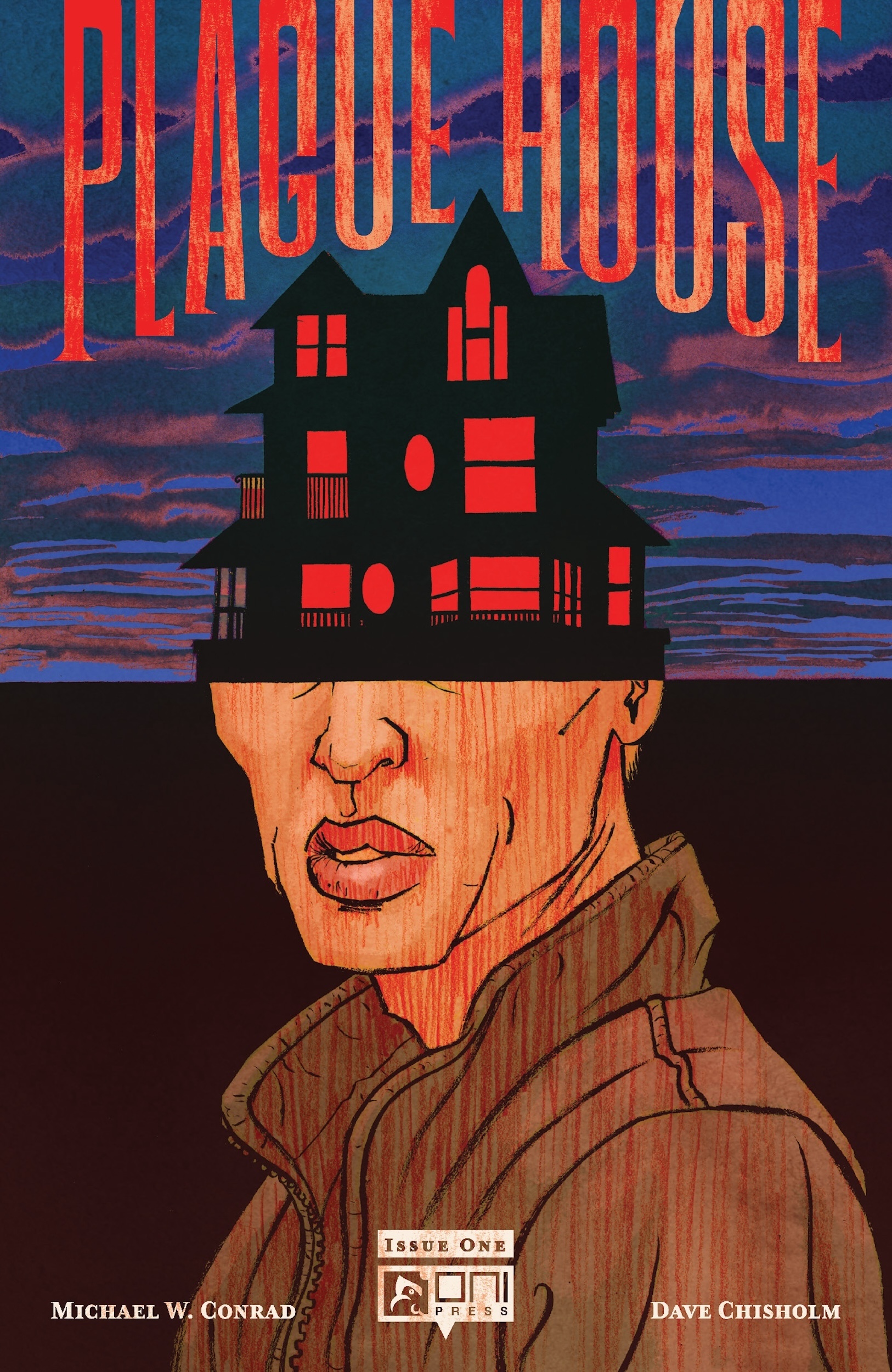
Discussing New Oni Press Horror Series ‘Plague House’ With Michael W Conrad And David Chisholm
by Olly MacNamee
A skeptic, a priest and a ghost buster … this sounds like the start of a bad joke located in a dive bar. Instead, it’s the start of a promising new horror series from writer Michael W Conrad and artist David Chisholm. And ahead of the debut issue hitting shelves, I caught up with them both to discuss Plague House from Oni Press and learn more about a series that promises to “rebuild the four walls of the American ghost story from the foundation up.”

Olly MacNamee: “Rebuild the four walls of the American ghost story from the foundation up.” That’s a bold claim. I’m intrigued by your plans to elevate the American Ghost Story. Can you elaborate?
Michael W Conrad: Most stories are well served by taking a swing for the fences. I have a reverence for horror that requires me to either bring something fresh, or to stay away entirely. We’ve all had disappointing experiences with various media, but I always respect when creators are willing to challenge accepted tropes in effort to deliver something that will stick with us. If Dave and I have done this thing correctly, we will at very least provide something that will do just that. Of course we hope to present something entertaining, but along with that we want to disturb the underlying expectations of fans of these kinds of stories.
MacNamee: David, you mentioned in a recent Forbes interview that you are both taking “the haunted house trope on its head in a really clever, chilling way”. Is this one way in which you are creating an original take on common horror tropes and archetypes?
Dave Chisholm: You can just call me Dave! I don’t want to spoil anything so y’all will just have to read the series to see how we’re flipping some tables.
MacNamee: Rereading the solicits again, it would seem “America’s unquenchable appetite for violence” is a big theme in this series. We see that with Otis massacring his family, but how else will this theme play out? What should readers look out for?
Conrad: A lot of what defines the series will be a matter of perspective. As the series unfolds we will close the aperture a bit, but it will remain the reader’s job to determine what exactly is being said about America in Plague House. I think it’ll be really clear, but I’ll be interested to see if readers land where the story directs them, or if there will be another take entirely. I’m more interested in the conversation of horror than I am in dictating it. Sometimes specificity disallows folks to insert their own anxieties, and I see that as a missed opportunity. It’s like when the monster in a film emerges from the shadows and we see that the thing we have dreaded is actually something we’re well suited to deal with, or worse, laugh at.
Chisholm: Without spoiling the story, I think so often in comics — in mainstream, genre comics and in related media adaptations — the only solution is to punch something. Violence-as-panacea. The trouble with this is that the violence itself is a problem and leads to an endless chain of violent solutions to problems created by violence. Where does it stop? This is very much part of American — maybe human— culture. This book follows a few links in this violent chain and it reflects that haunted-house stuff in clever ways.

MacNamee: This first issue does a great job of establishing characters, motivations and backstories, with great character designs. How does the collaborative process work between you two?
Conrad: Knowing Dave had joined early on, I’ve been able to write knowing that he is at his best when he has a ton of agency. As a fan of Dave’s solo work, I didn’t want to impede on that, but there are indeed elements that were less fluid. It’s a balancing act, one based on respect, and elbow room. Luckily most of the artists that I’ve done creator-owned work with are, like Dave, masterful at page composition, character design, and pacing. Alterations to the script were few, but when they arose, Dave always strengthened the scene.
Chisholm: Thanks so much for the kind words! Michael took the approach of only providing more details if I asked for them — which I do tend to do! I don’t usually like to do a ton of prelim work for the books I make, so usually on my end that involves a series of plans: how am I going to deal with color? How about shadows and midtones? Are the gutters white or black? How active will the camera movement from panel-to-panel be? And so on — and then, once I’ve decided all of those parameters, my job is to be as consistent as possible.
MacNamee: I’m impressed by your visualisation of the gore, Dave. You do it really well. I mean really well. Where did you draw inspiration/references for these scenes?
Chisholm: Haha well, ya know, I grew up watching a lot of horror movies and I drew some pretty gnarly stuff in my younger days. It was fun to revisit some of that visual ick.
MacNamee: Looking at your previous comic book work, horror seems like a new direction for you. You seem like a man, David, who likes to break with convention. Have you enjoyed the challenge and is it a genre you’d like to revisit?
Conrad: I wanna jump in and say, as a fan of Dave’s work, it has felt amazing to be able to script terrible things for him to draw. I love the beauty he brings to the absurd and profane images he has made for this — they’re just as beautiful as one might expect.
Chisholm: Yes, creativity is definitely more fun when you have a deep knowledge of convention — specifically so you can upend it for narrative effect. I’ve definitely had a blast and would do it again in a heartbeat!

MacNamee: Finally, the main characters. The skeptic, the priest and the ghost buster. Common archetypes, I know, so how will you be breathing vitality and originality into these guys? And inspirations drawn from real-life or other quarters in their backstories and/or look?
Conrad: I’m a fan of stage magic, and the set up is typically playing with expectations. You’ve seen me shuffle, you don’t expect me to have moved your card to the bottom of the deck. Similarly here we are playing a shell game, you show up with ready made judgements on the characters, that’s where we want you to be. For the characters themselves, and their backstories, some are pulled from my own life, some from folks I know, but all are brought to the page with intention. I’m a firm believer that we can have complex characters whose moralities are different from our own. I’ve grown weary of binary alignments, and the three characters addressed in this question all exist on a spectrum. In some ways I most appreciate those I am most different from philosophically.
Chisholm: Del is definitely inspired by some cast members of a specific ghost-hunting tv show. All of these characters feel like they have this internal need to define their inner philosophies by how they present themselves to the world, so I decided right away that they’d more-or-less stay in costume throughout: Del would be in black cargo pants, a black members-only jacket, Holland would maintain their particular look, and Jacob would always look the part of the priest. It’s important for each of them to remind the world of who they are, of what they stand for—or stand against. No judgment, but I’m super fascinated by people who feel the need for this kind of consistent visual identity and have been friends with a lot of people like that. I am not like that. Or at least … I don’t think I am!
MacNamee: Thanks, Mike and Dave, and all the best with the debut issue.
Plague House #1 will be out on Wednesday, 2nd April from Oni Press with FOC this Monday 10th March.


