
An Interview With Merle Oberon Biographer Mayukh Sen
by Rachel Bellwoar
When Merle Oberon was nominated for an Oscar in 1936 for her role in The Dark Angel, it wasn’t known that she was making history. That’s because the studios had concocted a backstory for her which named her birthplace as Tasmania. The truth was Merle was Anglo-Indian, making her the first Asian actress to be nominated for an Academy Award (Michelle Yeoh would be the second and the first to win… 87 years later). As someone who fell in love with Merle watching These Three and The Divorce of Lady X, a new biography couldn’t have been more welcome, which is why it was great to be able to ask Mayukh Sen about Love, Queenie:

Rachel Bellwoar: Before Love, Queenie, the last biography written about Merle Oberon was Charles Higham and Roy Moseley’s Princess Merle: The Romantic Life of Merle Oberon (1983). How key was establishing a relationship with Merle’s surviving relatives in being able to correct some of the misinformation that book contained?
Mayukh Sen: I knew that I wouldn’t be able to write this book sufficiently, and let certain myths about Merle rest, if I didn’t connect with her surviving relatives from India. One of the major presuppositions in Princess Merle (1983), that prior biography of Merle Oberon by Charles Higham and Roy Moseley, is that a woman named Charlotte Selby (Thompson) was her mother, though it wasn’t until 2002 that the filmmaker Maree Delofski revealed in her documentary The Trouble with Merle that Charlotte’s daughter, Constance Selby, was in fact Merle’s biological mother. This was a secret kept from Merle, who believed Constance to be her half-sister, in childhood (and likely throughout her entire life). That revelation, coupled with my own understandings of Higham’s occasional tendency to fabulate in his biographies (see the criticisms of his books on Errol Flynn and Howard Hughes), essentially necessitated I start from scratch, and report this book as if I had to test every claim in Higham and Moseley’s book as if it were untrue and find enough evidence to the contrary.
As such, her family clarified that—despite what one might read in Higham and Moseley’s book, and other articles about her — Merle was not part Māori; her grandmother was Sinhalese, while her mother was half-Sinhalese and half-white. Worse, Constance came off, in Higham and Moseley’s treatment, as an unsympathetic figure; I wanted to render her in more human terms, and thus connecting with Merle’s relatives from India allowed me to — I hope — achieve that. What I want my readers to understand is that Constance, too, lived with a great deal of pain just as Merle did, giving birth to Merle at fourteen and thus maintaining the charade — even amongst her own immediate family members, ones I spoke to—that Merle was her half-sister, not her daughter.
Bellwoar: In the introduction you talk about first seeing Merle in Wuthering Heights in high school. How quickly after that did you start seeking out her other movies and were there any you discovered over the course of writing this book that surprised you?
Sen: It was the summer of 2009 when I first encountered Merle Oberon’s work in Wuthering Heights, as you point out, and I was mesmerized by her ability to give a performance of such composure, power, and lyricism when she had such a difficult life off screen. But it’s the movies that she made after Wuthering Heights that truly impressed me, and I sought them out in the years after my initial introduction to Merle’s work. ’Til We Meet Again (1940), the first movie she made under contract for Warner Brothers after she and [Samuel] Goldwyn (Wuthering Heights’ producer) dissolved their partnership, contains a remarkable performance from her: She plays a woman who’s dying of a heart condition and boards a cruise ship, falling in love with a man who, unbeknownst to her, is a convicted criminal. It’s a classic “woman’s picture,” the kind Hollywood once readily churned out, and Merle’s ability to locate her character’s torment, and make the viewer feel the gravity of all that’s happening to her, is immensely moving.
A year later, she’d give another luminous performance in Lydia (1941), where, as the title character, she plays a woman who falls in love with various men over the course of her life, only to end up alone in old age as she ruefully recounts each of the men who got away. Merle plays so many notes here—she’s brash and bratty in her youth, a romantic heroine, a fighter, a wizened spinster; this film really shows you just what she could do as an actress when given the proper script that allowed her to soar.
Bellwoar: Merle’s career would see movies make the transition from black and white to color. Do you think she would’ve had more opportunities, or not been made to feel as self conscious about her skin tone, if movies had stayed black and white?
Sen: I absolutely think that black and white technologies shielded her from scrutiny about her skin tone, an element of her passing that her family emphasized to me. The adoption of color in Hollywood became treacherous for her: As I write in my book, there were certain films she was promised but then lost out on to actresses like Marlene Dietrich because of insufficient color tests. When she made The Divorce of Lady X (1938) in color, reviewers commented on the oddity of her appearance, and how she effectively looked jaundiced due to the makeup she wore. As such, Merle may very well have had more longevity had the industry continued to make films in black-and-white. That’s partially why you see so many of her contemporaries start to outpace her in the 1940s.
But I don’t want to distort impressions and imply that the popularity of color cinema was the sole reason why her career took a downturn in that decade. For real stamina in the industry, she would’ve needed the guidance and protection of a figure like Samuel Goldwyn who was invested in maintaining her stardom. But the two of them parted ways after Wuthering Heights disappointed at the box office, and she just couldn’t find a studio boss of his stature in the years that followed who could have helped preserve her allure to fickle American audiences.
Bellwoar: So much of Merle’s story is understanding the context in which she was making these decisions to hide her ancestry, like the production code being in full force when she came to Hollywood (which would’ve prevented her from playing the romantic lead to a white co-star if people found out she was Anglo-Indian) or the immigration policies at the time that would’ve prevented her from seeking citizenship. Were there any aha moments during the research process that felt especially revelatory?
Sen: It really wasn’t until the second draft of my book that I became aware of the extent to which Merle’s life was shaped by immigration and citizenship law of the era, especially as I spent time with her travel records. That, for me, was the moment when these disparate parts of her narrative started to click into place. For those who are unaware, America imposed a wholesale ban on immigration from what was then known as India (now also encompassing countries like Bangladesh and Pakistan) with the 1917 Immigration Act, while a 1923 Supreme Court ruling also barred Indians from obtaining citizenship due to their race. These conditions did not change until 1946. Many people gesture towards the Hays Code, and its dictums against the depiction of interracial romance on screen, as the sole reason for Merle “passing.” But there was so much more at stake for her being in this country at all.
What was especially heartbreaking, however, was seeing the ways in which Merle hesitated to partake in America’s more open attitude towards Indians, and South Asians generally, in that post-1946 era. She did not obtain American citizenship because she was fearful of the publicity that process would inevitably attract; that made me understand how this trap that others — studio publicists — had set for her felt impossible for her to escape as she rose in stature. This was a trajectory she would’ve only dreamed about as a young woman being handed a ticket out of poverty back in 1932 when publicists created that lie about her being a white woman born in Tasmania. I want my readers to put themselves in Merle’s shoes. If you’d built your reputation on a lie that others made for you, how easily would you be able to forfeit that after years of living that fiction?
Bellwoar: Throughout the book you occasionally touch on other actors who were working during the studio era with Asian roots, like Boris Karloff and Anna May Wong. Why do you think it’s important to consider their careers alongside Merle’s?
Sen: I felt it was especially necessary for me to consider Merle’s life in concert with those of other Asian performers in Hollywood during that time, even if there were very few, to make clear to my readers that she wasn’t alone in her struggle, and that the choices she made for her survival were not unique to her. Boris Karloff, whose parents were both Anglo-Indian, also concealed his South Asian heritage, adopting a surname that he claimed would suggest Russian ancestry; he came to America in a time when rhetoric about Indians was especially poisonous, essentially forcing his hand. He made a similar calculation for his survival in a deeply prejudiced time. When you look at the South Asian performers who followed Merle and Karloff, you see a story of America’s shifting attitudes towards India: When Sabu, a teenage action star, came to America in the 1940s after a successful few years in British cinema, his Indian identity and exuberance were his main bargaining chip, appealing to Americans in a time when their venom towards India had begun to soften into acceptance—anticipating a shift in immigration and citizenship law for Indian immigrants in subsequent years. By the time Anna Kashfi came to Hollywood in the 1950s, outlooks had changed to such an extent that she felt proud about owning her Indian heritage, even if she faced cruel accusations—ones still parroted by so many—that she was lying about her identity, especially after her 1957 marriage to Marlon Brando. (Sarah Broughton corrected these myths in her fabulous 2019 biography of Kashfi, Brando’s Bride, in which she confirmed that Kashfi was, indeed, Anglo-Indian.)
But I also wanted to include mention of Anna May Wong because her name is one I often hear when people discuss Merle. Merle, despite having the cards stacked against her early in life because of her roots in poverty (and her mixed-race heritage in a time when that was frowned upon in British India), also did possess the privilege of passing. That option was unavailable to someone like Anna May Wong, whose Chinese American identity hindered her in the Hays era. Merle seemed to understand this, as she would sometimes point to Anna May Wong as an example of what some called an “exotic” screen star in Old Hollywood. In including Anna May Wong’s story in this portrait, I wanted my readers to understand that Merle could access certain benefits and gain entry into circles that were cordoned off for someone like Wong.
Bellwoar: If Merle was only concerned about money she could’ve married United Artists president, Joseph Schenck. She wanted to become an actress. What do you wish more people knew about her passion for her craft?
Sen: As someone who enthusiastically read Oscar blogs in the late aughts, I noticed that the common opinion of Merle Oberon seemed to be that she wasn’t much of an actress—just a great beauty with a tragic secret. But what I came to understand about her is that she wanted to be seen, and regarded, as a serious actress, despite the fact that she came from next to nothing and had little in the way of formal training, already putting her at a disadvantage in the industry. It’s time we honor her as such. If you look more closely at her filmography, really study it, you see what a technically proficient actress she became in her later years, especially after Wuthering Heights (1939). She could cry so convincingly; even in her late-career films—Hotel (1967), the widely-derided Interval (1973)—she has such an innate star quality, combined with an ability to emote truthfully, that you really understand why she was a star in her time. Of course she had her limitations. She wasn’t very strong with accent work, and there were times when she couldn’t fully submit to the demands of a role in the way some of her contemporaries could. But what I want my readers to understand is that she was, contrary to that received wisdom, an actress of exceptional talent. Once you understand where she came from, and how few possibilities she had before her at the start of her life, you appreciate her as an artist more.
Bellwoar: Thanks for agreeing to this interview, Mayukh!
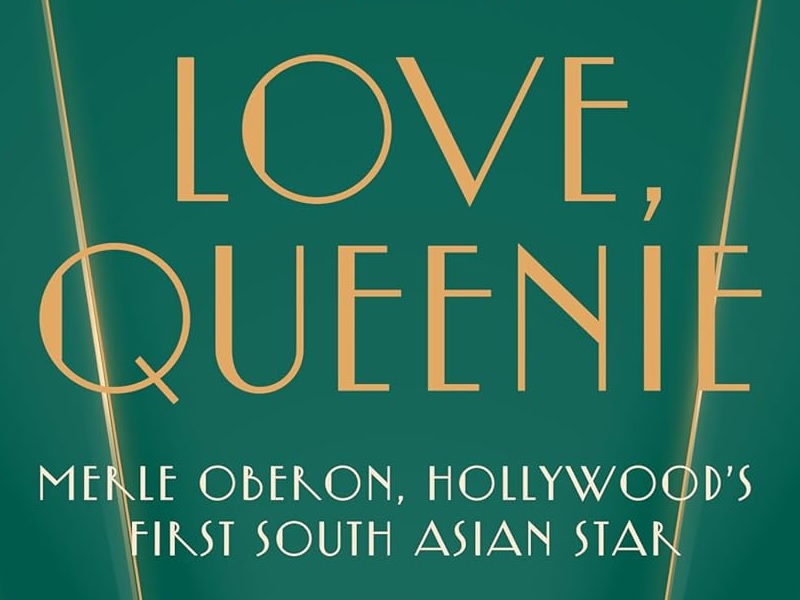
Love, Queenie: Merle Oberon, Hollywood’s First South Asian Star is on sale now from W.W. Norton & Company.
