
Talking ‘Squeak Chatter Bark’ With Ali Fitzgerald
by Rachel Bellwoar
The idea behind the Biosphere is a place where scientists can help animals develop life-saving adaptations. When Hazel’s scientist parents go missing, however, a more sinister side to the Biosphere is revealed. With the help of animal witnesses, Hazel is on the case in Squeak Chatter Bark, a middle grade graphic novel by Ali Fitzgerald. For more on the project, here’s what Fitzgerald had to share:

Rachel Bellwoar: In the tradition of The Jungle Book, Tarzan, and The Wild Thornberrys, Squeak Chatter Bark is about a young girl who can talk to animals and is living alone in the wilderness, with only animals for company. There’s a lot more to it, but were you fond of those types of stories growing up?
Ali Fitzgerald: I was raised by a single working mother, so I was a big fan of any “feral kid” story because it reflected some of my own childhood experience. I was quite shy and constantly trying to meld minds with the suburban animals that hung around my neighborhood. My first attempts at making comics involved imagining things from the animal’s point of view.
Bellwoar: The unexpected part is Squeak Chatter Bark is also an eco-mystery – Hazel’s parents have gone missing and she’s trying to track them down. How would you define “eco-mystery” and what was it like getting to play around with genre and cultivate a hardboiled atmosphere in such unlikely settings as the jungle and the Arctic?
Fitzgerald: It was a lot of fun! And that’s one thing I wanted for the book to be: fun. As humans, our relationship to the environment is fraught–with Squeak Chatter Bark, I wanted to explore some of that darkness in a way that highlighted the bonds between people and animals. A genre-melding whodunnit appealed as a way to navigate our conflicting realities. For me, an Eco-mystery is a story where the twists and turns revolve around flora and fauna–one of my favorites is Drive Your Plow Over the Bones of the Dead by Olga Tokarczuk.
Bellwoar: Had you been wanting to create a graphic novel geared towards kids for a while or did the subject matter inspire that decision, and was it an adjustment from creating comics for The New Yorker and a more adult audience?
Fitzgerald: A little bit of both. It’s definitely an adjustment to write for a different audience, but it helped to use my childhood-self as both a guide and intended reader. I’d always wanted to create a book for kids, and when I thought up the P.A.W. biosphere, it seemed like a narrative that would appeal to the younger-version-me. Back in the nineties, there were fewer female protagonists in comics, and I felt a bit estranged from some of the macho male characters who were cast as the main adventurers. For that reason, it was a joy to write Hazel, the intrepid girl-explorer.
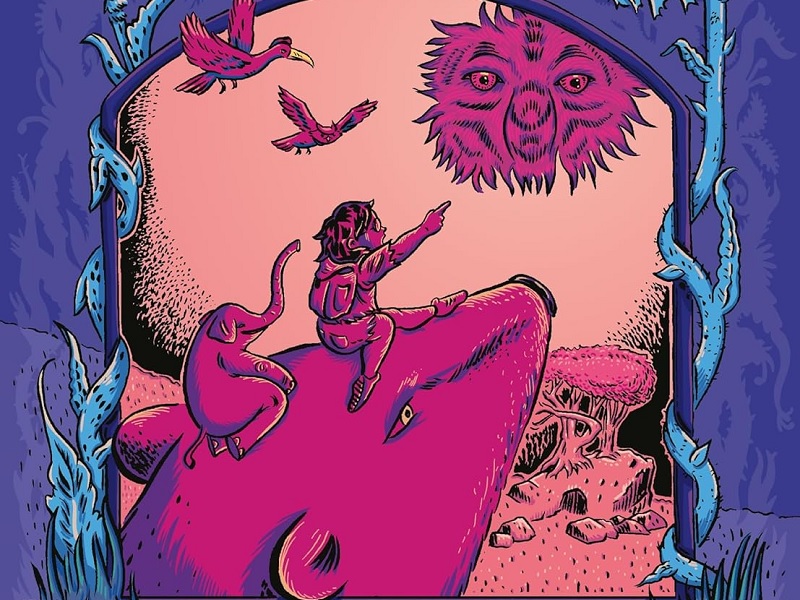
Bellwoar: How did you approach the cover for this book? I especially love the Alice in Wonderland flowers and the unexpected proportions of a miniature elephant on a giant polar bear’s head.
Fitzgerald: The cover was a lovely collaboration with Justin Allan-Spencer, a graphic designer at Fantagraphics. He suggested that we go with a sketch that included the back of the polar bear’s head which reminded both of us of adventure stories from the seventies. We also used the older Narnia editions as inspiration and I added some medieval bestiary elements. I personally love a wild and ferocious plant and so we toyed with how they might creep across the page.
In the book I play with the scale of animals quite a bit—-I’m interested in how evolutionary pressures are currently altering fauna, like the lengthening of beaks in birds or how some animals are getting smaller in response to shrinking food sources.
Bellwoar: While Squeak Chatter Bark includes some hybrid and evolved animals that don’t exist in real life, it also looks at how different animals communicate, like Nina the elephant with her trunk, or the specific calls different birds make. What was the research process like?
Fitzgerald: Animal language is a topic I’ve been fascinated by for most of my life.
*See my answer above concerning my (failed) childhood attempts to communicate with ducks and dogs.
For Squeak Chatter Bark, I read articles decoding animal communication and listened to a lot of birdsong on YouTube. I also read Ed Yong’s book, An Immense World, which really delves into the mysterious world of animal sensory perceptions. While writing the book, I was living in Berlin and learning French, so I mused a lot about interspecies misunderstandings and whether they mirrored my own frustrations with being understood.
Bellwoar: Among Hazel’s animal friends are a multitude of personalities. Did you have a favorite to write or draw for?
Fitzgerald: My favorite is definitely Nina, the miniature elephant. She’s very dynamic, which is always fun to sketch out, and I love that she speaks through trunk gestures.
Bellwoar: Squeak Chatter Bark provides some closure to the central mystery, but could you see yourself returning to the Biosphere for a sequel someday?
Fitzgerald: I’d love to get back to some of the characters—-maybe in a different semi-wilderness?
Bellwoar: Thanks for agreeing to this interview, Ali!
Squeak Chatter Bark is on sale now from Fantagraphics.

