
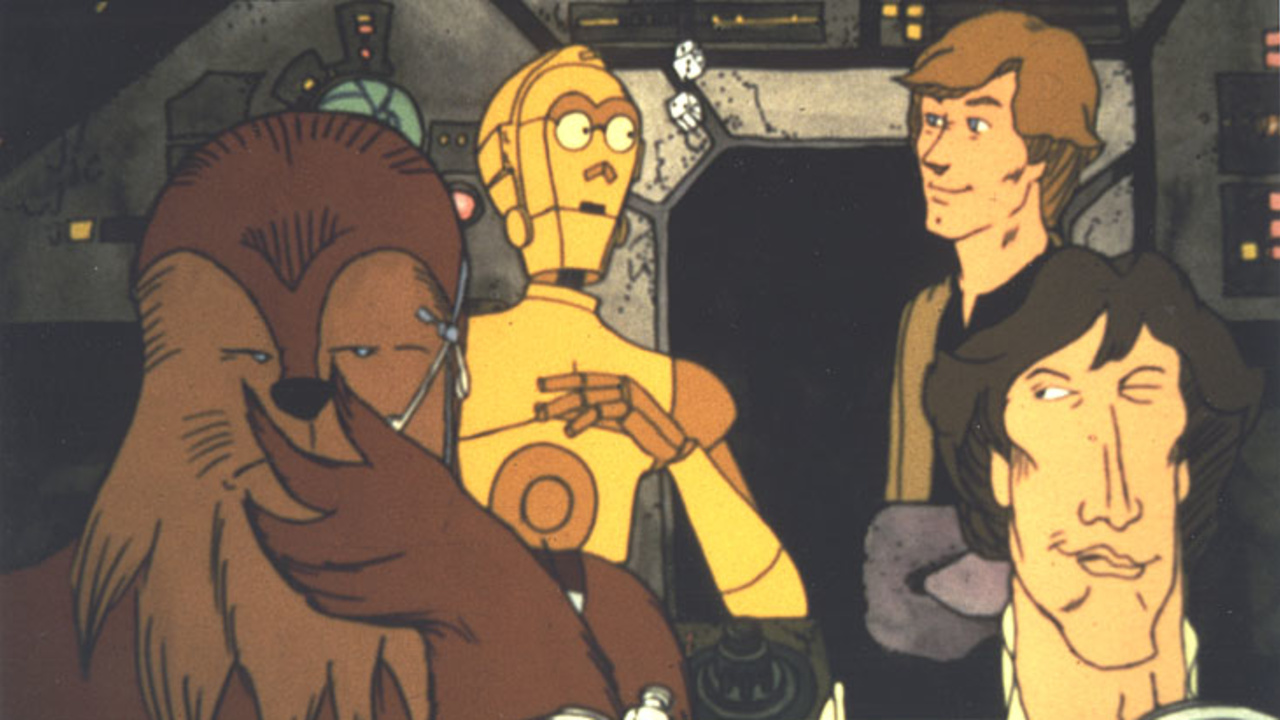
Star Wars Celebration Japan: Michael Hirsh And Clive Smith Talk ‘The Faithful Wookiee’
by Erik Amaya
Star Wars Celebration, which began today in Japan, is known to look forward at the next big movie or television show. But, sometimes, it also takes a look back. And for the 2025 edition, it offered the chance for Nelvana founders Michael Hirsh and Clive Smith to remember their brush with Star Wars – the animated short now known as “The Faithful Wookiee” and the two Saturday morning series from the 1980s: Droids and Ewoks. Comicon editor-in-chief Erik Amaya had the opportunity to talk with the pair prior to Celebration, offering those who might not make to the presentation in Japan a glimpse of what they will discuss. In part one of the interview, the trio dive into the creation of the Star Wars Holiday Special short that introduced Boba Fett to the world.

Erik Amaya: In the US, the name Nelvana means something to animation fans like myself. But in the 20th century, we had a little way of knowing it was this Canadian powerhouse. What were some of the founding principles that led the company to be so distinctive?
Clive Smith: I think the founding principle is that we loved animation and we started the company because there was nothing else happening really. Not very much in Toronto. There were no studios. The only animation that was being done was by a couple of commercial houses and some optical printing houses. And, also, when we started Nelvana in the early seventies, there was Sheridan College, which was virtually just down the road from us that was starting up an animation course. The people that were coming out of those courses had studied good animation, like full Disney style animation, and they had nowhere to go. So, we started to get some of the students from the course and we were able to build the studio on the basis of full animation, good quality animation.
Michael Hirsh: We were experimental filmmakers, too, at the very beginning. We were doing these very interesting combinations of animation and live action, and we were doing animation using paper animation, claymation, other forms of stop frame, and essentially doing whatever we could to make our little films interesting and exciting. And out of that sort of inspiration from doing experimental films, innovative formats, innovative structures, really came this passion for not repeating ourselves. And that was a key factor in the Nelvana story. I think that our shows don’t all look alike. Each one builds in a different way from another one as a result of having these great students, when we were able to make our first fully animated show, we focused on making it as high quality as we could, because what was happening in the US at the time was quality of animation had really descended.
EA: What sort of brief did George Lucas film give you when you were approached about making the short? Was the storyline sort of there, or was it, “oh, you have to introduce this character”?
MH: The brief was simple. There was a script for a 10-minute short. It was part of the two-hour holiday special. George was personally involved in it. And when I flew down for the first meeting, he basically said at the end, “you’ll get to introduce Boba Fett.” What attracted George was the fact that we had this innovative quality in our work. Cosmic Christmas doesn’t look like anybody else’s show. It was sci-fi. People weren’t doing sci-fi at the time. The brief was really, “you got to make a great short, but because you’re the last thing being commissioned, there’s no money.” So, we were given just enough money to pay our expenses. It was like we were doing it really just at cost, but we understood the opportunity.
CS: The Boba Fett character, by the way, they had built a mockup in California. I think it was Ben Burtt and Joe Johnston who put that together. And somebody was filmed wearing this mock-up costume made of cardboard or whatever it was. And we actually were sent a 16 mm black and white film, really low quality, of this guy staring around in a field; just about five or six minutes of footage. And that’s what we used to finalize the design that we used in the short.
EA: Beyond the Boba Fett design, how hands-on was Lucas at that point?
CS: We decided on a style. I was always a fan of Moebius, the French animator, designer, and comic book artist. We put together some designs, but it turns out that George also was a fan of Moebius. We decided on that direction because it was different from most other animation. It was somewhat grown up, somewhat adult looking, and it has a depth to it too, and a texture. A lot of animation [at the time] was very flat and very simple designs. Whereas Moebius, it had more of a realistic quality to it.
MH: [George] loved Moebius, so it was an easy decision, but it really was a critical decision because the short was playing in prime time and we didn’t want it to look like Saturday Morning. I think the next time that we sat down with George and his team was to present the storyboard. Clive and I flew out to Marin County from Toronto, and we actually had made a film strip of the storyboard. We took everybody through it and Clive acted out the story. At the end of it, George had two — maybe three — comments, and he was able to go right up to the storyboard on the wall, which he hadn’t spent any time looking at, and identify the three spots where he wanted changes. And then we were off to make it because we had no time.
EA: Was getting the film cast to reprise their roles always part of the plan or were you thinking you would cast sound-a-likes locally?
CS: It was always given that we would have the cast. I ended up directing the session in Los Angeles and that was fun because [Luke Skywalker actor] Mark Hamill, I didn’t realize that he had been a kid voice actor. And then, of course, he’s had a great career as a voice since. He just kept doing take after take. Interestingly, the movie actors in the group — Carrie Fisher and Harrison Ford — had a different approach. They knew their characters. They gave us the line that was Leia and Han Solo, and that was it. There were not going to be any other takes. It was just their interpretation. Boom! It was a contrast.
Anthony Daniels. who does C3PO, was very similar to Mark. He had done a lot of work in England as a voice actor. He understood how important it was to give these performances with nuance and with different takes so that the animator could actually bring it to life. But all-in-all, I think the original voices worked really well in the show.

EA: The squash-and-stretch quality of some of the animation in the short is something that I know was quite common at the time, but it definitely surprises younger viewers who are used to the more modern convention where the models basically just stay on-model. Was there ever a question about using that technique, or was it just a matter of course?
MH: I think it’s really part of the characteristic of hand-drawn animation. You have that flexibility and you put that in to express movement — express emotion, even, to some extent. Whereas characters that are created with computer tend to be more solid and retain their shapes.
CS: When I had the first meeting with George to land the gig, so to speak, he expressed an interest in that. It was one of the things he was looking to us for: squash-and-stretch animation as part of that, because otherwise it doesn’t really come to life the same way. Yeah, I think that is one of the highlights of that. And I think we kept up some of that in as much as we could in Ewoks and Droids, which were the next things that we did with Lucasfilm.
Next week: the conversation continues as Hirsh and Smith tell Erik about working on the two animated series and Erik asks a question or two about The Magic School Bus.
