
Timeless Favorites And Hidden Gems — Talking ‘TCM Imports’ With Author And TCM Host Alicia Malone
by Rachel Bellwoar
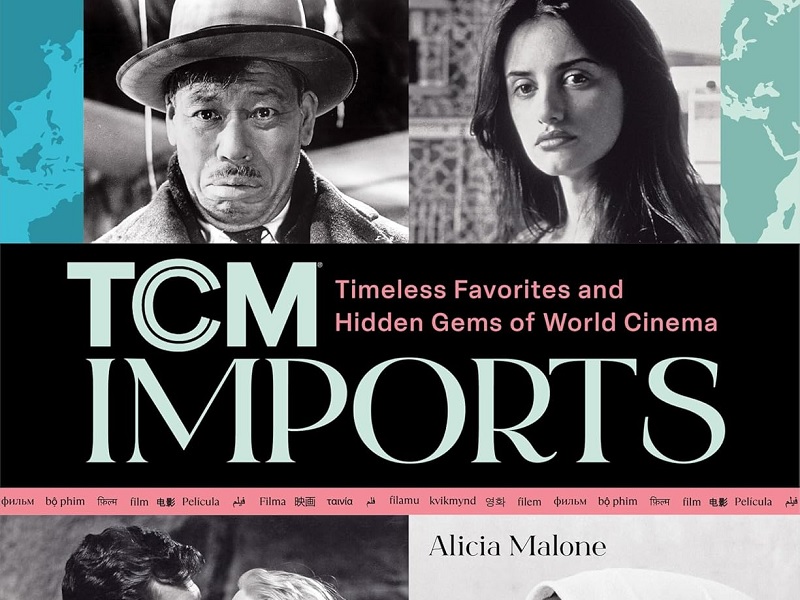
As the host of TCM Imports, Alicia Malone has been celebrating and providing additional context and behind-the-scenes stories on foreign films for years. Her fourth book, TCM Imports, utilizes that expertise to write about fifty-two movies (one for each week of the year) that offer a diverse sampling of what foreign films have to offer. For more on how Malone narrowed down her selection, check out the following interview:

Rachel Bellwoar: You touch on this in your introduction, but how do you think growing up in Australia helped foster your love for foreign films?
Alicia Malone: Being from Australia meant that almost every film I saw – including Hollywood movies – were foreign to me! I didn’t travel internationally until I was an adult, and always had a sense that Australia was far away from the rest of the world. Plus, the majority of our TV shows were from America and the U.K., and the theaters were filled with movies from other countries, so it became the norm for me to watch foreign content.
Bellwoar: When Parasite won Best Picture at the Oscars I remember how much focus there was, not just on the fact that it was a foreign film, but that it was a film with subtitles. Do you think that stigma around subtitles continues to be an impediment to people discovering these great movies?
Malone: I think it’s finally starting to change, but there’s still a feeling that watching foreign films will be like doing homework or reading a book. I am encouraged, though, by the success of international movies such as Parasite, and how many younger people are now watching content with subtitles on, even if it’s in English. Open captioning is also becoming popular at movie theaters, even with audiences who are not hard of hearing. A lot of that has to do with the modern need to multi-task at all time, but it leads me to hope that reading subtitles will become second nature and open more audiences up to movies from non-English speaking countries. A good story is universal.
Bellwoar: In trying to whittle down which films to cover, were there any that made it through every iteration of your list?
Malone: I always try to include movies made by female directors, and particularly, one from Australia – My Brilliant Career. I have written about this movie before and talked about it numerous times, but I knew I would have it on my list no matter. That’s primarily because it’s a wonderful movie, but also because it allows me to also write about the history of film in Australia, the Australian New Wave, and director Gillian Armstrong as a pioneer.
Bellwoar: Did you get to choose which films were featured on the cover?
Malone: Running Press (the publisher) had a great design team, and they designed a few options for me to look at. They were very open to my suggestions and notes, and we went back and forth. We all wanted to make sure the photos represented the broad range of movies in the book, as well as being identifiable and striking. There were a few different iterations but I’m happy where it ended up!
Bellwoar: For prolific directors like Fassbinder or Bergman, was it difficult limiting yourself to one film?
Malone: Extremely difficult! There are a handful of directors who dominate any book about international cinema – like Federico Fellini and Akira [Kurosawa as] well as the two you mentioned – but I made a rule for myself that I would only choose one film per director. Then once I decided on the seasonal angle, it was then hard to limit films made by Eric Rohmer and Yasujiro Ozu, because both of those filmmakers have specifically set movies during seasons. It was a fun challenge.
Bellwoar: While some of the usual suspects are included, there are also some titles cinephiles might not know as well, like Spring in a Small Town or Paris Pick-up. Is it especially exciting when you get to shine a light on a film that isn’t always part of the conversation?
Malone: Yes, and those two films, as well as DDLJ (a popular Bollywood movie) were ones I hadn’t seen prior to doing my research! I wanted to include movies for all levels of cinephiles, from the casual to the truly hard-core, so I pushed myself to go outside of my own knowledge, and sought advice from some very smart film loving friends.
Bellwoar: At one point in the Fall section I started to wonder why there were multiple horror films in a row and then I realised I was thinking about Fall in terms of Douglas Sirk and not Halloween. How did you land on the seasons as a way to organize this book?
Malone: Deciding on how to structure the book was the hardest part! I knew I didn’t want to write a “Greatest Films of All Time” type of book, because plenty of those exist and I don’t feel qualified to make that distinction. And simply listing my own favorites seemed superficial and repetitive – there are certain genres, filmmakers and countries I return to. I knew I wanted about 50 films, to be manageable, and started thinking of how I like to watch movies. Seasonally – horror films around Halloween, film noir in November (for Noirvember), festive films around Christmas. Doing it that way lead me to create a list that is more eclectic than I expected!
Bellwoar: Are there any films you wanted to include but couldn’t due to lack of accessibility?
Malone: There are so many foreign films that are impossible to watch, so I tried to start with availability before a movie made my list. Although, I was a bit sneaky with Paris Pick Up, as it is [tough] to find! One example of one I wanted to include but couldn’t was Spring Awakens from Japan, made by director Mikio Naruse – he was a lesser known filmmaker who often featured female protagonists. It’s a charming film but nowhere to be found on streaming services etc, so I had to give it a miss.
Bellwoar: Thanks for agreeing to this interview, Alicia!
TCM Imports goes on sale April 22nd from Running Press and Turner Classic Movies.

