‘Transformers’ #19 Review — Too Much Lore, Not Enough Character
by Austin Gorton
Overview
Similar in structure to the earlier Starscream flashback, Transformers #19 steps back from the main action to focus on a tale from Megatron’s past. But the end result leans to heavily on the development of backstory and lore and not enough on deepening our understanding of its protagonist.
Overall
6/10Like the last “between arcs” Starscream-focused story in issues #13-14, Transformers #19 is another between arc issue. This installment focuses on a specific character: Megatron. Though his presence has loomed large in this book (and arguably, throughout the Energon Universe) despite his absence, this issue represents the most concerted page time the character has yet to receive in the Energon Universe.
Unfortunately, though, it features a Megatron at the youngest point in his timeline yet (the character notably lacks the Decepticon insignia on his chest throughout the issue), it doesn’t really offer a new or different tack on the character the way the previous Starscream tale did. Instead, it is focused more on using a Megatron who sounds an acts an awful lot like “usual” Megatron to develop little bits of Energon Universe lore and Decepticon backstory.

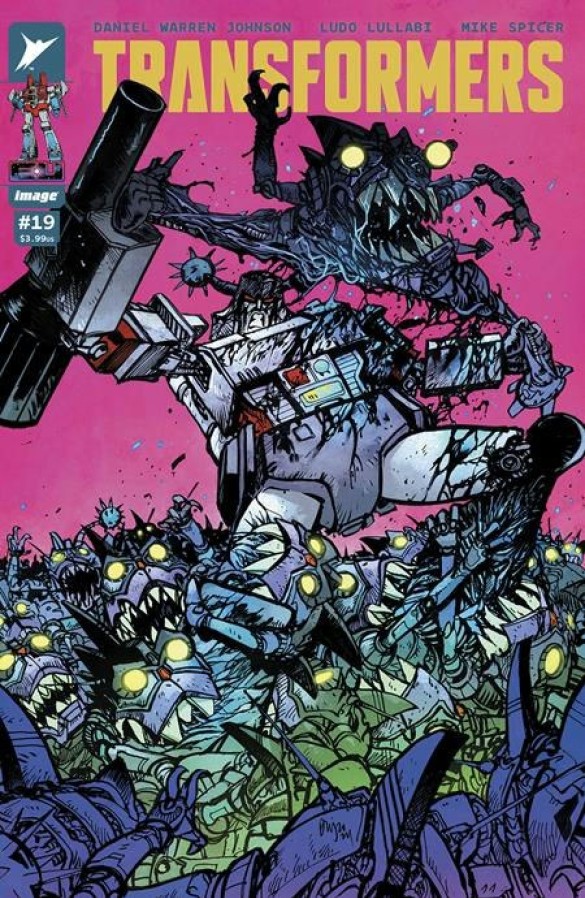
Opening more or less in media res, Transformers #19 features Megatron being put on trial by the Quintesson prosecutor Dezimir. The “trial” is essentially trial by combat, in which Megatron is forced to battle a hoard of Sharkticons and the massive Mechanokoar. When he’s eventually overwhelmed, he suddenly wakes up back in his cell, in front of Dezimir, and the trial beings anew. So it goes, across hundreds of trials, with Dezimir’s master insisting Megatron must accept his relative insignificance to successfully end the trial.
Art in the issue comes from Ludo Lullabi. As with the previous Starscream story, Lullabi’s style is notably different from that of series artists Daniel Warren Johnson and Jorge Corona. While still fitting the general aesthetic of the series, Lullabi’s figures are much more polished and fluid than Corona’s, which often feel like a random piece might just tumble off the Transformer.
There seems to be more of a manga influence to Lullabi’s style, eschewing the usual bombastic, pro-wrestling style of action in the book for something with more speed lines and quick action (along with a robotic Kaiju that is more like a mechanical Godzilla than, say, Devastator and Bruticus). Megatron under Corona is a massive block of a figure, visually-dominating the page as an expression of the fear and loyalty he commands. Here, Megatron is much more lithe and agile, which helps underscore that this is a younger version of the character.

The action is well-rendered and while the repetition of the trials doesn’t offer much in the way of character development for Megatron, it does effectively underscore the anger and arrogance that drives the character. But in the end, the entire outing turns out to be a vehicle less for showcasing Megatron as a character and more for filling in or establishing bits of lore.
Notably, it brings the Quintessons — characters with connections to previous iterations of Transformers and already established in fellow Energon Universe series Void Rivals as being connected to the history of these Transformers — into the series for the first time, but offers little context for anyone not reading Void Rivals or less well-versed in general Transformers lore.
It also introduces the “Dark Matrix”, a counterpart to the Autobots Matrix of Leadership, something suggested in previous Transformers stories but appearing for the first time here. And it reveals that the Quintessons, as the culmination of this issue’s trial, used the Dark Matrix to change Megatron’s alternate form from a tank to a handheld gun, imbuing him with the ability to exert his mental control over whomever wields his gun form (which explains the sequence in issue #14 when Megatron forces a reluctant Starscream to kill prisoners while wielding him, and probably also the hints of Megatron’s voice Optimus Prime has been hearing in his head since donning Megatron’s gun arm).

All of which is perfectly fine. Serial stories occasionally have to stop and do this kind of work, looping in plotlines from other books, dotting narrative i’s and crossing narrative t’s, and seeding future developments. But the structure and timing of Transformers #19 automatically puts it in comparison with Transformers #13-14, and that story much more successfully walked this tightrope, furthering the backstory of the series while also deepening our understanding of its protagonist. Here, that balance is out of whack in the wrong direction, and the issue suffers for it.