
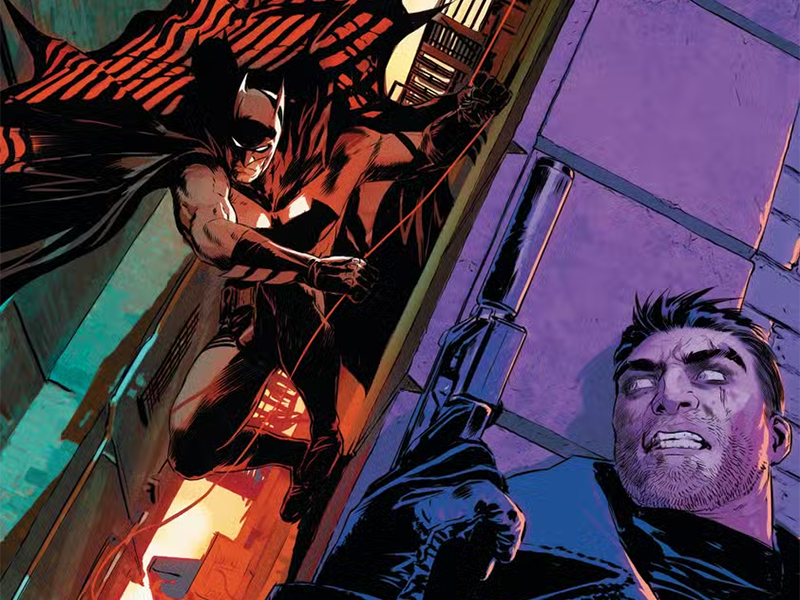
That’s Some Killer Math — Reviewing ‘Detective Comics Annual 2025’ #1
by Scott Redmond
Overview
There’s no case too big or small for the caped crusading detective, whether in his backyard of Gotham or across the pond. A duo of stand-alone mysteries showcase the variety of sides this eight-decade old character. Truly some of Batman at his finest.
Overall
10/10World’s Greatest Detective is one of the many monikers often dropped on the shoulders of Gotham City’s dark knight protector. Whether he gets to prove the value of this label depends on the stories being told.
Writing a genuine detective mystery story that carries the intrigue is not easy. Especially when the Batman focus tends to turn towards a lot of deep punching (and kicking) action. Detective Comics Annual 2025 #1 makes it look pretty darn easy.

That’s because it’s got the writing chops of Al Ewing (making his Bat-debut) alongside the artistic talents of John McCrea, Stefano Raffaele, Fico Ossio, Lee Loughridge, Triona Farrell, Ulises Arreola, and Tom Napolitano.
“Batman do not solve my murder,” written in blood.
The dead pleading with the living to leave their murder unsolved. That’s a hell of a way to open a mystery story, for darn sure.
Everything about this story clicks. Stories that take up the bulk of extra sized Annuals can feel a bit much at times. It’s like they are stretched to fit the format of the issue rather than actively planned that way. Not in this case.
The three act setup works wonders here, for the pacing of the overall story and also in regards to having three different artistic teams on board.

McCrea, Raffaele, and Ossio are very distinct artists. They each have their own intricacies, stylistic choices, and voices. Yet they share enough in common to make this ‘art baton hand off’ situation occur smoothly. Shifting art can at times cause a slight pause in the reading process or even be quite jarring, because the art styles chosen are so far apart from one another or happen in a random unexpected moment.
It works here.
All three styles have that right touch of roughness befitting a noir mystery story. This really shows the sharper edges of the character and the world as he moves through it. Plenty of depth, weight, and details are found on every page. Each artist lets the story flow through their pages by their choices in paneling and layout. This represents artistic styles that favor the more exaggerated or fantastic energy. The approach works wonders with this particular character.
Similarly, the color palettes follow suit where Loughridge, Farrell, and Colorist join their respective artistic partners in setting the tone for the story. Most of the colors eschew toward darker and heavier tones, sprinkling in their own bits of particular roughness to boot. This allows lighter colors to pop up as necessary to give the world a more authentic but also outlandish sort of feeling.
Use of more vibrant fantastic tones are saved for scene or backdrop filters as well as some of the more magical elements we see. This contrasts beautifully against the more muted and neutral level colors.

More focus is on setting the tonal atmosphere and locational aspects on both artistic fronts. There is some action here but it’s very minimal. Scenes rely heavily on location and pinpointing of details for the mystery. Batman’s presence in England, and how he moves about this space takes up the lion’s share of space.
Ewing approaches Batman with a natural ease, as if he’s writing the character for a year-long endeavor rather than a debut attempt. He fits Batman into another space, which is something that has been done a million times. All that knowledge and preparation makes sliding into a square, triangle, or even circle space seem simple. This is what Ewing touches on as he sends the character to his part of the world for this particular case.
Even with the smaller focus, the essence and character of Batman is here. This is boosted through the very steady and smooth voice that is created by Napolitano. Each caption has the analytical bordering on cold voice we expect from the detective. Dialog is infused with the actual genuine care, and some warmth, that we know the character actually contains.
‘Done in one’ mysteries like this are such a welcome thing. There is a beginning, middle, and end. It’s not strung out for months, where the overall mystery can become bogged down or dragged out. This is right to the point, and still very pointed about the world around us.

Attached to the main story is a small and cute little back up piece from Joshua Hale Fialkov, Mike Norton, Nick Filardi, and Troy Peteri.
David Rosales is a student at Gotham Public Middle School 96 and founding member of the Junior Batman Detective Club. As students begin to fall ill, with hallucinations, David begins to suspect something more foul happening. It seems very Scarecrow related.
This is a solid and grounded tale. It’s very fitting for how things would happen in a world that contains a character like Batman. People try to find their place in the world, devoid of actual community, finding solace in trying to be like their hero.
The interplay between David and Batman is solid. Fialkov really nails the voice and the demeanor of Batman when it comes to how he interacts with children. There is never any talking down, sending the child away, or anything. Batman likely already knows what is happening, so he knows (character) isn’t in actual danger. Instead, he works alongside David and explains how things can get better for the ostracized student.
The actual solution to the case is even scarier than the suspected Scarecrow appearance. It showcases actual stuff that happens in our world every day, putting the corporations and powers that be into the unseen villain space. Just like real life.

It’s all rendered incredibly well by Norton’s artwork, which really dips between whimsical and firm spaces. This gives the story dual levity and depth that it needs. We can feel the overall scope of this space without losing the knowledge that it’s a school. It gives the whole story a bit of a softer feeling, which is appropriate for its structure, without losing any of the overall edge.
Each of the color choices that Filardi makes matches this, keeping things in a more middle-ground sort of space. Nothing is too dark or too vibrant, flirting with the line easily. Filardi uses the right lighting approach to make the night and day scenes, as well as the dark school, feel authentic. This gives everything even more of an impact.
There is a ton to be said both verbally and through captions here. Peteri smoothly weaves text through the rest of the art. Bringing all the right inflections and emotional energies that are necessary. He lets each character’s voice really build and come together in our minds, helping present that somewhat softer but still firm Batman I spoke of earlier.
Detective Comics Annual 2025 #1 is now available from DC Comics.

