
‘Andor’ Episodes 4-6 Center Its Title Character And Are The Better For It – Review
by Austin Gorton
One of the (very few)(mild) criticisms I could level at the first three episodes of Andor Season 2 is the way they position Cassian Andor (Diego Luna) in the least compelling and thematically-rich plotline, and then make him the least interesting character in that plot. Outside of his opening, action-packed TIE theft and discussion of coming home to yourself, he mostly plays the straight man to the Rebel doofuses in the Yavin 4 jungle and their game of Space Rock Paper Scissors.
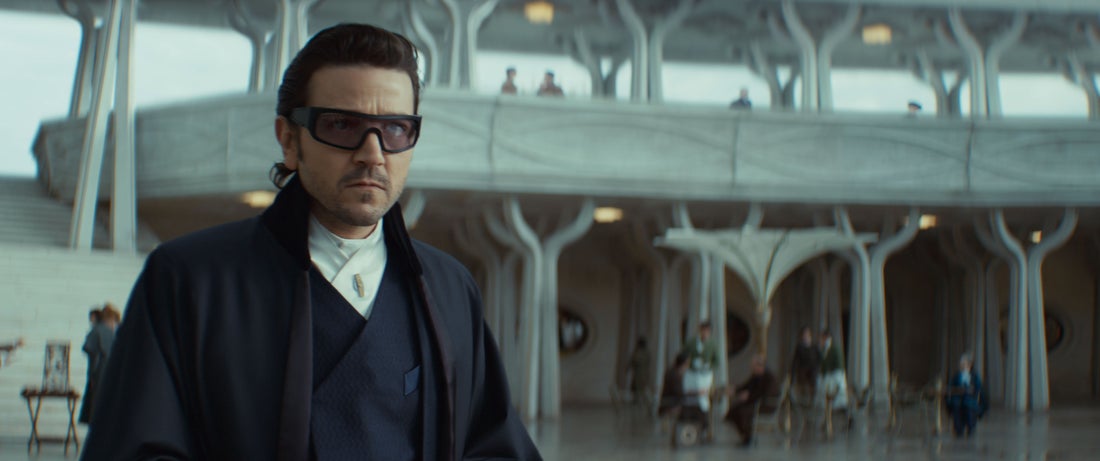
But the next batch of episodes — “Ever Been to Ghorman,” “I Have Friends Everywhere,” and “What A Festive Evening” — written by Beau Willimon and directed by Ariel Kleiman, rectifies this. While there are certainly plots and themes happening absent Cassian, he is at the center of the most important ones (even when not physically present) and the episodes benefit from that.
As is this show’s wont, all three of these episodes are thematically rich. But the two themes which rise to the top in terms of driving the action and characterization are the question of cost and the unending drumbeat of time. From the opening title card that tells us how many years before the Battle of Yavin (which concludes Star Wars: A New Hope), along with the ringing of a Ferrix bell, to Luthen (Stellan Skarsgård) telling ISB agent Lonnie (Robert Emms) they have to move faster, to Kleya’s (Elizabeth Dulau) desperate efforts to remove a bug from an ancient relic before being discovered by Director Krennic (Ben Mendelsohn), time — and the respective quantity and speed of it — is all over these episodes.
The other central question is how much one is willing to sacrifice to the cause. We know, from season 1, that the answer for Luthen is “everything.” For Saw Gerrera (Forest Whitaker), huffing toxic gas, he’s already given up his sanity to the cause of rebellion. And right now, Mon Mothma (Genevieve O’Reilly) is on a point in that arc of “more than I would have thought.”
Yet not all of Luthen’s subordinates are on the same page. Vel (Faye Marsay) has, since her introduction, been less militant to the cause than either Luthen or her lover, Cinta (Varada Sethu). In fact, this three episode arc reveals that Cinta is backpedaling (from Luthen’s perspective) having realized that Vel matters at least as much as the cause, if not more. Much to Luthen’s dismay, Cassian is loyal to both his cause, and to Bix (Adria Arjona) — and as suggested by the relative brevity with which he conducts Luthen’s mission to Ghorman, possibly more loyal to the later.
And thus, Cassian is centered squarely in the two big thematic elements of this three episode arc. He insists that it’s too soon for the Ghorman Front to make their move. Is he right, or does he just want to get back to Bix, because he’s more concerned with her well-being than the success of his fellow revolutionaries? Ultimately, the answer to both is yes — in a delicious irony, the Ghorman Front’s plan is all unknowingly part of a larger Imperial effort to crackdown on Ghorman (as setup in the preceding arc); had Luthen listened to Cassian and slowed down, not moved forward with the Ghorman resistance, they would handed the Empire a loss, and Cinta would still be alive.
The fact that Cassian is, ultimately, right and Luthen wrong is a key development for the series. It reinforces that the show is called “Andor,” and not “Luthen,” and it helps lay the foundation for the version of the character seen in Rogue One: A Star Wars Story, someone deeply committed to defeating the Empire but unwilling to take the shot to kill Galen Erso (Mads Mikkelsen) in cold blood.
This set of three episodes also benefits from the way it draws the Syril Karn (Kyle Soller) and Dedra Meero (Denise Gough) plot into closer orbit with the rest of the characters, positioning the two Imperials as the Evil Cassian and Luthen. The way Cassian — the object of both Syril and Dedra’s obsession that drove them together in the first place — arrives on Ghorman from Coruscant just as Syril is leaving Ghorman for Coruscant is a great Sliding Doors moment, and the creators smartly underplay it (there’s no lampshading it by, say, having the pair walk past each other in the spaceport or anything like that).
Syril and Dedra’s B-plot in the first three episodes was deeply entertaining (despite them both being terrible people), but the show is better when they’re more involved in the A-plots, serving as dark mirrors to the protagonists.
In the end, it is Cinta who pays the ultimate cost for the cause in these episodes, the result of Luthen not heeding Cassian’s warnings to ignore the drumbeat/bell ringing of time and move slower. That particular beat is a down moment for the arc, one which contributes to an unfortunate trope even as it fits with the thematic breadcrumbs the episodes laid down and what the episodes are trying to say.
It also foreshadows the possibility of another, unfortunate trope-y ending for Bix. As “What A Festive Evening” and this second mini-movie concludes, we see Cassian and Bix, on a mission together, the question of what matters more to Cassian — the cause or Bix — shelved, for now. What will happen when it gets taken off the shelf agsain, and will the series handle it well? Questions for another time. For now, we’re simply left with another chunk of outstanding storytelling from this dense and satisfying show, even as we draw ever closer to its time running out.


