
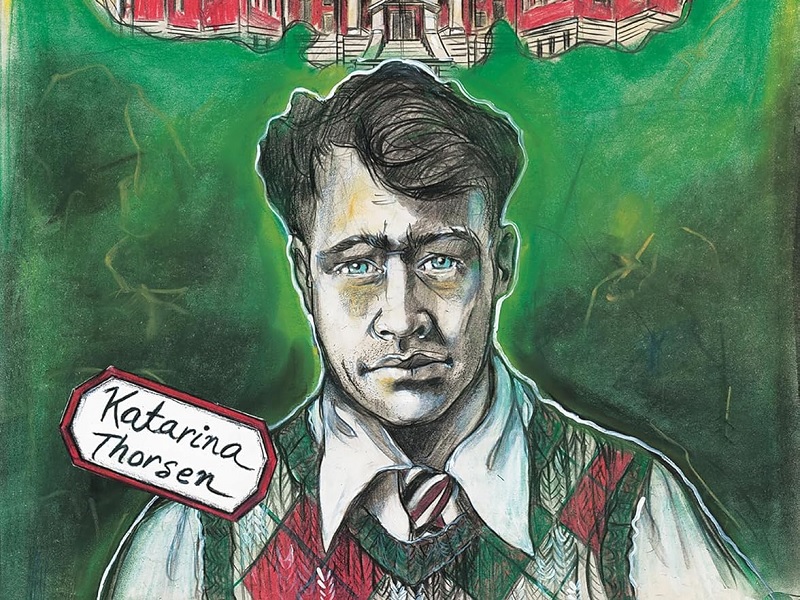
Talking ‘Salt Green Death’, James Joyce, And Mental Health With Katarina Thorsen
by Rachel Bellwoar
Research isn’t just for learning more about famous people and stories. It’s about finding and telling stories that have been forgotten, even in their own time. Nobody was keeping deep tabs on the O’Dwyer family and the many tragedies that befell them in life. Still to this day stories about mental illness get ignored because they can be difficult, uncomfortable, or because for all the strides that have been made, there’s still a lot that could be improved. Today we can question how Joseph O’Dwyer was treated at various hospitals in the 1940s until his death in 1963, but it took a while for concerns to be voiced — and that’s because these stories were easier to ignore. With Katarina Thorsen‘s graphic novel, Salt Green Death, there’s no looking away and here’s what Thorsen had to share about her research and the process of making this graphic novel:

Rachel Bellwoar: In the prologue, you explain that it was an article about Joseph’s sister, Molly, that started your research into the O’Dwyer family. What was it about that article that resonated with you?
Katarina Thorsen: On January 15, 1953, the skeletal remains of two children were found in Vancouver’s Stanley Park. Known as “the Babes in the Woods,” the victims had been killed with a hatchet, and evidence suggested the involvement of a woman, possibly their mother. The identity of the children remained a mystery until 2022, and the double homicide remains unsolved.
In 2003, I attended a talk at the Vancouver Public Library featuring a retired homicide detective and a forensic odontologist, who were guests of the author Timothy Taylor, who was promoting his book, Stanley Park. Though the book didn’t cover the story about the Babes in the Woods per se, there was a thread throughout the book about them. After the talk, I approached the detective and offered to volunteer as a researcher for the Babes in the Woods task force – using a creative approach and my skills in behavioral evidence analysis – and to my surprise, the detective accepted.
And so from 2003 to 2004, I was a volunteer researcher with the Babes in the Woods task force. My work was to interpret the cold case within a historical context, the historical context of a post-war city, folding in theories as to the psychological behavior of the offender or the offenders. To enrich the profile of the unknown woman involved, I searched for comparison cases regarding troubled women in post-war Vancouver, and came across a 1947 news photo of a young woman named Molly O’Dwyer, who died by suicide shortly after the photo was taken.
A tip from the 1950s mentioned a “Molly from Alberta” who headed west with two children and vanished. The name stuck with me, and I couldn’t shake the feeling that this Molly might be connected. I dug deeper, driven by both professional and personal curiosity. While assisting the detective – who was focused on a different suspect he called “Lipstick Liz” – I continued researching Molly. Eventually, I found her name in a patient file belonging to her brother, Joseph O’Dwyer, at the archives.
Though Molly was not involved in the Babes in the Woods case (nor was “Lipstick Liz”), she stayed in my heart. It felt like she wouldn’t let me go until her story was told.
Bellwoar: When did your research start to shift towards Joseph?
Thorsen: While my original goal was to create a graphic novel intertwining the Babes in the Woods and Molly O’Dwyer stories – two seemingly separate but emotionally linked narratives – my focus turned to exploring Molly’s life more deeply. I used collage and artwork to experiment with how their stories, and mine, could braid together.
As I researched Molly’s background (starting In Fall 2003), I discovered her Irish roots. It was a wonderful moment when I went to an Irish gift shop where I asked about them and they said “Molly” is actually a nickname for Mary. This helped unlock immigration records and details about her family. I learned her brother Joseph had been institutionalized, which piqued my interest due to my background in youth mental health and creative engagement.
In 2017, 14 years after first encountering Molly’s story, I accessed Joseph’s full patient file. This was a big turning point. Seeing his photo in the file was powerful. During COVID in 2020, with more time and emotional space, I revisited my archives – six to eight banker boxes’ worth – and decided to separate the stories. I unraveled the braid, treating the Babes in the Woods, Molly/Joseph, and my story as distinct narratives. That’s when I realized my true passion: telling Joseph’s story through his lens, using as much primary source material as possible, enriched with experimental art.

Bellwoar: Primary sources aren’t always allowed the spotlight they’re given in this graphic novel. Why did you want to ensure readers had access to the actual documents rather than an interpretation of them?
Thorsen: I visually interpreted the original documents, recreating them as faithfully as possible. I enjoy working within creative constraints, and the structure of the patient file gave me both limits and freedom. Once I separated the O’Dwyers’ story from the Babes in the Woods, I realized this was truly Joseph’s story – and that it could be told through his detailed patient file.
The archival records (so beautifully organized) offered a wealth of information – not just about Joseph, but his entire family. The social history sections helped me trace the family’s journey, revealing insights about immigration, mental health, and family dynamics. The file included letters, medical notes, and records of Joseph’s treatment and resistance.
This process deeply resonated with my long-standing interest in psychiatry, psychology, and human behavior, both from personal experience and my work with youth and mental health. Joseph’s story became a powerful focus – almost an obsession – as I sought to tell it with authenticity and care.
Bellwoar: What was the experience like of rewriting these documents in your own hand, because they’re not photographs and they’re not typewritten either, but were you influenced by the handwriting of the doctors and nurses (in many cases) who wrote them?
Thorsen: Rewriting the documents allowed me to step back into time. I didn’t want to just photocopy the originals and collage them into the story. I wanted to recreate them by hand, taking care to emulate the original typing and handwriting. What struck me was the hospital’s careful preservation of years of correspondence, i.e. letters between the parents and responses from physicians and staff. I could see the heartache in the words, the father’s struggle with spelling, his handwriting growing shakier over time. The visitors’ records and signatures added another layer, reminding me of my own experiences visiting loved ones and clients in hospitals. Rewriting everything by hand made me feel like I was walking in their footsteps, trying my best to approach it with compassion and empathy.
Bellwoar: The other thing you can only get from primary sources is the exact wording that was used. The thing that struck me the most were the letters from Joseph’s parents trying to find out more information about their son and how polite they continued to be despite how uncommunicative the hospitals were. Does it get aggravating not being able to fill in the blanks, like did they trust these physicians or was the wording their attempt to get answers?
Thorsen: The letters from Joseph’s parents were striking in their politeness and desperation. Though uneducated and working class, they did their best to communicate respectfully with doctors in an era when psychiatrists held immense power, especially over those involuntarily committed, like Joseph in 1948.
At the time, psychiatric treatment could be brutal and aimed more at quieting the patient. At the start of Joseph’s treatment, anti-psychotics [were] not yet available, and when they were, the side effects could [be] debilitating. His parents, with limited resources, struggled to visit him and pushed hard to have his care funded through Veterans Affairs due to his brief military service. [It] cost money for them to take the ferry from Vancouver Island to get to, you know, to stay with friends.
What humbled me most was realizing how supportive and determined his parents were, despite my early assumptions that they might have been indifferent or uninformed. As I read more, I saw how painful it was for them to lose their children and how earnestly they trusted the psychiatric system, which, though brutal by today’s standards, was the best available at the time.

Bellwoar: What is it like trying to find information about an ordinary family versus a famous case? I love, for instance, how long it takes to find out what happened to William’s brother after learning he ran away from home at 15. Is this reflective of your own research process and how long it would sometimes take to locate information?
Thorsen: Finding information about an ordinary family takes time and persistence, but older paper records make it possible. I’m saddened by the loss of that paper trail in the digital age. Back then, cemeteries, hospital files, physical newspapers, and microfiches offered an incredible wealth of detail, even for small, everyday events. Newspapers.com and searchable digital archives have also been invaluable in this process. For me, obituaries read like novels.
Over time, I uncovered surprising amounts about this family, especially through newspapers, though it was unclear if they were unique or just well-documented due to the era. It wasn’t until the final stages of my book that I discovered what happened to William. Many earlier attempts to share it fell through, almost as if the timing wasn’t right for the O’Dwyers themselves. As details finally had a structure and more information about each family member became clear, the story was finally ready to be told.
Bellwoar: Throughout the book you incorporate quotes from James Joyce, including the title (which comes from Ulysses). How do you feel Joyce’s words speak to the O’Dwyer family’s experiences?
Thorsen: I hadn’t properly started to read James Joyce until 2022, but as a voracious researcher and reader, I immersed myself quickly. I have a large personal library, especially focused on psychiatric history and literature. While researching schizophrenia, particularly through the lens of Joseph’s diagnosis, I discovered the book To Dance in the Wake (Carol Loeb Schloss, 2003), a dense and moving biography of Lucia Joyce, James Joyce’s daughter. Her life, marked by mental illness and a deep bond with her father, who really did his utmost best to care for her as she deteriorated, resonated profoundly. One quote from the book – “salt green death” – became the epigraph for my graphic novel, reflecting my strange obsession about the family.
That discovery led me to Ulysses. As I read it, in the final year of finishing illustrations for my book, I found unexpected, powerful parallels: mental health themes, Irish identity. Joyce’s collage-like narrative style mirrored my own layered drawing process. I don’t work very traditionally, and I love to collage as I draw. So not cutting out, but drawing very, like, overlapped imagery, and making people work. And you have to really work to read Joyce. His non-traditional, demanding approach gave me permission to ask the same from my readers.
Though I only began reading Joyce recently, the synchronicity was striking. For instance, I imagined Joseph stealing a copy of Ulysses from his psychiatrist — my creative license, based on a detail in his patient file about his love for reading. That fictional element let me explore how language from Joyce might have been misinterpreted as psychosis. Joyce’s own struggles — poverty, exile, his devotion to Lucia — deepened my sense of connection. It all began with Lucia, and the thread just kept weaving itself through my work.
Bellwoar: Birds and foxes appear throughout the graphic novel as well. Are they meant to be avatars for Joseph and his family, or for yourself (as the person researching them)?
Thorsen: Birds, foxes and other flora and fauna appear very often in my work. I use animals as metaphors, often without overthinking the meaning behind them. I have a recurring impulse to draw dead birds – perhaps as a way of sitting with aftermath, with grief. There’s a kind of presence in death, in what follows, and I’ve experienced that personally. The dead birds suggest innocence lost, while foxes have come to represent both Joseph’s wild anger and my own journey – snuffling around for clues, searching, scratching.
In April 2023, while at a residency where I met my future publisher, Andy Brown, I came across a line in Ulysses about a red fox scraping at the earth to reach the dead underneath. It was another uncanny moment of connection – themes overlapping naturally, mysteriously. The book unfolded like that, non-linearly. Drawings were done out of sequence, often led by feeling or resonance.
The phrase “salt green death” from the Lucia Joyce biography became both the emotional and structural spine of the book. Salt spoke to Joseph’s time in hospital — tears, sweat, separation from the mother. Green took us back to his birth and Irish roots. Death came last, in both story and process. The final drawing I made was of the father dying, and it felt like being present at an actual passing – deeply moving, and full of light.
This whole journey has felt mysterious, and filled with grace.
Bellwoar: Thanks for agreeing to this interview, Katarina!
Salt Green Death goes on sale May 20th from Conundrum Press.

