
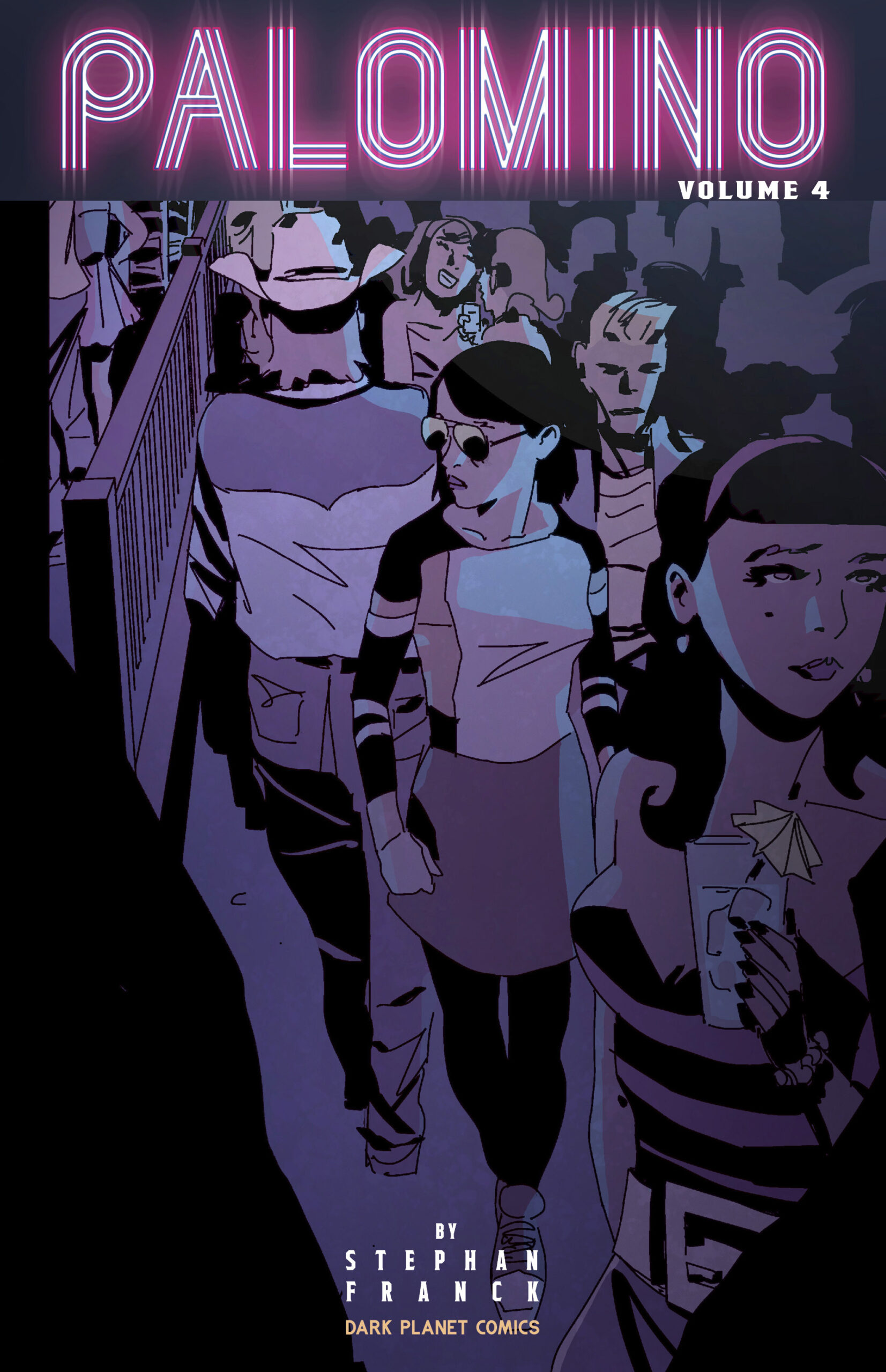
Kickstarting Comics: Discussing Neon-Noir Thriller ‘Palomino’ With Stephan Francks
by Olly MacNamee
Stephan Francks has not one but two volumes of his “neon-noir” crime story, Palomino, currently crowdfunding on Kickstarter. And that was all the incentive I needed to catch up with Stephan and discuss his two new volumes:

Olly MacNamee: While your first three graphic novels are neon-noir infused, these next two volumes will be more gritty, to suit the era. How does that change the way you create the art, the layout of the page and the colour palettes?
Stephan Franck: I starts in 1981 as a crime mystery in which Eddie and Lisette, our father/daughter detective duo, hustle to untangle a web of crimes through a fun procedural investigative process into things deeply hidden. In this second half of the story, most of the clues found and forgotten in 1981 resurface easily, almost as if animated by a need to come clean. However, the consequences are about to snowball out of control. As we follow Lisette — now 29 and going by Liz — though all this, the point of view of the book becomes even more first-person and subjective. The layouts become more and more immersive, and the experience only more visceral. The colors also begin to shift — whether it’s capturing the brand new 1990’s glistening highrises in Downtown Glendale, or evoking the changing music tastes at the Palomino.
MacNamee: And are you still utilising CGI models in your creative process? Or any other good practices you’re bringing over with you from your work in animation?
Franck: Absolutely! The city of Los Angeles itself has always been a character in Palomino, and all the locations are super specific in terms of their accuracy in all their details and connotations, so I built elaborate sets for them in SketchUp. The fun part is dressing the set with enough props and details to make them feel organic and lived-in, and most importantly, to support the story. I’ve heard someone refer to the process of dressing the set in anticipation of what the characters will do as “archaeology in reverse”. I love it. Then, the next key aspect is using the right lens (or set of lenses) — in this case, anamorphic wide screen lenses to really chase the cinema feel — and scout around the set, and let it surprise you.

MacNamee: In these new volumes Lisette is now 29, but still at odds with the world. And new tech like emails. She’s clearly still haunted by her past. And as a local reporter she winds up revisiting her dad’s old unsolved murder case. Where does it go from there?
Franck: A common thread to noir characters — regarless of whether they’re good, bad, or morally ambiguous — is that they never let things go. That’s the case with Lisette — who now goes by Liz. She’s tried to bury the trauma of all those unresolved cases in her past, but they lay restless in a very shallow grave. Given half a chance, she will dig everything up, only to find that the mysteries that have been looming over her life are even more connected than she could have imagined. Her story turns into a harrowing gauntlet, with only two possible outcomes: rebirth, or death.
MacNamee: I was interested to see you seem to introduce an element of the supernatural in Lisette’s mum appearing. Albeit in a dream. But I was wondering, will we be seeing more of this more gothic element in the forthcoming volumes? Or am I reading too much into it?
Franck: It is there for you to read into it exactly as much as you want. I think the world is a mysterious place. Life only exists through your own subjective experience. So if it’s real to you, then, for you, it is.
MacNamee: Of course, the real life Palomino Club was a huge inspiration on the original trilogy. But are there any new influences at play on this one given the change in time?
Franck: 1981 — which was the setting of the first half of the story — was the high point in the club’s history, and 1995 — when the second half takes place — is the year that it closed. So we have this awesome symmetry, where we can enjoy the club throughout the story, while also telling its own story of change. Change and time-passing are a major theme in Palomino, and we see this through the club’s changing fortunes as well as musical transformations. On a wider level, 1981 is the beginning of the Reagan Revolution, which aimed to convince people that the New Deal is what’s holding them back, and 1995 is the moment where the Digital Revolution begins, when the consumer consents to becoming the product. So the passing eras let us explore the club’s history in a dynamic way, while also feeling the changes in society that underpin everything.


MacNamee: As this is a Kickstarter, what can fans expect in the way of pledge prizes? And will there be stretch goals?
Franck: This campaign features not only Palomino Vol. 4 and 5, but also the first wide edition of Romance in the Age of the Space God, a graphic novella, which saw a very, very limited run last year. I call it a weird comic for and about weird times, and I think it is super fun and cool! On the Palomino side, I might highlight a groovy set of book plates that are all “in-world” posters, from fictional TV producer Philip Lamaz’s catalog — Lamaz’s name might be familiar to the reader because he’s been pulling the strings from the shadows since volume 1. Those book plates are cool and ironic, and really fun world-building! And then, we have cool “1981” slip cases that will turn your existing Palomino volumes 1-3 into a stylish boxset!
MacNamee: Well, thanks for your time, Stephan, and all the best with the campaign. If it’s anything like the others, I’m betting it will do well. But, one last question. Where’s Eddie?
Franck: Thank you, it’s my pleasure! Where’s Eddie? That’s for people to read and discover!
Palomino Vol. 4 and Vol. 5 are crowdfunding now on Kickstarter here.


