
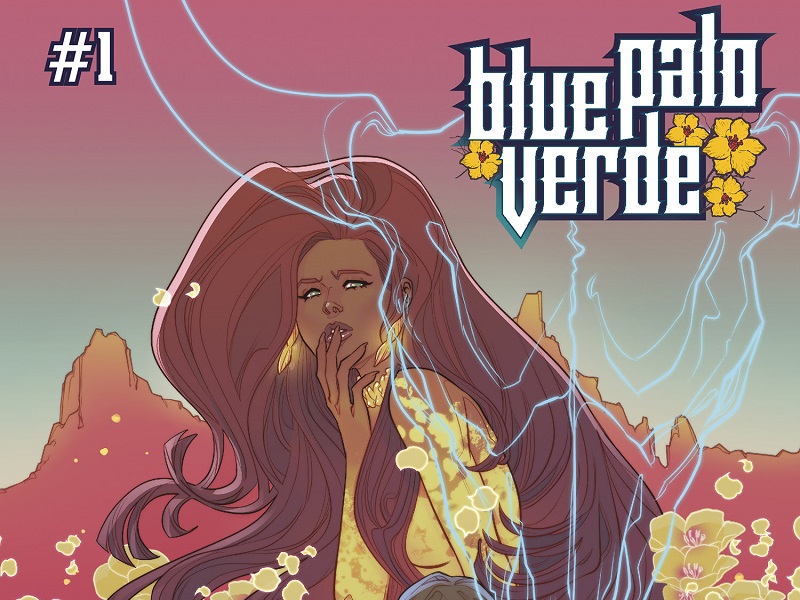
Talking ‘Blue Palo Verde’ With Ray Fawkes And Rimanti Nurdarina
by Rachel Bellwoar
It’s one thing knowing a town’s bad news — a name like “Promise” was always going to be a hard sell. It’s another having to visit that town because your dad’s gone there. In issue one of writer Ray Fawkes and artist Rimanti Nurdarina‘s new series, Blue Palo Verde, Kristine is heading for Promise, New Mexico and you can learn more about the series in the following interview:

Rachel Bellwoar: What drew you to telling a folk horror story as your next project, and specifically a folk horror story set in the American Southwest?
Ray Fawkes: I’ve always been a lover of Folk Horror – it’s such a unique and fascinating genre, exploring the strange legends that can grow up tied to a specific location, and the small, isolated communities that believe them. As I was sitting down to write a piece, I realized that almost every decent Folk Horror story I’d seen took place in Europe or the UK, and that the American landscape is rich with its strangeness – so I decided to set my story in the desert there.
Rimanti: It kind of surprised me, too. Rifan [Kartakusumah]—who’s not just the project manager but also the colorist—offered the project to me, and I just went with it. But once I started digging into the script and sketching out characters, I got pulled in deeper than I expected. There’s just something about the drama and those sweeping desert landscapes that stuck with me. Before I knew it, I was loving the whole wild west vibe.
Bellwoar: The first issue opens with Kristine Woods being released from jail. Is there anything you can tell us about her and why you wanted to start the series there?
Fawkes: Kristine is a person with a violent past, and her struggles with the law have set her up to be the perfect protagonist for this story. Simply being who she is will provoke reactions from other characters in the story, and how she meshes or clashes with the community she finds is what sparks the trouble we’ll see unfolding.
Rimanti: That was all Ray. When I read that scene, I got the cinematic mood he was aiming for—breaking out of this tight, claustrophobic space, frame by frame. It sets the tone for the whole series. You feel that freedom, but also the weight of whatever’s coming next. It just clicked.

Bellwoar: Before we even see Kristine’s face, we see her arms which are covered with tattoos. Especially in light of how tattoos have been used recently to justify unlawful arrests, when did you know you wanted Kristine to have tattoos and how did you come up with the designs?
Fawkes: Kristine’s tattoos are integral to the story. Where she’s headed, the marks on her body are going to serve as a strong signal, whether that’s her intention or not. For her, they’re just decoration. For other people, they’re a statement of her destiny.
Rimanti: Ray had already pictured a desert pronghorn tattoo on her chest, so that was the starting point. For the tattoos on her arms, I wanted them to feel balanced and a bit more familiar, kind of symmetrical, left and right, so they wouldn’t distract too much from the chest tattoo, which is more personal and unique.
Bellwoar: We don’t know much about her past, but we do know Kristine’s looking for her father. How representative of their relationship is the car he’s left behind for her?
Fawkes: Kristine’s relationship with her father is of utmost importance to this story, and gets explored in depth. Let’s just say his leaving his favourite car for her – and her reaction to the gift – is a strong indication of what they are to each other and what kind of patterns they’ve set in their relationship.
Rimanti: A lot, honestly. I think it’s his way of reaching out, kind of a quiet “I’ve got your back.” It’s a little piece of freedom he left behind for her, and a connection, even from a distance. A fatherly gesture in its own way.

Bellwoar: You could cut the tension between Kristine and the sheriff in Promise with a knife. What was it like creating that tension visually?
Rimanti: That one came together pretty easily, thanks to Fawkes’ detailed notes. I could picture it right away. Both characters are strong and kind of mysterious in their own ways. They’re different, but that’s what makes the tension so fun to draw. You just know something’s going to snap, and the visuals get to play with that.
Bellwoar: Folk horror is filled with memorable masks and costumes. What inspired your design for the deer mask and flower poncho worn by the high priest character?
Rimanti: I really wanted it to feel rooted in nature, like something an old tribal leader might wear—nothing too polished or modern. So the clothes are more like layered pieces of fabric than something sewn. And the deer mask, I pictured it being carved out of wood, with a rough, blocky look to contrast the flowy poncho. It gives the character this eerie, grounded vibe.
Bellwoar: Thanks for agreeing to this interview, Ray and Rimanti!
With colors by Rifan Kartakusumah and letters by Frank Cvetkovic, Blue Palo Verde #1 goes on sale June 11th from Mad Cave Studios.


