
‘Andor’ Season 2 Episode 10-12 Are A Powerful And Bittersweet End
by Austin Gorton
As the events of the first episode in Andor‘s three episode finale, “Make It Stop”, began to unfold, I initially bumped up against it. Why, with such scant few minutes left in the series, are we getting the backstory of Luthen (Stellan Skarsgård) and Kleya (Elizabeth Dulau) now? Is it even necessary to show us the specifics of their first meeting and the context of their relationship? Had Andor finally succumbed to the kind of problem that plagues all too many prequel stories, of spending time explaining “so THAT’S why X happened!” on things that don’t need it?
But by the end of Andor‘s final episode, “Jedha, Kyber, Erso”, I’d come back around. Because as much as these final three episodes are about, on a plot, level, writing Luthen out of the series while linking events up with the beginning of Rogue One, what they’re really about is the “children” of Luthen and their fates, and more broadly, a generational passing of the revolutionary torch. And that’s why we needed the Luthen/Kleya flashbacks now, to underscore that Kleya wasn’t just Luthen’s assistant or Gal Friday, but his daughter, a child of his revolutionary mission as much as Cassian (Diego Luna) or Vel (Faye Marsay) or Bix (Adria Arjona).
As Luthen long predicted, he doesn’t get to live in the world he helped create, but his children do (some of them, at least). In underscoring this point, the series — which is ultimately giving the backstory of a character who ends the series by leaving on the mission which will conclude with his death — is able to end on something of a hopeful note.
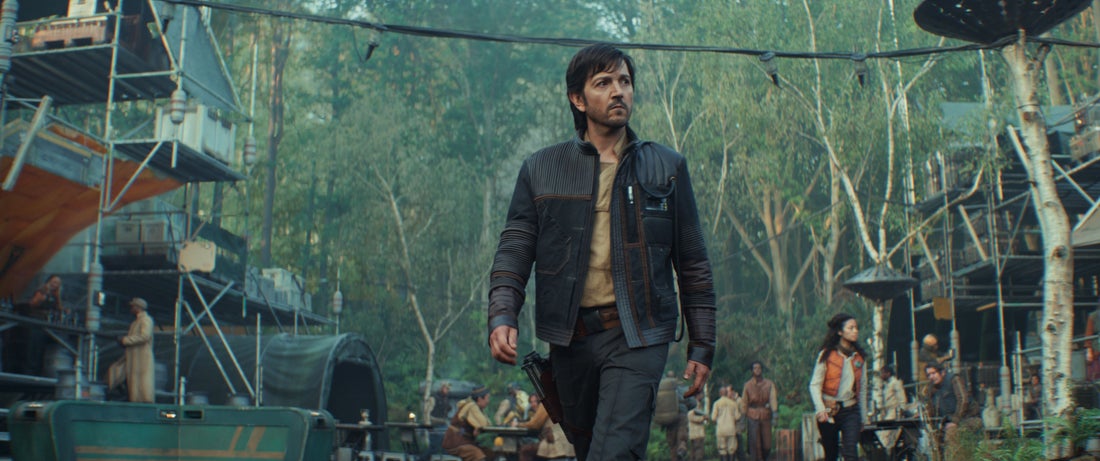
With Cassian more or less where he needs to be, character arc-wise, at the start of these episodes — he’s spent the year between arcs dealing with Bix’s departure by becoming the Rebel leader some say he was destined to be while turning his treehouse into a frat house where he drinks and plays space cards with Melshi (Duncan Pow) and K2SO (Alan Tudyk) — the episodes turn their focus to chronicle the falls of both Luthen and Dedra Meero (Denise Gough), and in doing so, offer up in microcosm why the Rebellion succeeds and the Empire fails.
After an electric scene between the two- five years/two seasons of TV in the making- things fall apart when Dedra botches the arrest as Luthen does his best to kill himself. Kleya immediately springs into action, going into full badass mode as she ruthlessly steals into the Imperial hospital to execute Luthen (a moment given additional emotion weight thanks to the flashbacks unfolding alongside her mission) and protect the Rebellion. After which, she calls for help, which prompts Cassian, Melshi and K2SO to disobey orders to rescue her. In the end, she is brought into the fold on Yavin, wrapped in a blanket by Vel, given the opportunity to see the world she and Luthen helped build.
In contrast, from the moment Dedra fails to capture Luthen alive, she is completely isolated. We next see her alone in an ISB cell, before Director Krennic (Ben Mendelsohn) enters and proceeds to absolutely devour the scenery with relish as he dresses her down for not only botching the Luthen raid, but having gained access to information about the Death Star, putting his project at risk. When Heert (Jacob James Beswick) comes and asks her for help finding Kleya, he makes it clear they are not friends. In the end, her foul-up spreads upward, as even Krennic can’t save his old buddy Partagaz from repercussion for the security leak, leaving him to end his life (alone) at his own hands.
Ultimately, Dedra ends the series completely alone in an Imperial prison, a victim of her own ambition which she had to deploy to overcome the way she system to which she belonged devalued her. Where the Rebellion unites — we’re here to help, you have a place here — the Empire isolates and divides — this is your fault, not mine, I can’t save you. This, as much as stolen plans and plucky farm boys, is why the Empire will fall, and it’s an important point for Andor to make in its closing moments.

It is a common theme in stories of revolution (fictional or otherwise) that all too often, the revolutionaries are fighting to make a world they’ll never see, a world their children will grow up in without their parents. That continues here, as Andor concludes first by firmly passing the torch from Luthen to his children in revolution and then, through its last scene, from one of those children to the next generation. The reveal of Cassian’s child in Bix’s arms, moments after Cassian flies off to his ultimate fate is, of course, heartbreaking. To know that Cassian dies having never known his child, that his child will grow having never known its father, is devastating. But it also speaks to the cycle of revolution that these final episodes — and the series as a whole — are all about.
The first season concluded with Maarva (Fiona Shaw), Cassian’s mother, calling Cassian to action from beyond the grave. She will never see the world she helped create. And Cassian will never see the world his sacrifice on the shores of Scarif will help create. But his child will, and it will be a better world for the sacrifices of Cassian, and Maarva, and Luthen, and so many more. There is sadness to that, of course, but triumph, as well. And, ultimately, hope.
