
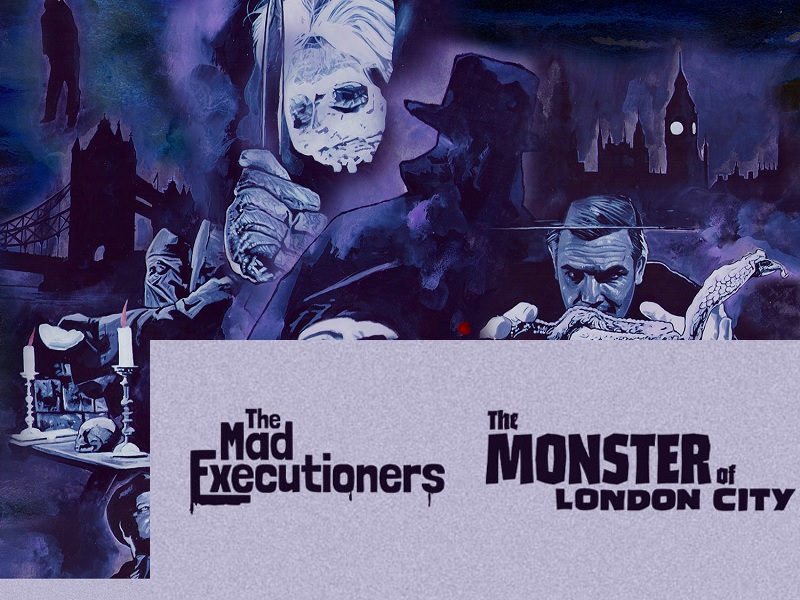
Krimi Double Feature: ‘The Mad Executioners’ And ‘The Monster Of London City’
by Rachel Bellwoar
Simply speaking, “krimi” means “crime thriller” in German but what exactly is a krimi film? The ones contained in Terror in the Fog were all produced by CCC Films. Unlike the krimi produced by Rialto, CCC’s were, or often claimed to be, based on the works of Bryan Edgar Wallace (instead of his father, Edgar Wallace). There’s a whole essay by author Howard Hughes that goes into defining “krimi” in the booklet that comes with this box set, but for me the best krimi – or the ones I’m most fond of – are crime films with an eccentric flair.
Without having known this when I chose them, both films in this double feature were directed by Edwin Zbonek and written by R.A. Stemmle (none of the others in this set were). Both star Hansjörg Felmy and both are the strongest entries Terror in the Fog has to offer. If you want to find out whether krimis are for you, these two make a good start:

The Mad Executioners (1963)
A killer who targets criminals is still a killer, which is why Scotland Yard have assigned Inspector Hillier (Felmy) to look into a series of hangings being carried out by vigilantes. Dressed like executioners (hence the title), these vigilantes have been meeting and conducting mini trials for their victims before finding them guilty and passing sentence (sort of like the kangaroo court in Fritz Lang‘s M but more organized). Hillier doesn’t want this case, though. He wants to catch the killer who’s been decapitating women (including his sister) around the same time.
Like Scotland Yard, viewers are kept in the dark about who these vigilantes are under their hoods, but they are shown how they conduct their trials so it’s possible to pick up on their rules and weigh in when the cops start to have suspects. What really makes The Mad Executioners fun are the unnecessary details which make this film special but aren’t always logical, like the choice to film all of the trial scenes so that they feel extremely gothic and from another time. Because the film opens with one of those trials, too, it’s almost a shock when they come out of their dungeon courtroom (where they use actual coffins as desks in the most macabre piece of set design) and it’s the ’60s.
The police are extremely incompetent. Like apparently the vigilantes keep insisting on using the same rope for their hangings (which, again, is one of those details that doesn’t make sense if you really think about it) so they should be able to catch them when they steal the rope back but no such luck. Nothing Scotland Yard does in this movie inspires confidence (which is why it’s a wonder when Hillier’s love interest (Maria Perschy) puts her life in their hands — that is, when she’s not randomly showing up places, her character’s used so poorly).
Chris Howland is wonderful as a reporter named Pennypacker who likes to wear disguises and gets a fantastic entrance (because, rather than give his gags away, Zbonek is a director who’s willing to take risks so it’s even more rewarding when you have to do a double take and wonder if you’re going crazy because the film doesn’t immediately react and confirm you saw what you saw).
All of the films in this box set include an introduction by genre film expert and Video Watchdog founder Tim Lucas. While they are completely safe to watch as introductions, in that they’re spoiler-free, I found I got a lot more from rewatching them after I’d seen the movie than from when I watched them before. Maybe that wouldn’t be the case if I was more familiar with German cinema and actors but it can be an overwhelming number of names when you don’t know who anyone is and being familiar with the characters makes it easier to follow and appreciate all of the information Lucas has dug up.
The Mad Executioners also comes with a very entertaining commentary by film historians, Kevin Lyons and Jonathan Rigby, where they poke fun at some of the liberties the film takes, like having the crime museum be located right off of Scotland Yard, and consider how these German films portrayed London. They also point out an early appearance in the movie by Dieter Borsche that German audiences would’ve caught (think Peter Cushing showing up in a Hammer film) but which American or British audiences might miss.
The Monster of London City (1964)
It shouldn’t have to be said, but playing a killer on stage is very different from being a murderer in real life. You wouldn’t know it, though, from how quick people are to want to accuse Richard (Felmy) when a Jack the Ripper-like killer starts terrorizing London while he’s been playing Jack the Ripper on stage. According to film historians, Kim Newman and Stephen Jones, in their commentary, a similar thing happened in real life to a German actor named Richard Mansfield while he was playing the lead in Dr. Jekyll and Mr. Hyde. Speaking of Jekyll and Hyde, the makeup Richard wears while he’s playing Jack feels reminiscent of Frederic March‘s in the 1931 film version of that story.
The Monster of London City provides an alternate option right away: the uncle (Fritz Tillmann) of Richard’s love interest (Marianne Koch) has been acting suspicious lately, but is he the killer or is the film too eager to make you believe he might be the one? The flipping back and forth between the investigation and the stage show is done very successfully and while one of the murders is edited badly (one minute they’re in a car on a busy street, the next they’re by a cliff top, the killer having managed to murder the driver without getting in a car crash), that’s part of this film’s charm.
The Mad Executioners and The Monster of London City are both included in Terror In The Fog: The Wallace Krimi At CCC. Eureka’s box set also includes The Curse of the Yellow Snake, The Strangler of Blackmoor Castle, The Racetrack Murders, and a standard definition master of The Phantom of Soho.

