
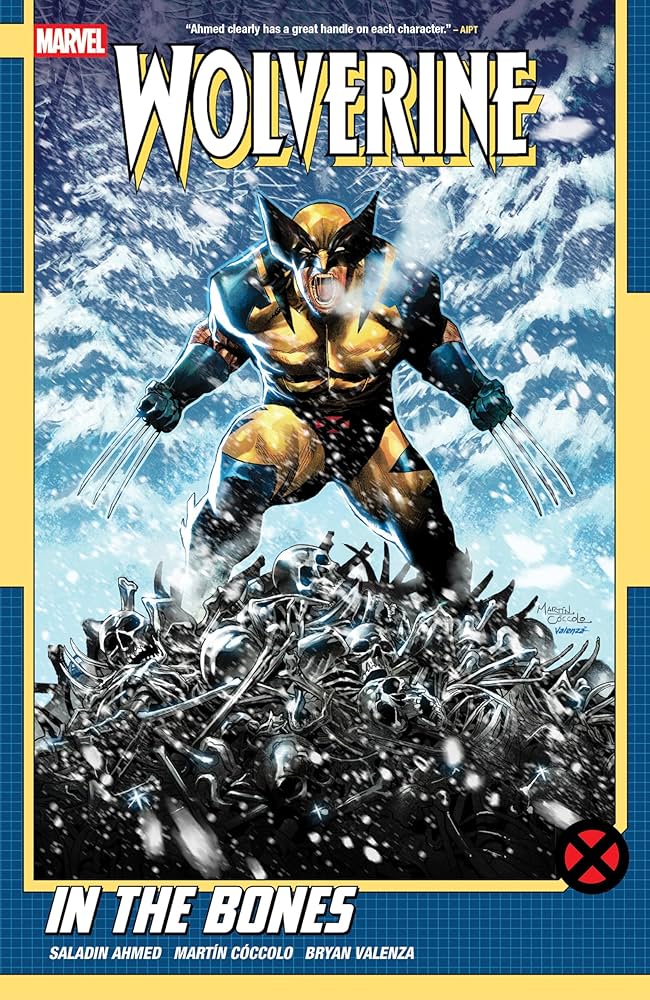
‘Wolverine: In the Bones’ Review — A Familiar But Incomplete Story
by Austin Gorton
Overview
Collecting Wolverine #1-5, Wolverine: In the Bones is suffers from a non-ending and some overly-familiar plot points. But some fantastically-drawn fight scenes, impressive color work, and a compelling new character riffing on a beloved trope are enough to make it an entertaining read.
Overall
6/10Wolves run through a snowy tableau. A man runs along with them. They are being hunted, man and beast alike. In fact, the distinction between the two is unclear.
The opening to Wolverine: In the Bones, collecting Wolverine #1-5 by Saladin Ahmed and Martin Cóccolo opens like many other Wolverine stories. From there, it introduces a new villain — the Adamantine, a kind of animated spirit of the original material which gave the Marvel Universe adamantium — who uses as his agents familiar villains from Wolverine’s Rogues Gallery.
Thus, much of this story reads like the platonic ideal of a Wolverine comic, for better and worse. It delivers exactly what it promises, explicitly and implicitly, but also stops short abruptly just when it’s about to do something new and interesting.

The story opens in the wake of the end of the Krakoa Era, with Wolverine having decided he’s done with the constraints, sacrifices, and frustrations of civilization, and has retreated to a wolf pack in the Canadian wilderness (please note here that wolves and wolverines are in fact different animals despite the shared letters in their names). But as is always the case whenever Wolverine does this, it doesn’t last long.
By the end of the first issue, he is bombarded by familiar figures and plot devices. An old enemy who tormented Wolverine in his youth? Check (here, it’s Cyber, the Peter David-created heavy with adamantium skin who debuted in Marvel Comics Presents back in the 1990s).
A friendly member of the X-Men popping in to remind Wolverine of his connections? Check (here, it’s Nightcrawler). Wolverine reluctantly springing into action despite “having given all that up” to save some bystanders threatened by the villain? Check. Berserker rage? Check. Being forced to let the villain go to save his friend? Check.

Wolverine: In the Bones succeeds most when it tries to put a new spin on a familiar trope. That mostly comes in the form of “Kid Wendigo”, a new character who is a teenager cursed to transform into the savage, blood thirsty Wendigo Wendigo (a monster brought forth by human cannibalism whom Wolverine encountered in his very first appearance).
Wolverine first fights the creature then, seeing the parallels between them (learning this Wendigo is a teenaged boy forced into cannibalism by unfortunate circumstances just as Wolverine was also transformed into a monster by forces outside his control) helps the boy fight to control the monster and keep his more violent nature in check — a struggle Wolverine knows all too well.
This then is another Wolverine trope being showcased: Wolverine as the reluctant mentor to an impressionable teenager, with Kid Wendigo stepping in for 80s era Kitty Pryde or 90s era Jubilee. But it works well here, in part because it is a familiar, rich trope and in part because Ahmed’s spin of it — the mentee in question is a teenage snow monster — and the more direct parallel with Wolverine’s own internal struggles put a different enough spin on it to not make it feel like a complete retread.

Another standout element of Wolverine: In the Bones is the art. Though Cóccolo does struggle occasionally in drawing faces and figures consistently between close-ups and distant shots, the action sequences throughout the story are top notch.
The hits are drawn in such a way that they feel impactful. Cóccolo shifts perspective effortlessly, such as in one standout two panel sequence in which he moves both Wolverine and the “camera” across the axis of Wendigo’s arm at the same time. A later two page spread in which Wolverine learns of the Wendigo’s origins via a journal he wrote before his transformation, rendered as a comic within the comic, is another visual highlight.
Kudos go to colorist Bryan Valenza as well. Despite the relatively bland palette of the setting — a full 3/5 of this story takes place in a wilderness setting where everything that isn’t snow is covered in snow — the art still pops. Even when the action consists of the shaggy white Wendigo attacking against a snow-laden backdrop, Valenza is able to keep the action from blending into a visual blur by making subtle distinctions between the various cool blues and whites of the setting.

Unfortunately, the story ends just as it starts to get particularly interesting, concluding in a final wheel-spinning chapter that ends as it begins, just as Wolverine is drawing closer to the truth about the Adamantine and its agenda, but without actually revealing any of that information to the character or the reader. It’s an unfortunately abrupt ending, one which makes this a difficult story to fully enjoy without quickly following it up with the subsequent (currently forthcoming) volume.
But there’s enough Wolverine “greatest hits” in the opening chapters — and some really engaging, kinetic art — to likely satisfy casual fans just interested in seeing Wolverine do Wolverine stuff, and the developing mentor/mentee relationship with Kid Wendigo offers a novel enough twist on an old standby to serve as an engaging hook for more seasoned readers. All in all, it’s enough to keep the abrupt non-ending from making Wolverine: In the Bones a total wash.

