
An Interview With ‘Sew Torn’ Director Freddy Macdonald
by Rachel Bellwoar
Originally conceived as a short film in 2019, Freddy Macdonald‘s new movie Sew Torn considers the butterfly effect a lost button can have on a young seamstress’ life. For more on what it was like to direct his first feature, check out this interview with Macdonald below:

Rachel Bellwoar: Sew Torn started out as a 6-minute short film. It’s also won awards for its trailer. What has it been like reconceiving the film to all these different lengths?
Freddy MacDonald: It’s been a wild (and exhausting!) journey – and one I never would have anticipated!
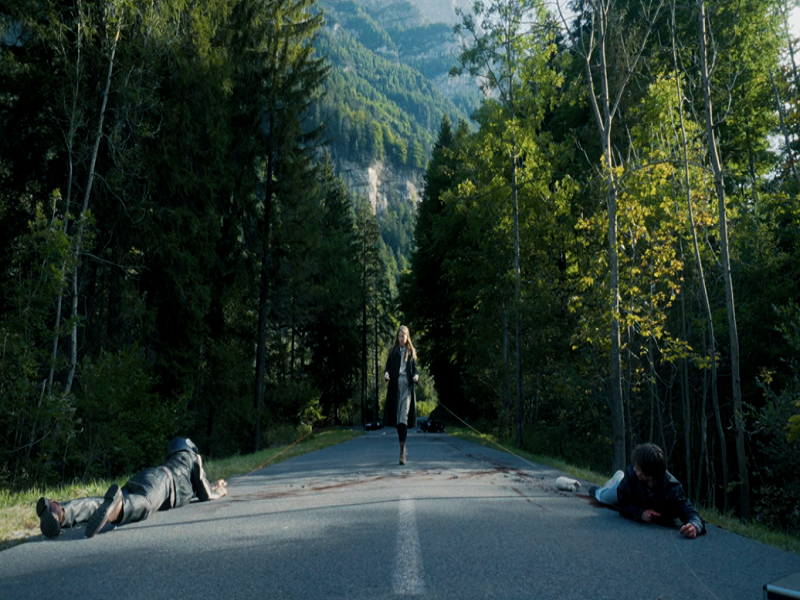
The Sew Torn short film was my application to film school; I made it in high school with the sole hope of getting into the American Film Institute. AFI’s application prompt my year was to tell a story about “a change of heart” – so I immediately started brainstorming a concept with my dad (Fred Macdonald – we have the same name!). We co-write, and both pretty quickly fell in love with the concept of a seamstress coming upon a drug deal gone bad. We shot the short on one day in the Swiss Alps, and after sending it to AFI (and into the world) we never suspected it would land in the hands of my hero, Joel Coen. He asked to meet for coffee, and when we sat with him his biggest advice was to turn the short into an independent feature.
We then spent the next few years writing many drafts trying to figure out the best way to adapt the short. About 20 of those drafts were a linear version of the narrative, which we eventually scrapped because it simply wasn’t working. Once we really thought hard about what the core theme of the short film was – a moment of choice, a change of heart – did we realize we had been thinking about the film in the wrong ways. We completely changed the film’s narrative structure, and finally landed on a script we felt escalated/elevated the plot and themes of the short. We were excited!
Reshooting the short film on the same road in the alps (with the same car) was incredibly stressful, as we did it shot-for-shot – but with more resources. It was probably the hardest day of filming for me – because it felt like I was reliving the past.
And it was such an honor to get a Golden Trailer Award once the film was completed! Thankfully we worked with the brilliant trailer house Good Hands – who did a fantastic job. But having to look at the same footage of that same deal gone bad scenario, and communicate this story in only a few minutes, was arduous. Thankfully I didn’t have to edit it this time!
MacDonald: We were very inspired by the work of the Coen’s when brainstorming the original short, and we just love the tension of No Country for Old Men specifically; we wanted to spin the premise of coming upon a drug deal gone wrong on its head with a protagonist we had never seen before in that set up. We loved the juxtaposition that comes with a seamstress and that set up inherently – her thread and the blood for example. But we also love shorts that subvert expectation with a joke-like structure – so we wanted the seamstress to not only contrast the set-up – but to take advantage of it.
Once we realized this character could have a superhero-esque thread ability – one that is very Rube Goldberg inspired – we had a lot of fun thinking of creative ways she could commit the perfect crime and steal the briefcase.
My dad taught me stop motion animation when I was 9 years old, and I try to maintain a stop motion aesthetic when shooting live action now. So the Sew Torn short felt like the perfect opportunity to lean into that.
Bellwoar: On a practical level, how much string did you go through while making this movie and did a lot of thought go into the colors used?
MacDonald: We went through a LOT of thread – and thankfully we had BERNINA (a sewing machine company) and Mettler (a thread company) as supportive sponsors! Thread was not only used in Barbara’s (the seamstress) thread contraptions – but also in embroidery featured throughout the narrative. BERNINA kindly crafted all of these – and they ended up taking millions of stitches. Our thread contraptions were also designed during the screenwriting process – which we filmed shot-for-shot in our backyard. So there was a lot of thread preparation!
Sebastian Klinger (our incredible cinematographer / producer) and I both were very specific about our color palette in pre-production. We wanted each narrative Barbara goes down to have its own design. We realized we could use the thread colors to dictate this visual design as well – and our brilliant production designer Viviane Rapp really leaned into creating three distinct ‘worlds’ too.
Bellwoar: At its heart Sew Torn is about grief – specifically the grief the main character, Barbara, is dealing with over the loss of her mother. I wanted to ask about the talking portraits Barbara’s mom used to sell as part of her business. They reminded me a little of the voice recording books you sometimes find in stores like Hallmark. What was it like creating those?
MacDonald: Very early on in the screenwriting process we wanted to create a tool that could help represent Barbara’s emotional stuck-ness visually. Barbara has a sewing shop that is going under, and we realized one of her primary products could be these embroidered portraits with a pull tab that triggers an audio recording. We were definitely inspired by those greeting cards! But I loved the notion that this product could be directly linked to Barbara’s deceased mother (who we learn created this sewing shop) – and for Barbara to have these embroidered portraits suspended all around her apartment. This externalized her grief in a suffocating way. And as mentioned above – BERNINA was very kind in making them all for us – with their embroidery machines. It was a lot of work – but every time they sent one to set it felt like a beautiful present.
Bellwoar: Silence plays a big role in this movie. Did you always want to keep the dialogue sparse?
MacDonald: Yes – I absolutely love visual storytelling and we actually ended up cutting a lot of dialogue both in the script and later in the edit. We knew it would be a risk – as the protagonist essentially attempts to kill two men within the first 10 minutes – and with a character that doesn’t speak we knew empathy for her would be an uphill battle. But when Eve Connolly auditioned for the role, and showed us her stunning performances – how she can say so much with one expression – we committed to keeping the dialogue sparse.
Bellwoar: At the same time, this makes the film’s soundtrack really stand out. What was it like working with Jacob Tardien on the music and finding ways to utilize the song lyrics?
MacDonald: It was wonderful working with Jacob; he was very kind to agree to finding the film’s ‘sound’ prior to production. This was amazing – as once we landed on the score’s tone we then had a much better grasp of the tone of the film as a whole. I fell in love with the way he captured a tense, comedic, yet melancholic sound – all while using practical thread and sewing machine noises! I loved it so much that I immediately sent it to the entire cast and crew, and we frequently played his music on set. It really gave everyone – in every department – a better sense of the movie we were making. Jacob was even composing in person – on set as well. It was very special.
In terms of the licensed diegetic music, we wanted to find old songs that also captured Barbara’s stuck-ness. Betty Hutton’s “The Sewing Machine” was a highlight.
Bellwoar: Both the short and feature were filmed in Switzerland. Why did you choose that location?
MacDonald: My mom is part Swiss, and so I have a Swiss passport. I grew up going there a lot as a kid, and my family moved to Zurich when I was 15. I fell in love with filming there – because of the incredible collaborators I met (like Sebastian) and Switzerland’s immaculate on-screen presence. It felt like the perfect, desolate environment to contrast the bloody crime scene carnage.
We filmed both the short and feature in a small town called Vättis, which is wedged in the alps. The surrounding mountains felt like yet another visual metaphor for Barbara’s emotional condition. They can become suffocating at times, with the sun only visible a few hours of the day. I loved that notion as well, and it helped us create this heightened, and fictitious world.
Bellwoar: Other than Thomas Douglas (who plays the thug in both films), the feature includes a new and expanded cast. How early did you know you’d found your Barbara in Eve Connolly?
MacDonald: Sharon Howard-Field and Nathan Wiley were our fantastic casting directors on this – and pretty early on brought Eve into conversation. Our first audition was to act out driving through the crime scene – to see if the actors could tell a story with their face. And Eve was phenomenal. When she finished she was in tears – and I found her performance to be very moving.
Her callback – which I felt incredibly guilty asking actors to do because it would terrify me – was to do an improvised dance. I don’t want to spoil which scene this ties to – but it’s a very complex one in which Barbara has to simultaneously distract, set up a thread contraption, and have an emotional catharsis. Eve nailed it. We knew it wouldn’t be choreographed due to the nature of the scene – and I was blown away with what Eve came up with. It was an honor to work with her and I hope I am lucky enough to collaborate with her again!
Bellwoar: Thanks for agreeing to this interview, Freddy!
Sew Torn is available now on VOD.
