
Hear Me Out: ’28 Days Later’ Actually Sucks Without The Music
by Mal White
Welcome back to “Hear Me Out,” a weekly series of unsolicited movie opinions. We all need a break from our regularly scheduled doom-scrolling. Might as well watch something.
Who was I when I thought 28 Days Later (2002) was good? Mind you, I’ve watched it no less than thirty times since its release. Had the same “rage-infection” versus zombie debate, even coded my MySpace page to play John Murphy’s “In the House, In a Heartbeat.” I loudly defended Alex Garland and Danny Boyle‘s indie infection movie as among the best in the genre.
I was loud and wrong.

In advance of 28 Years Later (2025), my friends and I decided, mistakenly, to re-watch the 28 series. A bit of nostalgia, a bit of catch up. What followed was a terminally confused outbreak aesthetic movie. So many of the film’s decisions don’t withstand the test of time. Some make absolutely zero sense. When a single line edit can resolve a film’s infamously controversial premise, we have to reassess whether this movie is worthy of its nostalgic cult-hit title.
28 Days Later is often credited with starting the Great Zombie Resurgence of the 2000s. As if infinitely better, Ravenous (1999) or Resident Evil (2002), weren’t released. The zombie/outbreak subgenre resurgence built on the momentum of several pop culture movements and those still in their nascency.
Y2K apocalypse anxieties converged with the rise of the alternative anti-hero and budding social media and music platforms. 28 Days Later rode that momentum, but its success is entirely due to Murphy’s iconic score. And, of course, amazing performances, but we knew that.
At the time, Murphy was fresh off Lock, Stock and Two Smoking Barrels (1998) and Snatch (2000), whose soundtracks were hits. The movies showcased his skill in creating atmosphere to enhance scenes through composing and song choice. Lock, Stock’s soundtrack topped UK charts, becoming as iconic as the film. That success was duplicated in the Snatch soundtrack, which I still associate with The Stranglers’ “Golden Brown” and The Specials’ “Ghost Town.”
28 Days Later didn’t have the same budget as those earlier projects, yet it emerged as one of the most iconic horror soundtracks of all time with one of the most recognizable original songs. It’s Murphy’s composing mixed with his proven talent to pair song to scene that drives the film’s most intense sequences. He’s so good that he made a mediocre commentary on violence a hit.

His use of Godspeed You! Black Emperor’s “East Hastings” showcases how Murphy amplifies tension while creating a haunting dystopian atmosphere. We overlook the fact that Selena (Naomie Harris) and Mark (Noah Huntley) blow up a gas station that miraculously doesn’t burn London down to save Jim (Cillian Murphy). Manchester, however, burns to the ground as our anti-heroes stare mystified at the horizon.
In another overused panning shot, a twangy guitar intensifies the church’s “Repent the end is extremely fucking nigh” scrawled on a stair wall. We overlook the fact that someone, in the middle of a rage-outbreak with a thirty second incubation period, said “Get me a ladder, I got something to say.”
“In the House, In a Heartbeat” builds tension so well that we overlook the fact that a trained army outfit completely loses all ability to function. When an infected Private Mailer (Marvin Campbell) — a black man infected with violent rage chained and collared in the yard like a dog as an experiment — is let loose, suddenly no one has training or bullets. They just run around or hide.

In the climactic sequence, the camera angles up as Selena and Corporal Mitchell (Ricci Harnett) look up, then cuts to Jim breaking into the house’s attic. This leads the audience to believe Jim is in the room with them. The song’s building intensity and tension effectively overwrites that choice. As we reach the end with pounding drums and raw guitars, the atmosphere of Jim’s violent return mimics a racing heart and a descent into madness. The tension is so well built that when Selena raises that machete, we’re breathless.
Without the soundtrack, Garland and Boyle’s artistic choices just don’t hold up. Wes Craven’s Scream (1996) already made commentary on the impact of televised violence on disillusioned youth and did it better. The commercial success of the Resident Evil video game in 1996 already revitalized post-apocalyptic horror and returned zombies to the cultural zeitgeist. Its first movie was released in March of that very year to incredible success. Even the “wake up elsewhere” trope was overdone at that point. Notably, in The Day of the Triffids (1963), which is one of the movie’s inspirations, and Jacob’s Ladder (1990).
Visually, the use of digital cameras tanks the experience. Their grainy, low-resolution scenes become unintelligible on modern screens. Digital cameras were popular in the UK at the time for their gritty found footage appeal and realism. The use points to the film’s mimicking of mainstream news coverage as played on-screen for the rage-infected chimpanzees.
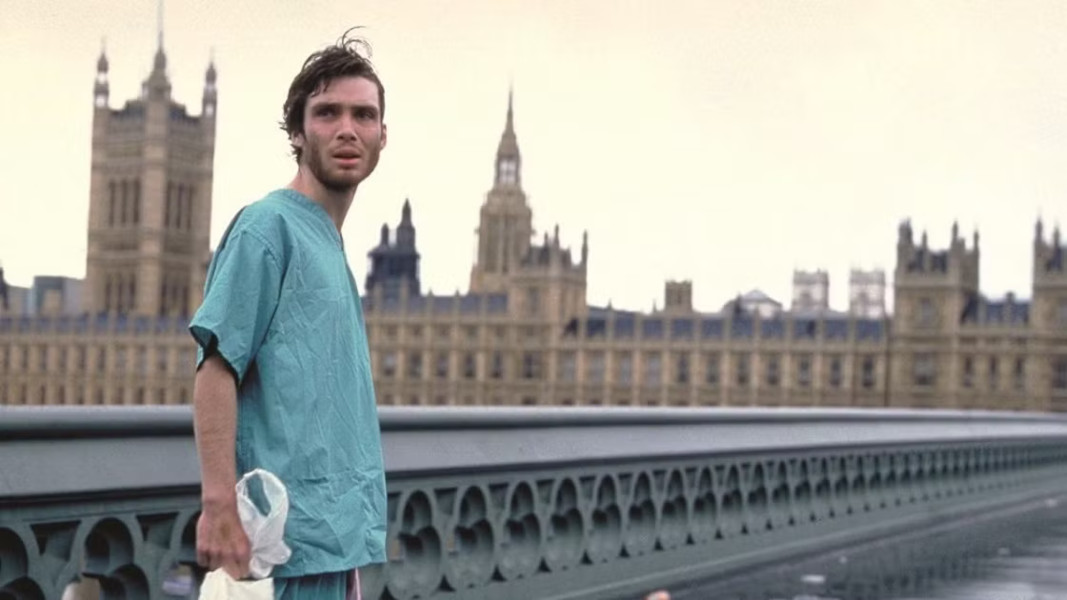
Combined with the “day for night” technique and filters, London turns into a blurry blob. During the gas station explosion scene, the fire stands out with Jim’s hospital scrubs, but nothing else does. The techniques and sharp cuts unnecessarily confuse the story’s messaging and plot.

As we prepare for 28 Years Later (2025), returning to the widely acclaimed film reminded me just how heavily music influenced the movie’s reception. Without its stellar performances and incredible soundtrack, it only introduces us to the fast zombie. It regurgitates old zombie metaphors with arguments from the ’90s that televised violence creates more violence. Worse, it completely ignores the reason that these televised movements existed.
Ultimately, Alex Garland and Danny Boyle’s 28 Days Later is a punk aesthetic movie without the politics.


