
Review — ‘The Pale Night’ #1 Evokes Classic Film Feelings And Existential Dread
by Anton Kromoff
Summary
I’m not sure what is coming next, but if they can maintain this tone and bleak storytelling, this could be one of those books, coupled with its fantastic litany of alternate covers, that could lead to The Pale Knight becoming a timeless classic.
Overall
8/10Welcome to the table,
I think the first time I watched Ingmar Bergman’s The Seventh Seal, I was in my early teens. It was on at three or four in the morning. It was one of those “free movie weekends” we used to get. This was before we had wonderful streaming services that put thousands of titles at our fingertips whenever we want them. The movie made very little sense to me then, or when I watched it again as part of a film class a handful of years later. It was not until I was sitting in a dark apartment in my mid-20s when I saw it on basic cable that I think I picked up what it was putting down.
The long and the short of the plot is that a knight, Antonius Block, is playing chess with Death itself, while plague and the horrors of survivor’s guilt play out across a really surrealistic landscape. There is a really rad scene at the end of the movie where Death, leading the knight and his companions, are seen dancing hand in hand. Death is at the head of the procession, taking them over a hill as a representation of them passing from the living world to the next.
I bring this all up because Mad Cave Studio’s The Pale Knight, written by Peter Milligan, with art by Val Rodrigues, colors by Cristiane Peter, and lettering by Dave Sharpe, feels like a spiritual successor to that film. At least, it felt the way that film made me feel. Let’s get into it.

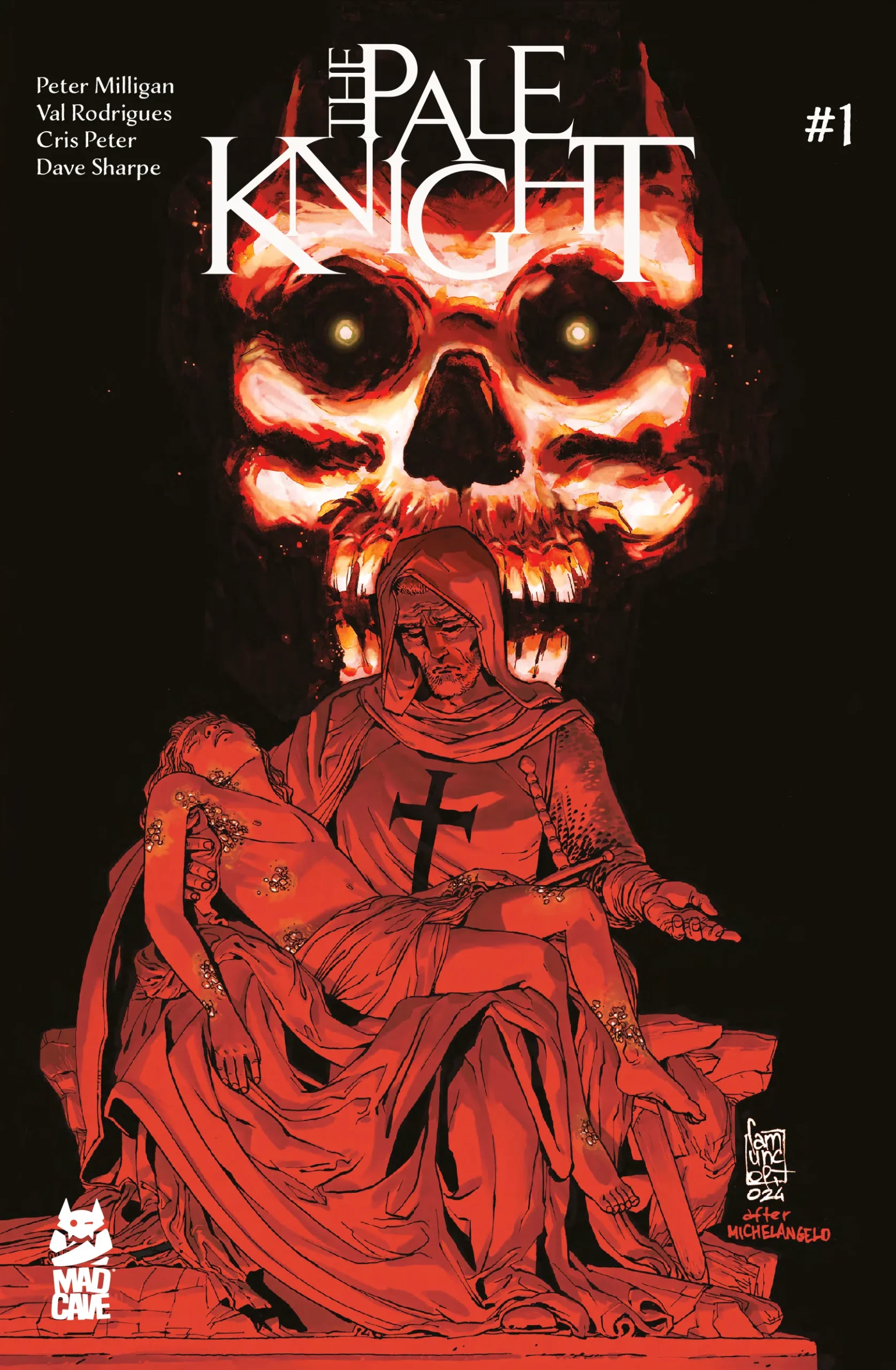
The story is set in England in the year 1349. It centers on Sir Hugh de Grey, known as “The Pale Knight.” After returning to his home from a lengthy war, de Grey finds his home and the lands surrounding it ravaged by the Black Plague.
<<<Spoilers Follow>>>

His son is infected, and the body has already started to rot with maggots burrowing into the festering flesh as his child pleads weakly for relief. His wife has done her best to protect their son by following various folklore remedies that would have been prescribed at the time but would have resulted in no real defense against the infection of the pandemic that annihilated one-third of Europe’s population at the time.
Sir Hugh de Grey, having no other option, prays to a god asking to have his son saved and finds himself in the company of Death itself. Death informs Sir Grey that he will take his son by the next moon. However, if Sir Grey can slay a knight known as Gilbert the Pure, he will spare his child.
Sir Grey agrees and sets off with his squire to find Sir Gilbert, and the first issue draws to a close.

The whole comic has this very ‘film grain,’ archaic feel to it. The characters are illustrated very ethereally with thin line work and very light line weight that is deepened by textured shadows and large swatches of color, giving a shallow depth of field perspective that feels very ‘early film making’ in scope. The whole thing is haunting and a bit uncomfortable in its presentation. That works towards setting a tone that immediately conjures the few times I have watched The Seventh Seal.
Until next time, existential art pieces always give me pause because they run this razor thin line of being either super solid and worth the exploration, or totally full of themselves and a turn off. For now, The Pale Knight is working towards the super solid side of things.

