
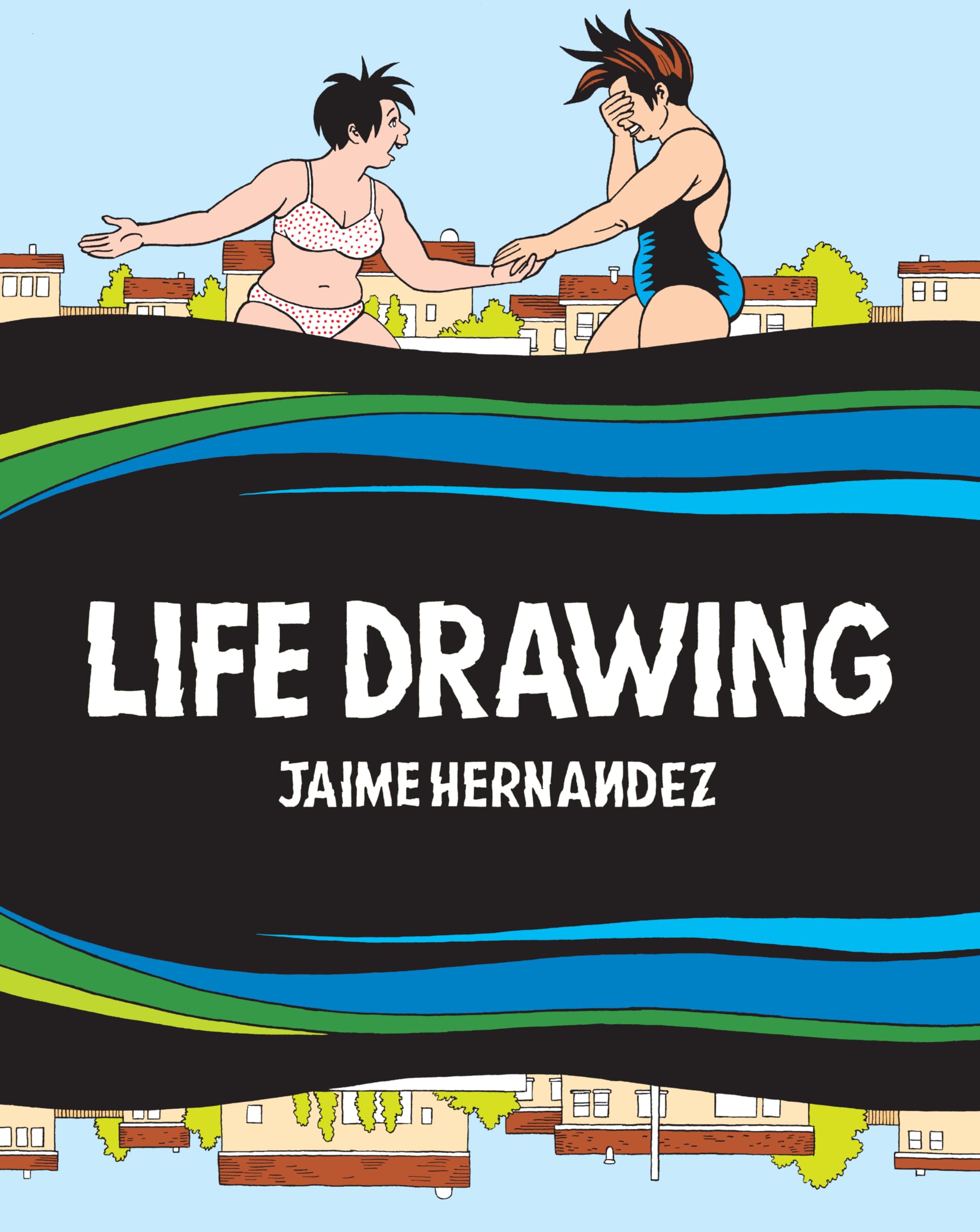
Review: ‘Life Drawing’ By Jaime Hernandez
by Koom Kankesan
Summary
“Ten years in the making (and torn from the pages of the legendary Love and Rockets), Jaime Hernandez’s newest graphic novel skillfully weaves two generations of his beloved characters into a satisfying story of love — both young and middle-aged. ‘Life Drawing’ darts primarily between the youthful Tonta and the venerable Maggie. Tonta has a crush on her art teacher, Ray, as well as an axe to grind with an older woman in the neighborhood. When Tonta finds that the woman, Maggie, is married to Ray, things get complicated. And Tonta does not handle complications well.”
Overall
10/10
Following on the heels of the collection Tonta which came out some six years ago, Life Drawings continues with slice of life mini-episodes centering around the lives of out-of-place teenager Tonta and her friends, while still featuring Tonta’s troubled half-sister Vivian and old stalwarts Maggie and Ray and Hopey as they chug on through their lives. While some of these episodes seem to overlap in time with those in Tonta, this collection hits much more powerfully upon reading the collected volume. In the pages of Love and Rockets through its iterations, Jaime and his brother Gilbert Hernandez have chronicled the lives of their characters as they age in real time. Over the years, their respective casts of characters have expanded. Reading their exploits within Love and Rockets, which sees a wait of many months between issues, means that readers are often absorbing these sagas in free-floating doses, a sense of detached but elusive poignancy hovering through them. This particular collection however, as compiled, reworked, and perhaps subtly refashioned by Jaime, hits much more powerfully when read in collected form.

The problem with seeing classic characters Maggie and Ray and Hopey age in real time is that as middle age hits, the characters seem to slow down. They still have their fights and grievances and petty dramas but perhaps for Jaime, something was missing. Enter a new generation of characters starting with Vivian Solis and Angel Rivera. These latter characters seem to have ridden out much of their oomph too and now we embrace the teenage dramas and insecurities of Tonta and her group. Tonta, in some ways, seems to have replaced bumbling, anxious, embarrassed Maggie in the same way the buxom, sexualized, slightly insane Vivian replaced Penny Century. However, there are many intersections between Tonta and Maggie and Ray (who have been living together common law for a while now), and this is only slightly complicated by Tonta’s crush on Ray and her initial spat with Maggie before she realizes that Maggie is Ray’s partner. Despite their initial conflict, Tonta and Maggie bond (they are featured on the cover holding hands) because Vivian is in no way suited to taking care of her younger half-sister. To complicate things further, Vivian resents Ray and Maggie being together (she’s been involved with both of them at various times) and pulls a pretty dramatic upset towards the end of the collection that I won’t spoil here, as I’ve been chastised for revealing this dramatic twist in the past.

Dramatic twists aside, this collection is really filled with exquisite small moments. Vivian’s intersections with people involved in crime and her penchant for creating havoc and chaos in her own life as well as others take a back seat to Tonta trying to figure out her purpose in life while all her friends are in the midst of going away to college. Many of the vignettes presented here take place against the backdrop of teens drawing their own comics or attending a comic convention, hanging out at people’s houses, the beach, or (life drawing) art classes. The title of the collection is a reference to the latter as well as to the lessons one is forced to suffer while navigating life, awkward social interactions, and learning to find one’s way. Maggie at her ripe old age seems no better at this than Tonta. And of course, it also figuratively refers to Jaime’s penchant for not only drawing in a way that captures people’s bodies and expressions realistically, but also his attempts to write about them in a naturalistic manner. Whereas Jaime leaned heavily on his youthful interest in punk culture for the early work he produced, this volume seems much more grounded in the world of producing comics and drawing art.

That’s not to say that the lives of his characters reflect Jaime’s own life experiences or those of his cartoonist compatriots, but simply attending SPX and SDCC and all the other shows year after year must have engendered some of this material. A question longstanding Love and Rockets readers must ask is: are the new characters and their scenarios as compelling as those of the classic characters in the eighties and the nineties? Perhaps the corollary to that question is: will new readers be able to relate to the younger characters today and thus find their way in to a world with such a storied past? The true answer, if I’m being honest, is: I don’t know. Certainly, Vivian’s sexual indiscretions aside, the stories aren’t as ‘punk rock’ as they used to be simply by virtue of the fact that pop culture and comics have become a lot more permissive in terms of what’s portrayed, so Los Bros.’ work is no longer as transgressive or cutting edge as it once was. The Bros. themselves, like their characters, have had to submit to the ravages and mellowing of age while a host of young, new, rambunctious creators have emerged in their wake.

I also don’t know if Jaime’s young characters will be familiar or resonant to their true life cohort. My suspicion is that middle aged readers like myself form the core of Los Bros.’ readership. His young characters talk and act more like his older characters than the teenagers I encounter. They use references to things like Gilligan’s Island and Of Mice and Men which I don’t think the average teenager will get. They also seem to be consumed with wrestling, sports competitions, and drawing with pencil on paper as opposed to using tablets or being on their phones all the time. I’m not complaining – I like understanding the small concerns and human dramas of these characters as I often find their real life cohort baffling and impenetrable when it comes to social interaction. Plus, this volume beautifully knits together these slice-of-life vignettes into a powerful whole that is extremely compelling to read and plumbs characters’ lives and social relationships. Finally, the sense of humour and timing is top notch. Whereas the previous volume was embroiled in crime drama (did Vivian and Tonta’s mother really kill her two ex-husbands?, and what are her children going to do about it?), this new collection is sublime in its handling of social awkwardness, growing up, and comedy. I honestly can’t wait for the next ten years of Jaime’s installments!