
‘Doctor Who: Black Sun Rising’ Featuring Very Early Stories By Alan Moore
by Koom Kankesan

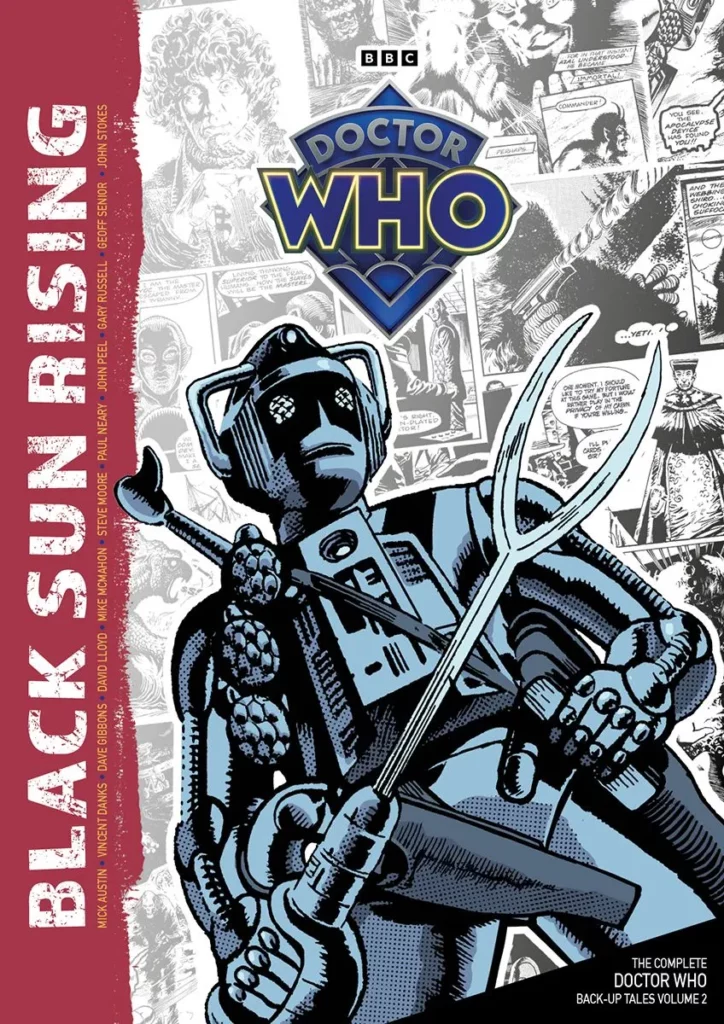
I recently bought Panini Comics’ Black Sun Rising: The Complete Doctor Who Back-Up Tales, Volume 2, for the early Alan Moore back-up stories it contains. I’m not a Dr. Who fan and know next to nothing of the lore, so this is not a review as I am approaching it more from the viewpoint of being an Alan Moore enthusiast, plus I’ve never read or really even heard anything substantial about these stories before. There are eighteen short stories in here, and Moore has written five of them (the last is titled “Black Sun Rising”), though he’s only credited as ‘The Original Writer.’

These stories, very much like the short stories in 2000 AD, are only a few pages long. This was very much keeping in the format of UK publications of the time which generally published anthology titles featuring a variety of ongoing serials or stand alone short stories as opposed to 22-page installments like American publishers did. Other writers of stories in this collected volume include Paul Neary, Steve Parkhouse, Steve Moore, John Peel and Gary Russell. Four of the five stories by Moore are illustrated by David Lloyd (his future collaborator on V for Vendetta) and one is illustrated by John Stokes.

Another reason that it’s difficult for me to review the book is that I’m such a fan of Moore’s and the history of his oeuvre that I can’t objectively judge this work – I can only talk about it. North American friends of mine profess disappointment in the stories but I do not. To be sure, this is some of Moore’s earliest published work as a comics writer (as opposed to his early efforts as a cartoonist where he drew his own strips) so it’s not going to have the same storytelling or writing chops his later work does. The format and writing might also be fairly influenced by his friend Steve Moore, who showed the young Alan how to write comic scripts. Finally, these stories are definitely intended to grow fan appreciation for the BBC Dr. Who series and so all of these back-up stories tie in with the lore of TV episodes, even if the connection is fairly peripheral. This means that Moore had to write stories with a connection to the show in mind even if he wasn’t the biggest Dr. Who fan (and reading these, I don’t get the feeling that he was). This differs from his exquisite stories for 2000 AD around this period, where he created some of his early masterpieces fooling around with time or the wonderfully absurd creation of Abelard Snazz, the man with the ‘double decker brain.’
The first of the stories by Moore, “Black Legacy”, is fairly stand-alone and features the Cybermen. It boasts incredible art by Lloyd (sometimes the British art of this period is the real goldmine!). The second, “Business as Usual”, is set on Earth, and you can almost forget that it’s a Dr. Who story, except that it does have a documented connection to the show. “Star Death”, “4-D War”, and “Black Sun Rising” attempt to establish an origin story for the Time Lords and their ability to do what they do but they are by no means contiguous and instead are more like random slices of this supposed origin story. We get Gallifreyans, Sontarans, the Order of the Black Sun, and cosmic wars that are more in keeping with what Moore would become famous for so we see him beginning to exercise and stretch things, although these very short vignettes seem inadequate ground to really work some of these ideas out. His writing is overwrought as is the fashion of those times, neither as smooth nor innovative as it would soon become. He introduces Wardog and the Special Executive, which Moore will take with him to the Captain Britain run for Marvel UK, and as others have pointed out, will then be transposed to the world of Marvel’s X-universe.

What I really like in this volume are the endnotes by Paul Scoones, commissioning editor at the magazine, who takes time to discuss each back-up story, production details, including sales of the magazine, what each particular story’s tie-in was to the TV show, and why a story was commissioned or rejected, etc. This provides a great deal of historical context, and that helps the non-Dr. Who fans appreciate this moment in comics history. The short stories in general (not just Moore’s) in this volume don’t read well together. They seem very scattered and haphazard, the TV episodes they’re tied to seemingly random and far apart in years, and therefore as a collection don’t pull together, although once again, that might feel different to a devoted Dr. Who fan. We can surmise that Moore probably did not have a lot of editorial control over what he wrote, that he would have to take feedback from Scoones or whomever else he was dealing with and apply the rewrites.
Ultimately, I don’t mind it as I spent formative years in the UK around the time this stuff was coming out and simply seeing its aesthetic takes me back to that: stumbling onto old anthology black and white newsprint comics at second hand stalls and reading their quaint twist-oriented short installments without having a clue what had happened before, marvelling at the art which owes much more to photorealism than American comics of that period. It is interesting, though as a collection that allows people not in the UK to get hold of some Moore stuff that isn’t easy to find. Like the Dark Horse collection Wild Space of Marvel UK’s original Star Wars stories (which Moore also briefly wrote for), a collection like this is invaluable for Moore completists. It looks like a new collection of Moore’s 2000 A. D. stories is also being released, so that’s another thing to look out for.
