
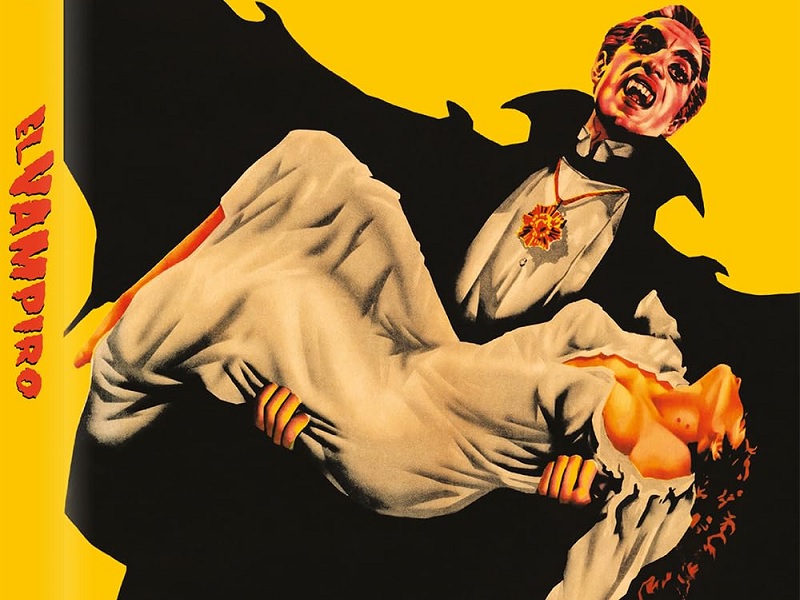
Mexican Horror Double Feature: ‘The Vampire’ And ‘The Vampire’s Coffin’ Reviewed
by Rachel Bellwoar
You’ve seen one Dracula film, you’ve seen them all… if that were the case, then there’d be no accounting for the success of Sinners earlier this year. That film didn’t feature Dracula exactly but, with vampire films, it’s not so much about reinventing the wheel as appreciating the capacity for variation. Every version of the story somehow finds a way to add to the mythology and take what should be a tired monster and make him endlessly relevant. Vampire movies are fun precisely because they are familiar. They build upon each other and are meant to be compared. To appreciate how far Dracula has come, though, means first familiarizing yourself with the classics and that includes not just the Universal monster movies starring Bela Lugosi but international examples like Mexico’s El Vampiro.

Directed by Fernando Méndez, El Vampiro came out in 1957 and is actually set in Mexico. This is a bigger deal than it might sound at first. Take spaghetti westerns, which were often filmed in Italy but would insist on setting their stories in the US anyway, or vampire films from other countries (like Japan’s Bloodthirsty Trilogy) which would keep the traditional European castles of Bram Stoker‘s novel instead of moving the action to Japan. El Vampiro is quintessentially Mexican.
The film begins with Marta (Ariadne Welter) trying to find a ride to her childhood home where her aunts and uncle still live. One of her aunts is sick and she doesn’t want to waste any time getting to her but (in the first sign that a vampire’s about) none of the townsfolk want to travel at night. Luckily she’s not the only one looking for a ride. Enrique (Abel Salazar) is in need of one, too, and when a man shows up looking to pick up some Hungarian soil that was just dropped off by train (nothing suspicious there), he’s able to convince the fellow to give them a lift to the hacienda.
It’s not exactly a spoiler to identify Mr. Duval (Germán Robles in his big screen debut) as “the vampire,” but he’s not the only one, and while he ultimately gets distracted by Marta’s arrival and wanting to turn her into a vampire, the more interesting story is that his initial mission is to bring his brother back to life. He was a vampire, too, but got staked a hundred years ago and now, on the centennial, is his chance to resurrect him. Dracula doesn’t always get a mission (terrorizing women is usually enough) and I wish the film had completely committed to that idea instead of caving to the more usual blood thirst.
As far as vampire rules go, doors and needing permission to enter a home don’t really apply here (Duval can literally walk through walls) but the film has a lot of fun with mirrors and the ol’ “vampires don’t have a reflection” trope. Alicia Montoya is spectacular as Marta’s “sick” aunt (the less said about her condition, the better.
I do think there could’ve been more family drama exploited from Marta’s two aunts (Carmen Serrano talks about the one aunt being a traitor to her family in the excerpt from her 2016 essay in Vampires and Zombies: Transcultural Migrations and Transnational Interpretations that’s included in the essay booklet).
Indicator’s Blu-ray comes with a commentary by Robles that sounds like it was recorded for the film’s 50th anniversary in 2007. While there’s no question of Robles being enthusiastic, a moderator might’ve been helpful to pull out more specific memories. One of the bigger revelations is that Robles learned from a friend who attended a BBC party that Christopher Lee had seen El Vampiro before playing Dracula himself in the Hammer films.
Abraham Castillo Flores (who conducted a lot of the interviews on this set and was one of the release’s producers) appears on camera to talk about Carmen Montego, who played Marta’s other aunt. There’s also an interview with two of Salazar’s daughters (besides starring in The Vampire, Salazar produced it).
Salazar wasn’t able to convince Robles to return for a third film but he did make a sequel. The Vampire’s Coffin sees Enrique and Marta having moved on from their trials with vampires and now working at a hospital. Big Mouth Enrique told one of his colleagues about Mr. Duval, though, and (like the overly curious scientist he is) that colleague (Guillermo Orea) decided it would be a good idea to exhume Mr. Duval’s coffin (which has a really cool family crest on it).
In the first film, one of the major differences between Mr. Duval’s wardrobe and that of other vampires was his medallion and that medallion gets a purpose in The Vampire’s Coffin. There’s also a higher death doll in The Vampire’s Coffin and an understanding that a change in setting can spice things up. Marta’s character gets really muddled in the sequel though (her career move from nurse to actress feels random) and why the film felt the need to throw in a theater subplot when Welter doesn’t appear up to being the lead in a dance revue is anyone’s guess.
For bonus features, Indicator’s Blu-ray includes an interview with the son of screenwriter Ramón Obón, as well as a featurette on production designer Gunther Gerzso by film historian Elisa Lozano. Horror specialist Roberto Coria also provides a featurette on Robles.
El Vampiro: Two Bloodsucking Tales from Mexico is available on Blu-ray from Indicator and comes with an 80-page booklet that includes an essay by Robles’ biographer, Jesús Palacios, interviews with Carmen Montejo and Ariadne Welter from 1998, and an excerpt from Eduardo de la Vega Alfaro‘s monograph on Méndez that considers the agrarian setting of The Vampire versus the urban setting of The Vampire’s Coffin.

