
A Villain That Can’t Be Seen — Interviewing ‘The Mongoose’ Creator Joana Mosi
by Tom Smithyman
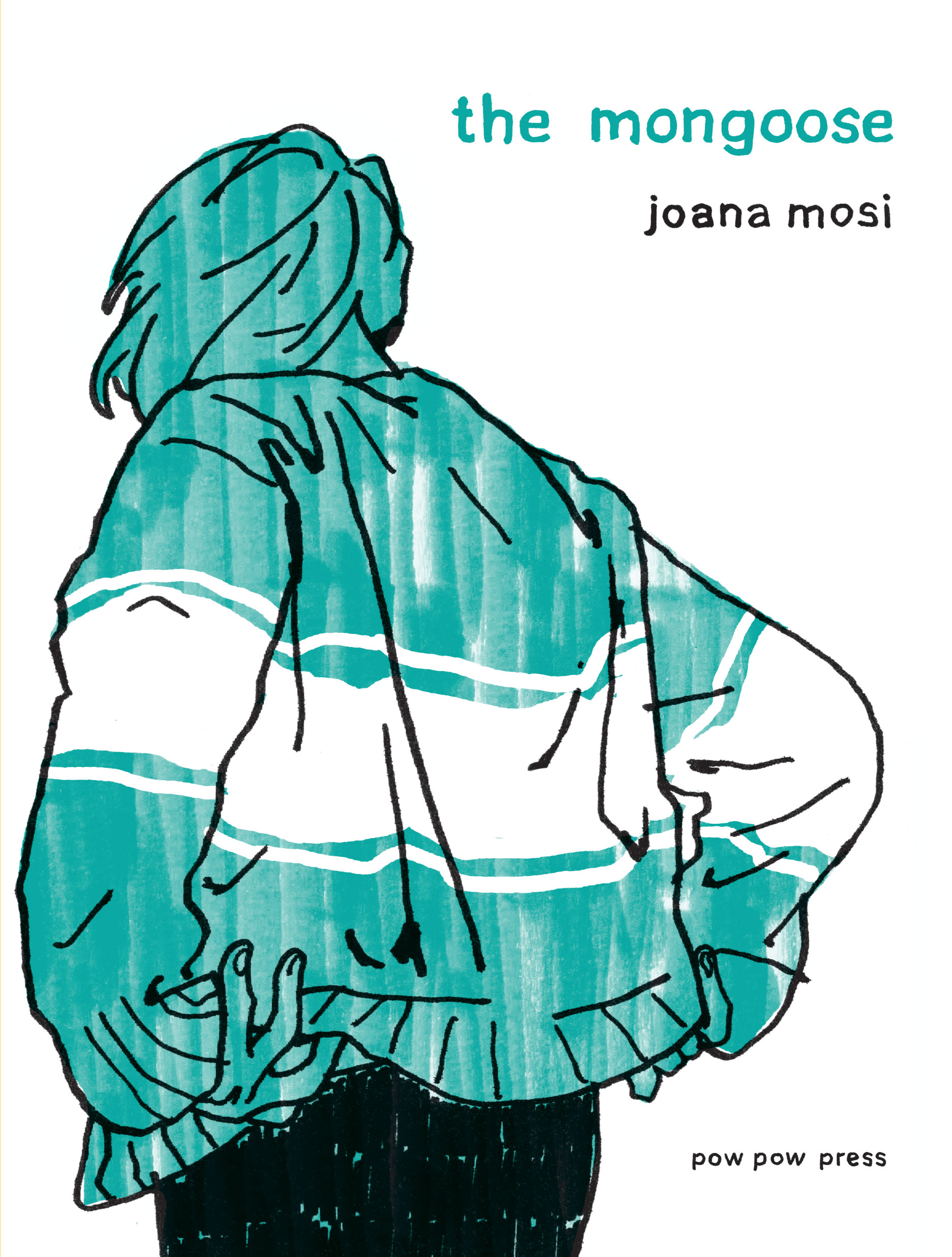
Portuguese creator Joana Mosi tackles the difficult subject of grief in her graphic novel The Mongoose, which is being translated into English for the first time by Pow Pow Press. In the story, Júlia is recovering from a devastating loss while dealing with family and work issues. She deals with her grief by planting a small garden, which is regularly being ravaged by an unseen animal that Júlia is convinced is a mongoose.
In an interview with Comicon.com, Mosi discusses the nature of grief and storytelling as well as why she chose a mongoose to be her protagonist’s unlikely foil.
Tom Smithyman: The Mongoose has an autobiographical feel to it. How much of what you wrote has actually happened in some way?
Joana Mosi: The story is entirely fictional, but I wanted it to have a real, genuine feel to it. The setting, the vibe of the town, the way people behave and talk are very much inspired by the settings I grew up with, especially my hometown, on the central coast of Portugal. Before starting to draw the book, I went out in my neighborhood to truly look at it for the first time. I took a lot of pictures of the houses, studied how the streets and the roads are built.
Portugal has become a famous, hip destination in recent years, but I always felt that its true, rural accidental essence is still somewhat underrepresented – the suburban, improvised layout rural, not the picturesque, touristic rural from our postcards.
Like Júlia, I always found my neighborhood boring and uninspiring, but now I find some kind of charm in it because its ingenuity can’t be found anywhere else. I grew to like it because of the memories I have here. Even though the story and its theme it’s about something else, the setting, despite being subtle, it’s a big part of it. Smithyman: The story is about grief. Every character seems to be experiencing grief and loss to varying degrees. What does The Mongoose to tell us about grief?
Mosi: That’s a really good observation! Yes, every character is, somehow, experiencing some sort of loss – even the annoying, chatty cousin, who seems to feel her own kind of loneliness. As the author, I have my own experience and take on it, but I’m not interested in passing that to the reader… Instead, I tried to tell the story in a clean, neutral tone, and I hope the reader takes their own emotional experience out of it.
Yet, I was more interested in deconstructing the difficulty in the process of grief; I’m not keen to find a solution, and I don’t believe that there’s a single, effective one either. Since the book came out for the first time in 2023, in French and then in Portuguese, I’ve heard so many different takes and interpretations of the story from readers, and some of them made me learn about the narrative, its theme and even grief in ways that I, the writer, was not even aware when I came up with the book. That’s what’s beautiful about making books for me, seeing them become someone else’s.
Smithyman: Why did you choose a mongoose as Julia’s nemesis for this story?
Mosi: As I said earlier, Júlia’s house and neighborhood are pretty much the place I live and grew up in, and that includes some occasional sightings of wild animals, such as mongooses, specifically the Egyptian mongoose. I saw one briefly myself and became intrigued with it. Despite living in a rural setting, I attended school, high school, and later started to work in cities, and often experienced people disbelieving me whenever I told them about seeing such animals as eagles, foxes, rabbits… and eventually a mongoose. Like Júlia, I was surprised to learn that they’re super common around here; they provoke damage in people’s farms, yet they don’t let themselves be seen so most people don’t even know about them.
I like the idea of a “villain” that can’t be seen, only its damage. I liked the potential for gripping psychological warfare with it, and the questions it ultimately raises. I thought it could work as a good metaphor for whatever Júlia’s going through… One funny thing is that some people, after reading the book, have come to ask me if mongooses do exist, which only proves to me that the metaphor makes sense.
Smithyman: It’s a huge task to write and draw an entire graphic novel. Why did you make the decision to do both?
Mosi: I don’t know how to do it any other way.
Smithyman: As an artist, you often use a lot of negative space to separate panels. What were you trying to convey with that technique?
Mosi: The beauty, challenge, and fun of building comics is to play with time as a visual experience. I love making comics because every new project is a new set of puzzles to figure out. While coming up with a new project, I work around a theme, or ultimately a problem. The story is a consequence of testing and attempting to deconstruct that problem, that theme.
The Mongoose is not only about grief, it’s about what lies behind it. There’s a lot of silence, distance and friction that I wanted to convey not through narrative, but through texture. The stiff grids, the impersonal drawing style, the silent black panels, and exhaustive parallels are some of the devices I like to use to create that texture.
Smithyman: Did you find that writing and drawing The Mongoose was a kind of therapy for you after your father’s death? Was it another coping mechanism, like going to formal therapy? And if so, what did you learn about yourself during the creative process?
Mosi: I don’t know if I have a straight answer to that, but I can say that writing, drawing and creating are what help me process and understand the world. Human beings are drawn to seek sense, and reason, and storytelling is a response to that. We need causality; we need to feel that A happened because of B, and that will lead to C. Building stories, even if they’re about dragons or giant robots, is an attempt to build sense and continuity, and eventually feel some control in the chaos.
I don’t believe in art as an escapist resource; I think art and creativity are outlets for humans to feel more connected to reality, to our surroundings, to our time, to others and ultimately to ourselves. Good music, films, books, and paintings remind me constantly that I’m alive, that I feel things, but also make me question my engagement as a person, as a daughter, a friend, a colleague, a girlfriend… what is my stake, my values and beliefs in the world?

We create because we feel and think things, but mostly because we have questions; we want to create a sense of what we don’t understand. That curiosity is what stems creativity for me. Maybe there’s not much difference between a scientist and an artist? Maybe that difference is only a matter of approach. Anyway, I keep learning every new project I get my hands on, and that’s what drives me to continue.
Smithyman: Thank you for talking to us about The Mongoose!
*The Mongoose is currently available for pre-order from Lunar at this link.
