
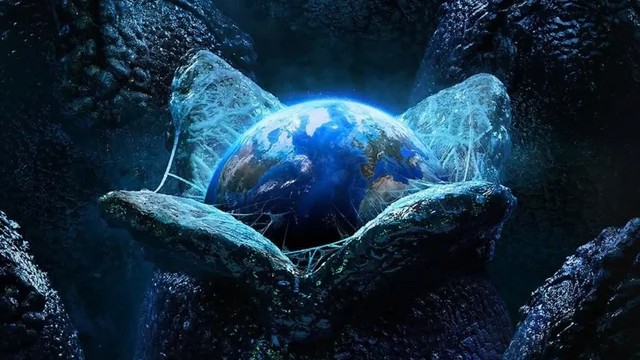
‘Alien: Earth’ Successfully Delivers The Franchise’s Big Budget Scares To Earth — And TV
by Austin Gorton
As the first episode of Alien: Earth opens, you’d be forgiven for thinking you were just watching the original 1979 Alien. From the familiar title font to the long exterior shots of a bulky ship, to the crew inside waking from their cryogenic pods, the opening moments of FX and creator Noah Hawley‘s long-gestating TV expansion of the long-running film franchise seem designed to create an aesthetic baseline for the series and assuage any concerns of long-time fans, to say, “we know what we’re doing.” (My personal favorite bit of the show’s “the future as imagined in the 1970s” aesthetic? The lighting of cigarettes immediately after emerging from cryo, just like in the original.)
But Alien: Earth isn’t content to just rehash the familiar. It quickly moves past its initial pastiche to introduce a world, characters, and conflicts that are both familiar and new, successfully striking a balance between the kinds of jump scares, body horror and philosophical musings which characterize the franchise and new ideas, new aesthetics and even new filming techniques to create the best kind of IP expansion: something comfortably familiar but also boundary-breaking.

Much of the first episode, “Neverland”, is about setting the table. We meet, in brief, the crew of the Maginot, a Weyland-Yutani vessel not unlike the original film’s Nostromo, on a mission to collect alien life. In particular, we’re introduced to Morrow (Babou Ceesay) and, via a series of quick-jump flashforwards, see snippets of the inevitable: when the aliens get loose and fight back. We then jump to Earth, where in the year 2120 a quintet of corporations rule the planet and fight for dominance, a conflict that resides, in part, in the details of humanity’s relationship with artificial life, with the race for immortality being carried out by cyborgs (humans with robotic enhancements, of which Morrow is the chief representative), synths (ie fancy humanoid robots, familiar to fans of the franchise, here taking the form of Timothy Olyphant‘s Kirsh), and hybrids, new creations of boy genius/trillionaire Boy Kavalier (Samuel Blenkin), who has developed a process to transfer human consciousnesses into synth bodies.
This is our entry point into the ostensible protagonist of the series, Wendy (Sydney Chandler), the first hybrid. Due to the limitations of this nascent technology, only the minds of (terminally-ill) children are transferred into the (adult) synth bodies. Before the end of the episode 1, the Maginot fulfills the promise of the series’ title and crashes on Earth, and Wendy has a number of sick-children-turned-robot playmates, called the Lost Boys who have all, like Wendy, adopted names from Peter Pan (the Peter Pan references are everywhere in this opening pair of episodes, up to and including actual scenes of the animated Disney version that plays as Wendy is “born”, an inclusion born of corporate synergy in this story about, in part, the dangers of corporate synergy).

It’s easy to see why FX decided to launch this series with its first two episodes; if “Neverland” is the table-setter, then “Mr. October” is the episode that quickly gives fans what they want: aliens — including but delightfully not limited to the famous xenomorph — running amok on Earth and scaring the beejesus out of us. Wendy’s human brother, Hermit (Alex Lawther) is a medic in a squad of marines, not unlike the Space Jarheads of James Cameron’s Aliens, who leap into action in the wake of the Maginot crash, picking their way through the wreckage of the residential tower into which it lodged itself. Wendy, watching her brother from afar, convinces Boy Kavalier to let the Lost Boys aid in the recovery effort; Kavalier agrees because he, of course, wants to get his hands on those sweet, sweet aliens.
What follows is an Alien film in mini, as a combination of marines, Lost Boys, and Morrow encounter a variety of murderous creatures. But again, Hawley isn’t comfortable just recreating the films — as impressive as it is to see that done on TV budget. In addition to the expanded roster of creatures, he uses the Earthbound setting to give us something relatively rare in the franchise. While there’s plenty of instances in which the xenomorph threatens characters we like, inducing fear, rarely are we afforded the chance to revel in its mayhem. That changes here, notably in a sequence where Hermit tries to evacuate a party of rich assholes in Louis XIV cosplay who don’t even realize a spaceship has crashed into their building, only to duck out of the way of a xenomorph which proceeds to tear apart the party. The image of the chief rich guy crawling away from his severed lower half is both disgustingly gory and rife with “eat the rich” schadenfreude, which is a relatively new tone for xenomorph attacks to strike.

Hawley also stretches the visual palette of the franchise. In addition to quick-cut flashforwards, he overlays flashbacks onto close-ups, so we see, for example, Wendy remembering an event from her childhood with Hermit and the event she’s remembering at the same time. He also — perhaps less successfully — deploys pop culture references in a way the films — always devoted to their future aesthetic — tended to eschew. Peter Pan is an easy story to mine for references, but if you had Ice Age: Collision Course (the fourth film in the animated comedy series about talking prehistoric animals on the verge of extinction) on your “plays a key role in the emotional arc of a character in this series about aliens that explode out of people like monstrous babies” bingo card, well, go buy a lottery ticket.
The scope of the series — at least in these first two episodes — is also somewhat limited. If the conceit of the series is “xenomorphs on Earth!”, at the moment, “Earth” looks an awful lot like the inside of a spaceship and some random chunks of an apartment building (after all, the inside of a windowless ship hurtling through space looks the same as the inside of a ship sitting inside a building). But that is a minor criticism, one that can be easily ameliorated by later episodes — or even seasons.
For now, Alien: Earth succeeds by striking the right balance between the new and the familiar, of giving us what we crave while also doing new and interesting things with the tropes and themes of the franchise.

