
Talking Mad Cave Comics’ ‘Red Vector’ With Tim Daniel, David “DB” Andry, And Chris Evenhuis
by Rachel Bellwoar
Rebels and prime ministers aren’t historically known to get along. However, in their new series Red Vector, writers Tim Daniel and David “DB” Andry are joining forces with artist Chris Evenhuis, colorist Sjan Weijers, and letterer Buddy Beaudoin to depict just such a scenario. Will rebel leader Rhett and Prime Minister Verseen be able to put their differences aside so they can create a working spaceship and get back home? For more on their sci-fi series, check out this interview with Tim, DB, and Chris below:

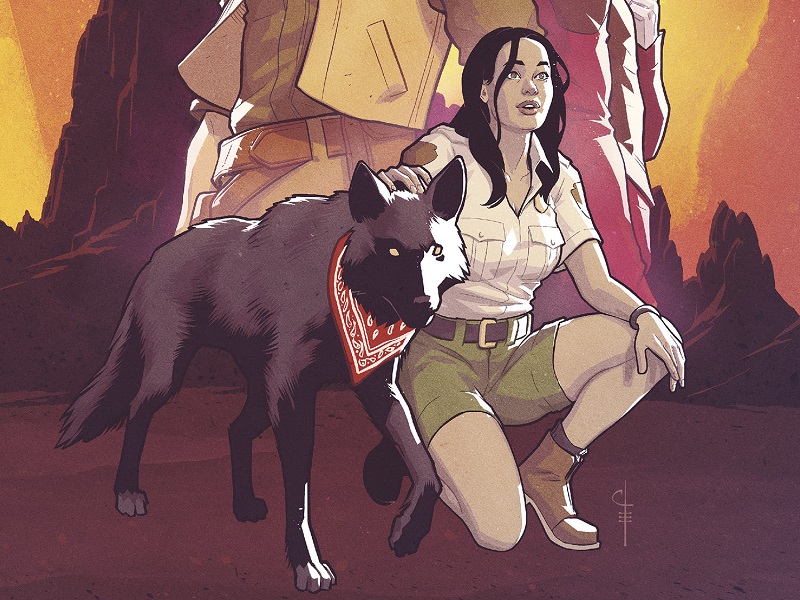
Rachel Bellwoar: Sci-fi movie posters are iconic for a reason and I feel the cover for the first issue of Red Vector really reflects that legacy, especially with regards to making all of the characters feel larger than life. How long did it take to nail down that image?
Tim Daniel: It’s pretty easy to trust such talented artists as Chris and Meghan [Hetrick] with even the roughest idea. When you see the results they both produced, we were so grateful because their covers evoked the kind of response in us that hopefully will register in reader’s minds – Red Vector is part of a genre continuum dating back to the serials of Flash Gordon or Buck Rodgers and carrying on the legacy of the modern master poster illustrators such as Drew Struzan.
Chris Evenhuis: I don’t remember exactly how long it took to put that cover together, but when I first read Tim and DB’s pitch, it was clear to me that this series was going to need those classic Struzan/[Richard] Amsel character-centric poster style covers. We wanted especially the first one to instantly invoke that vibe, while also introducing our main characters and hinting at the way they relate to each other. That said, Meghan Hetrick especially knocked it out of the park with our movie poster variant cover.
Bellwoar: It sounds like Red Vector is going to take place on Earth. What made you choose Earth over another planet, and will this be an Earth that’s familiar or will we start noticing differences early?
David “DB” Andry: No matter how fantastical the concepts that Tim and I have, we always like to ground our stories. I don’t think there is a better way to ground this wild, sci-fi tale other than to have it take place on our Earth, during our time.
Daniel: Red Vector’s Earth is our reality, a near future of the planet we know. I don’t think of it as different in any way from the world we currently occupy, and I’m personally in love with that because when I saw Star Wars in 1977, I wanted Earth to be a part of that galaxy far, far away so, so badly.
Bellwoar: Red Vector is also tackling assumptions around what an alien looks like, and it’s not a little green man with a big head. How someone looks shouldn’t change how they’re treated but why did you want your aliens to appear more human?
Andry: I think it’s easy in sci-fi to make your enemy look like a monster, that’s easier to hate and fight against. But when that creature doing terrible things looks just like you, it makes you confront the terrible things that humans are capable of.
Daniel: This is intentional—making Rhett and Varseen both humanlike in appearance, and especially one being a person of color too. We should be able to imagine and see that in science fiction and Cora Martinez, our Sonoran Desert Park Ranger, has something very important to say about this very thing…
Bellwoar: Sometimes the future is imagined as sterile and cold. Then you have the 60’s, where the future was colorful. Is there an aesthetic you prefer or that you wanted to harken back to with this series?
Daniel: We definitely mined the depths of Ralph McQuarrie and Syd Mead for some of the initial design concepts that Chris exploded beyond imagination. That era you refer to, from the early 60’s to the mid 80’s, especially on the movie screen, was so iconic and indelible–but it too was heavily referencing the prior eras of the 30’s and 40’s. Stuff like Logan’s Run, The Black Hole, Star Wars (obviously), Battlestar Galactica, and even The Last Star Fighter are retro-futurism. Red Vector has a touch of that, but is primarily naturalistic and imminently recognizable as an extrapolation of the present day.
Andry: I always enjoyed the hopefulness of the Star Trek world. That there would be a future where we’ve solved all the problems of Earth by working together and accepting our differences. But when I played in the backyard, I was always Han Solo, not Captain Kirk, so a clean aesthetic, but with the conflict of Star Wars is where Red Vector lives.
Bellwoar: Why do you think the idea of holograms remains so appealing when so many other conceptions of the future have evolved?
Daniel: Give me a sweet dashboard-mounted or handheld holographic device where I can see the real person or object represented in 3D. Though we don’t even yet have this kind of tech, it already feels quaint and oddly nostalgic.
Andry: What Tim said! Holograms are cool!
Bellwoar: What was it like designing the different spacecraft?
Daniel: Spacecraft are their characters and require a well-crafted silhouette and design that communicates that to the reader. Rhett’s Scyther is a crescent inspired by the tool or weapon, communicating that Rhett is of the labor class and a rebel. Varseen’s Blackknife is quite the opposite—a sleek but muscular corvette reflective not only of his wealth but engineering prowess. And as for the Rift itself, which is a space station, its starburst shape is a wink and a nod to another well-known weapon of mass destruction.
Evenhuis: Tim had already prepared some great sketches for the main spacecraft for me to riff on. I should probably mention that Rhett’s fighter was originally supposed to look more similar to the other Scythers, with wings vertically oriented. But I somehow interpreted Tim’s original sketch with the wings horizontally oriented, and even with the back and front flipped. The result ended up looking good either way, so we decided to keep Rhett’s ship like that and even expand on it in later issues.

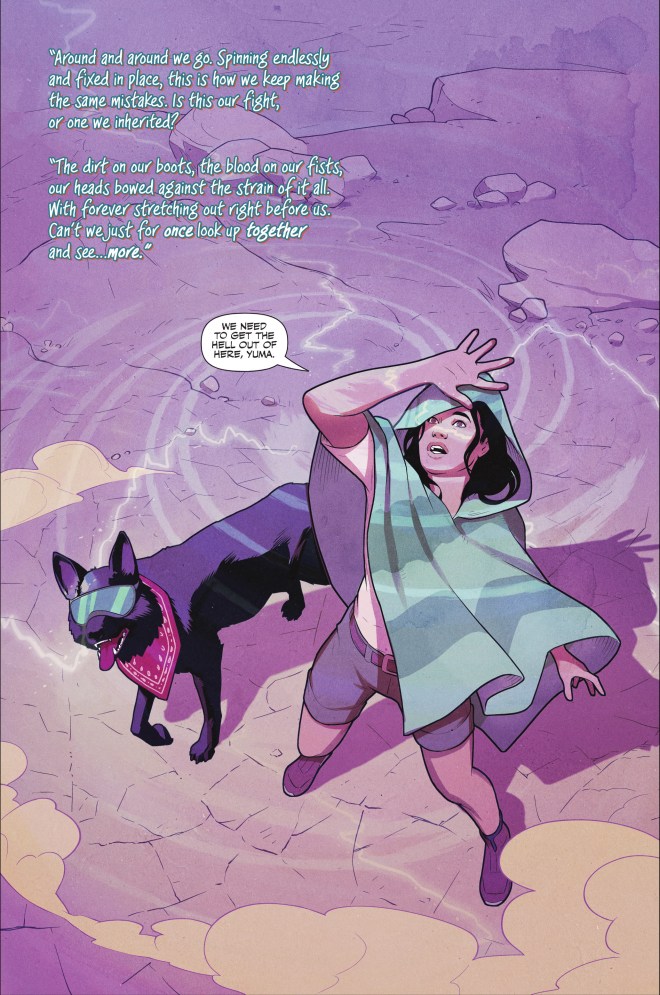
Bellwoar: One thing that the recent Superman movie really reiterated is there’s always space in every story for a dog. How does Yuma fulfill that role in Red Vector (other than the obvious he’s a dog wearing sunglasses – doesn’t get much cooler than that)?
Daniel: Sunglasses!?! Those are doggles! And that’s Yuma, who is the anti-Krypto. Both are heroic, loving, and loyal, but Yuma has the stoicism of Chewbacca. She’s a bit more focused than Krypto and always on a mission.
Andry: I’ll take any opportunity to put a dog in the things I write!
Evenhuis: Yuma is such a good girl, and you’ll find she’s also an excellent judge of character.
Bellwoar: Anti-heroes tend to get the best lines (and it seems like Varseen might be josteling for that position), but villains often get the best outfits and, without a doubt, Commander Perric looks cool in a sinister way (though, also, we don’t really know what he looks like yet since most of his features are hidden). What inspired that incredible silhouette and hat combo?
Daniel: Sure, villains get the juicy lines, but who’s to say there aren’t other characters readers will have to wait an issue or two to meet (DB’s Dalton Hemingway is a Bill Paxton-inspired scene-stealer) … and Lord Commander Perric’s helmet is more than ceremonial, more than wardrobe or design flair. That helmet and halo cloaks something extremely vital to this story.
Evenhuis: One of the things I’ve always loved about Ralph McQuarrie’s work on Star Wars was how many of his designs appear to be based around very simple shapes combined or subtracted from each other, resulting in something almost surreal, but instantly recognizable and iconic. This was also how I aimed to approach Perric’s helmet, as well as some of the other interior/exterior designs in the space setting.
Bellwoar: What are you most excited to hear from readers about?
Daniel: That readers tell us they’ve fallen in love with these characters and our story, and because of it, we get to explore them beyond the limits of a 5-Issue series. Help us, reader, you are our only hope!
Evenhuis: Same as Tim. Aside from that, I always get super excited when readers talk about characters we created as if they’re actual people.
Bellwoar: Thanks for agreeing to this interview, Tim, DB, and Chris!
Red Vector #1 goes on sale August 27th from Mad Cave Comics.
