
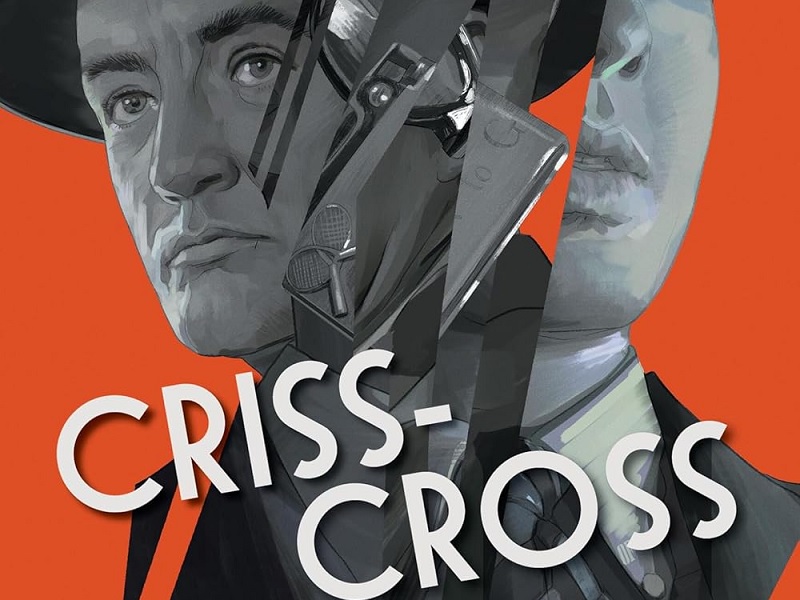
Talking ‘Strangers On A Train’ With ‘Criss-Cross’ Author Stephen Rebello
by Rachel Bellwoar
It never hurts to revisit a film you haven’t seen in years. While I remember thinking Strangers on a Train was a good Alfred Hitchcock movie, it was even better this time around. Adapted from a Patricia Highsmith novel, Strangers on a Train is about two men who meet for the first time on a train. One (Robert Walker‘s Bruno) proposes that they swap murders. The other (Farley Granger‘s Guy) thinks nothing will come of the interaction, but Bruno isn’t a man to be ignored. Stephen Rebello‘s new book, Criss-Cross, goes into the production details and here’s what he had to share:

Rachel Bellwoar: In the author’s note you explain why you chose to write a book about Strangers on A Train over one of Alfred Hitchcock’s other movies, but why another Hitchcock film after having already written a book on Psycho?
Stephen Rebello: It’s funny that you ask why I’ve written a new book on Hitchcock’s Strangers on a Train film after having already written a book on Hitchcock’s Psycho.. Funny because the questions I most often get are, Why haven’t your written another Hitchcock book since Alfred Hichcock and the Making of Psycho? And: When are you going to write another Hitchcock book?
Since the initial success of Alfred Hitchcock and the Making of Psycho — published 35 years ago and still in print — the book has enjoyed many subsequent U.S. and foreign language reprints and got optioned several times before the 2012 film version. That success has led to publishers and filmmakers asking me to write again about Hitchcock ever since. Many other writers have published multiple, excellent books on Hitchcock, as others have done on the subjects of John Ford, Frank Capra, Bernard Herrmann and film noir, The experience of writing about the making of Psycho was such a great one that I only wanted to write again about Hitchcock or another of his underappreciated films if there were new things to discover and to say. Most of all, it had to have a strong story and involve larger-than-life characters.
I found that with Strangers on a Train — so that’s why I’m writing again about a Hitchcock for the first time since in 35 years. I’m excited to be bringing out his new book about the making of a very risky, completely different (but, yet, related to Psycho) Hitchcock masterpiece made by a director during an especially challenging time in his career and while Hollywood was dealing with politically combustible circumstances because of the blacklist, anti-Communist witch hunts, rampant sexism and homophobia. Judging from the enthusiastic pre-publication response to the new book, I’m thrilled to say that even people who really know Strangers on a Train, let alone all things Hitchcock, have been surprised by the first time-ever information and details I’ve revealed — some of which may be controversial.
Bellwoar: Raymond Chandler isn’t the only writer who has a screenplay credit during the opening titles (Czeni Ormonde does as well, while Whitfield Cook has an adaptation credit) yet one could assume his would’ve been the name that would’ve stood out to moviegoers unaware of his tempestuous working relationship with Hitchcock. What was it like trying to work through the different versions of the script and determine who was responsible for what?
Rebello: Just as Raymond Chandler and Billy Wilder famously went head-to-head on Double Indemnity, so was there nothing but bad blood between Chandler and Hitchcock. Studio boss Jack Warner insisted on crediting Chandler strictly for publicity purposes despite Hitchcock’s opposition because the director insisted that nothing Chandler wrote got used in the film.
It was exciting to have access to so many different iterations of the screenplay. The subtle and not-so-subtle ways Hitchcock directed his writers to move away from Patricia Highsmith’s original novel – for cinematic purposes as well as for censorship problems – was so clear and illuminating. It becomes obvious that the work of Whitfield Cook, Czenzi Ormonde, and longtime Hitchcock associate Barbara McKeon saved the movie when Jack Warner constantly threated to shut it down and take the financial loss. Hitchcock went into production with a script he thought had not reached its potential and with a cast headed by several actors who were not his first choice.
Bellwoar: It’s hard to imagine Montgomery Clift could’ve done a better job than Robert Walker as Hitchcock’s original choice for Bruno, but what do you think Strangers on a Train would’ve been like if Hitchcock had been able to cast William Holden as Guy like he initially wanted instead of Farley Granger?
Rebello: Robert Walker delivers a phenomenal performance — one of the greatest in all of Hitchcock’s work. Montgomery Clift was one of the great actors and bigger box-office stars of his generation and Hitchcock knew that having him in the film would have brought it much more attention. For me, it isn’t a question of whether Clift would have done a better job than Robert Walker. The point is that he would have played Bruno entirely his way and today we would know that performance as the definitive take on Bruno. We’ll never know what fireworks might have been unleashed in Clift by that role or what his pairing would have looked like with a co-star as charismatic as macho William Holden, whom Hitchcock pursued unsuccessfully for several movies. I only know that Hitchcock was awfully good at casting and that thought the cast he got wasn’t as strong as it could have been. Ironically, when Clift agreed to star in Hitchcock’s I Confess, Hitchcock found Clift’s Method techniques pretentious and maddening. So we are left to wonder whether Clift — who could be very funny and playful offscreen — could have relaxed enough in the role to tease out the dark humor that Robert Walker did. Would the bisexual Clift have been as comfortable and provocative leaning into Bruno’s sexuality as the heterosexual Walker was? Would the two-fisted, sad-eyed Holden have been as convincing as a weak-willed, ambivalent Guy Haines the way the more passive Farley Granger was? I can foresee that Ruth Roman, opposite actors as gifted as Holden and Clift, would have been even less memorable. As you know, Roman was not the actress Hitchcock wanted at all.
Bellwoar: I loved some of the behind the scenes stories you were able to uncover, like how Laura Elliott, who played Guy’s wife, was essentially blind while wearing the bottle glasses her character famously sports. It’s something you don’t even think about while watching the movie – that the actress in it couldn’t see where she was going. Does finding out these tidbits change how you watch the movie?
Rebello: Not in the least. I’ve written screenplays and am about to do a new one. I’ve been on dozens of movie sets. When I watch any movie, I want to forget the things I know happen in the production of movies. How directors don’t get always get the actors they want. How actors convince view of their “screen chemistry” even when they sometimes loathe or are indifferent to their costars on the set. Things go wrong on sets. Problems crop up constantly. Actors as good as Laura Elliott — who I think is perfect in this movie — learn to roll with the punches. As a trained, intelligent actor and a well-rounded person with a sense of humor, she knew that the glasses helped her characterization. So, instead of whining or complaining, she and Hitchcock worked out solutions that kept her safe and assisted her performance. She knew that Hitchcock wasn’t being arbitrary or “punishing” her. She dealt with the challenge and used it to her advantage. That’s the kind of actor Hitchcock appreciated. Even when he was critical of the movie, he always praised hers and Marion Lorne’s performance as Bruno’s insane mother.
Bellwoar: It also was interesting to learn how much Hitchcock thought about color when it comes to the costumes even though the film was shot in black and white. Are there any color stills available from the production or that were taken years later of the costumes or did you mostly have to rely on word of mouth?
Rebello: Hitchcock was a technical master who weighed in on everything. He knew which colors absorbed or bounced light; he insisted that costumes in his films express psychology and character, not mere fashion. I never found costume sketches on Psycho or on Strangers on a Train, both of which were made on tight budgets. I’ve never seen any color images shot on the set of Strangers, only lobby cards hand-tinted by artists who had no access to information about the actual colors used in the film. Hitchcock’s notes indicate specific colors for the men’s suits, ties, pocket linens and sometimes even the screenplays suggest colors. I don’t rely on word of mouth. In the case of Bruno’s and Guy’s costumes, I relied on studio records and interviews in which the actor or the costume designer identify actual colors, fabric and details. One of my favorite little details I unearthed for the book was how Hitchcock personally designed Bruno’s garish lobster necktie — and how the tie related to the character and even the character’s movements in an important scene.
Bellwoar: Of the film’s set pieces, do you have a personal favorite?
Rebello: Those two long sequences played out on the carnival midway are masterclasses in screenwriting, set design, direction, performance, cutting, musica scoring, cinematography, sound design and slow-build suspense. Just spectacular.
Bellwoar: Do you think Guy’s lighter prop will ever resurface or is that likely lost forever?
Rebello: Being a hopeless romantic and an occasional optimist, I want to think so. If it does resurface, though I’d love to have it, it needs to be preserved, protected and on display in a world class film museum.
Bellwoar: You bring up some other films towards the end that have attempted to remake Patricia Highsmith’s novel. I’ve also seen the premise used for various episodes of TV shows. Are there any that you feel have worked, if not as well as Hitchcock’s, at least interestingly (or with more loyalty to the source text)?
Rebello: No but I wish that David Fincher and Gillian Flynn had done that Strangers remake that the press widely announced after their success with Gone Girl. Who knows if it would have been a more faithful version of Patricia Highsmith’s book — or if it needed to be? So many elements of her novel are inherently un-cinematic, let alone preposterous. Based on Fincher and Flynn’s past work, if nothing else, their take might have been at least as sardonically funny, perverse and dark as Highsmith’s. Or Hitchcock’s. It certainly could have been more sexually frank. As with the Strangers on a Train that Hitchcock never got to make in the repressive ‘50s under Jack Warner, the Fincher unmade version remains one of cinema’s more tantalizing ‘What ifs? Writer-director Steven Zaillian did such brilliant work with his Ripley miniseries that I’d love to see what changes he could bring to another Strangers on a Train. Meanwhile, though, Peacock is apparently developing a series to co-star Leslie Mann and Gabrielle Union based on Strangers on a Train.
Bellwoar: Thanks for agreeing to this interview, Stephen!
Criss-Cross: The Making of Hitchcock’s Dazzling, Subversive Masterpiece ‘Strangers on a Train’ goes on sale September 16th from Running Press.


