
An Interview With ‘Invisible: The (Sort of) True Story Of Me And My Hidden Disease’ Author David Soren
by Rachel Bellwoar
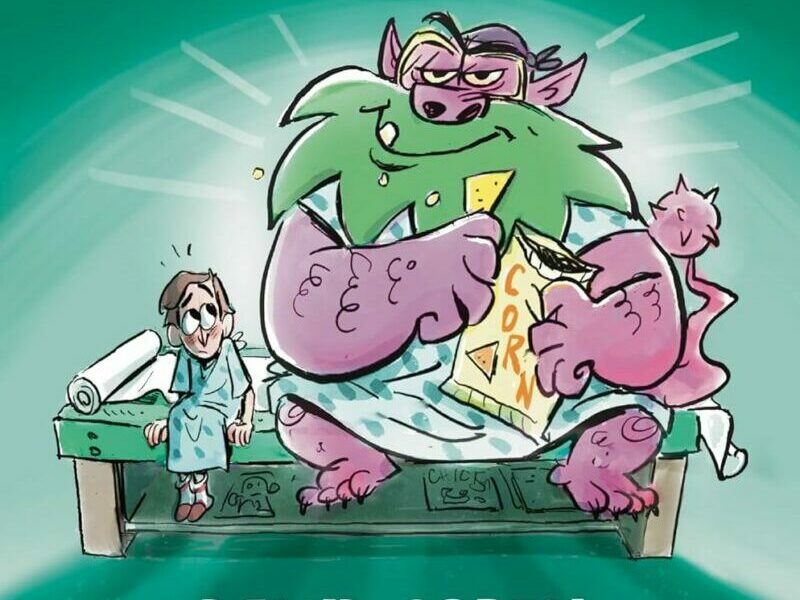
As much as it would be convenient if “seeing was believing,” there are plenty of challenges in life that are invisible. For J.J. Sugar in David Soren‘s debut book, Invisible: The (Sort of) True Story of Me and My Hidden Disease, none of his classmates realise he has Crohn’s disease and J.J, is determined to keep it that way. For more on J.J. and his invisible monster companion, check out this interview with Soren below:

Rachel Bellwoar: As you address with the title, Invisible is a very personal and “sort of” true story. Would you consider J.J. Sugar to be a pseudonym or do you see J.J. as his own character?
David Soren: Both. Over the years, I tried and failed many times to figure out how to tell this story. Was it a memoir? Was it fiction? Would my experience with Crohn’s disease be relatable? Was I even ready to share this part of myself with the world? Dozens of ideas were jotted down, sketched up, and abandoned. Then it hit me…The way in was to turn my disease into a character! An annoying, chaos-causing biker beast from my bowel who was determined to ruin my life!
This idea led to creating other characters based on disabilities, forming a rowdy, unruly gang of troublemakers who call themselves “the Invisibles.” It released me from the weight of writing a memoir and freed me up to write a story. My experiences could be funneled through J.J. The one rule I set for myself was that whatever J.J. was feeling at any given moment had to ring true to me. It’s still rooted in my journey with Crohn’s, but the larger purpose of the story came into focus: Not just to capture my experience but to capture how it feels to live with an invisible disease. Everyone’s journey may be different, but this way, the specific becomes universal. I felt like J.J.’s story could speak to a much wider audience than my own.
Bellwoar: What made you decide to tell this story as a book versus a movie, or a graphic novel?
Soren: Initially, I conceived of it as a movie. I wrote an outline, even pitched it to a couple studios. I got the most wonderful rejections I’ve ever had. The excuses were predictable – it was “outside their mandate” of blockbuster tentpoles, sequels and giant IP – but these hardened execs were visibly moved. Something about seeing me share my vulnerabilities opened the door for them to share theirs. Suddenly, they started telling me about an illness they had, or a close friend, or family member with a health challenge. It made me rethink my strategy.
I had too much to say about living with an invisible disability for a graphic novel. So I decided to write and illustrate it as [a] middle grade book instead. I stepped away from animation for six months to give it my full attention. The whole time I questioned if anyone would publish it. But the day it went out for submission, an editor at Penguin read it overnight and offered me a two-book deal! The whole experience has been incredibly satisfying and pure. Maybe one day it will become a movie but for a story this intimate, personal, and important, this was unquestionably the right place to start.
Bellwoar: In choosing a format for this story to take (and having co-written and directed the Captain Underpants movie), were you inspired by Dav Pilkey’s style of writing chapter books with pictures and fun fonts?
Soren: Absolutely! Dav Pilkey is one of my literary heroes. I was obsessed with his books long before I got the chance to adapt them. The format he created is ingenious. Easy to read, short chapters, fun fonts, killer illustrations, great character-driven comedy. There’s something silly and surprising on every page. They’re also deceptively smart. His books work on so many levels, it’s no wonder they’re wildly popular. Dav’s openness about his journey with ADHD has also been extremely inspiring to me.
I shared an early draft of Invisible with him and was sweating buckets while I waited to hear what he thought. I was blown away by his enthusiasm. Dav’s support for my book has meant the world to me
Bellwoar: Growing up, was there anything you wish more people understood about Crohn’s disease (or was that not on your mind, as the objective was making sure nobody learned your secret)?
Soren: Growing up, I didn’t know any other kids who had what I had. The only other person I knew with Crohn’s disease was my mom. There was very little awareness or support back then. Telling people about it was challenging for several reasons: First, I would have to educate them about it. That meant describing the symptoms which can be embarrassing. The risk of humiliation outweighed any obvious benefit, so I kept it a secret. I didn’t want people to look at me differently or be seen as less capable. I wanted to be known for my talent, not my disease.
It was handy that I could control who knew and who didn’t. It was also a huge part of myself to keep hidden, such a heavy weight. I didn’t realize how heavy until I started opening up about it. Now, my only regret is not doing it sooner. I wrote the book I wish I’d been given as a kid so that maybe it can help others get to the place I got to sooner. So they don’t spend so much of their lives keeping the most important part of themselves invisible.

Bellwoar: J.J. comes to really enjoy watching horror films with his best friend, Hot Lips. Are you also a horror fan, and do you feel that played into your decision to imagine diseases as monsters?
Soren: I love horror movies, but they have to have a good story. Rosemary’s Baby, The Shining, The Thing, Jaws, Sinners … the list is long. I especially love when the fear comes from something real. Something that we are forced to confront regularly, like social anxiety or prejudice (Get Out is a slam dunk!) Living with a chronic disease can feel like a horror movie at times, so making my disease the villain felt juicy. The harder J.J. tries to keep Norm hidden, the scarier he gets. They’re stuck together for life – no cure in sight. Even though Norm’s nature is to wreak havoc, he grudgingly starts to like the kid, and deep down wishes they could be friends.
Bellwoar: Both J.J. and his mom have Crohn’s disease yet their monsters (Norm and Francie) couldn’t appear more different. How important was it to you to individualise each monster (and show how everyone’s experience with illness can be different)?
Soren: I’m so glad you brought that up. Everyone has a unique story. While my mom’s disease and mine shared many similarities, our journeys have been different – medically and emotionally. She had her own completely valid reasons to keep her disease private. Many people never get to a place where they’re comfortable talking about their health challenges. I would never want to pressure anyone to share before they’re ready. It took me many decades to get to this place and it still makes me uncomfortable. The problem is that not talking about our disabilities only reinforces the stigmas that make them harder to live with. This book is my attempt to help change that.
Bellwoar: Can you speak more to your designs for Norm and Francie specifically – why a biker and a three-legged ballerina?
Soren: Our diseases threaten to derail our dreams. My mom’s disease (Francie) succeeded. My mom was trained as a dancer. She had just started her first job as a dance instructor when she was diagnosed with Crohn’s. It seemed fitting that Francie should be a terrible, clumsy dancer (thus the third leg). She needed to be the biggest pest possible to Mrs. Sugar.
J.J. refuses to let Norm ruin his dreams. My dad had a motorcycle when I was a kid. He’d take me for long rides that would leave my gut feeling like scrambled eggs. That’s where it came from but it evolved into a visual metaphor. I couldn’t shake the image of my disease driving a motorcycle, me in the sidecar holding on for dear life as he throws his hands in the air, threatening to swerve me off the road. My journey (and J.J.’s) is about finding the courage to take the handlebars and put the devil in the sidecar.
Bellwoar: One thing this book shows is how being sick or knowing someone who’s dealing with illness can make you more aware of other people who are in the same boat and what they’re going through, like when J.J. takes the time to talk to one of his classmates who has a peanut allergy. Has that awareness and empathy helped you with other aspects of your life?
Soren: We all have to deal with something at some point in our lives. I learned that younger than most. Hopefully, it’s made me a better friend, devoted husband, and present father. As a director, I care about everyone on my team. If I see someone struggling, some empathy goes a long way. I try to put myself in their shoes. I know how I’d want to be treated when things aren’t going well.
We need awareness and empathy more than ever. That can’t happen if we stuff all the hard parts down and keep them hidden. It only makes fear and isolation worse. My hope is that the book can be an ice breaker, a conversation starter. My relationship with my disease is still evolving, but I’ve come to accept that it’s part of my identity. And it’s not all bad. It has shaped who I am and the choices I’ve made. It’s the fire in my belly, my ticking clock, my curse as well as my gift.
Your turn.
Bellwoar: Thanks for agreeing to this interview, David!
Invisible: The (Sort of) True Story of Me and My Hidden Disease goes on sale October 14th from Penguin Workshop.

