
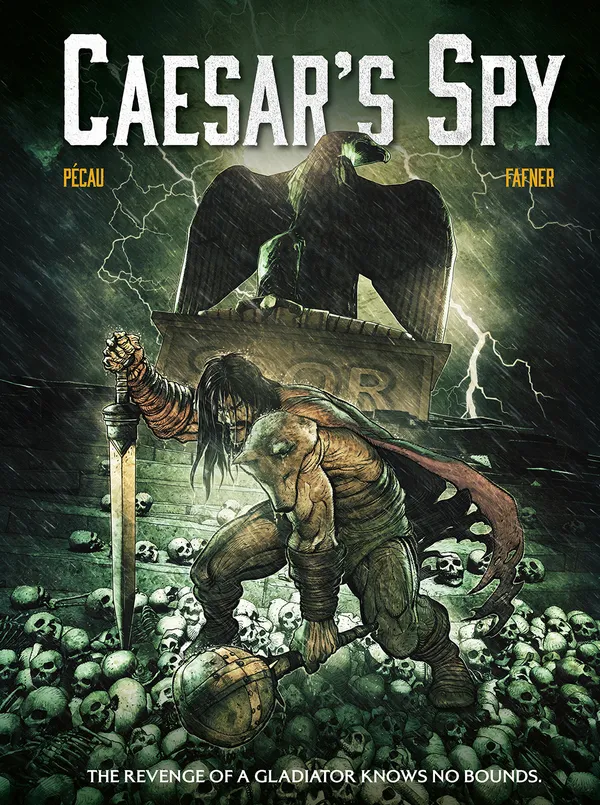
The Foundation Of Our Entire Western Civilization — Jean-Pierre Pécau Discusses ‘Caesar’s Spy’
by Tom Smithyman
Prolific French writer Jean-Pierre Pécau has spent much of his career writing graphic novels about history. His latest creation, Caesar’ Spy – out September 9 from Titan Comics – Pecau takes on the story of the mercenary Coax who unknowingly kidnaps a young Caius Julius Caesar. After being sold as a slave and competing as a gladiator, Coax is given the opportunity to become the ruler’s spy. In an interview with Comicon.com, Pecau discusses the Coax’ genesis and why we’re still talking about Roman history millennia after the empire’s fall.

Tom Smithyman: What influenced you to write Caesar’s Spy?
Jean-Pierre Pécau: Actually, it was an idea from my editor at the time, Fred Blanchard, who wanted to publish a James Bond story set in Roman times. The project changed slightly, and instead of 007, I invented a character similar to Conan.
Smithyman: Did you read a lot of Roman history before you started writing?
Pécau: I was originally a history teacher, so I think I know the history of Rome quite well. It’s also a period I really like; the formation of the Roman Empire has a lot to teach us.

Smithyman: Spies have been around as long as humans have. Did you base Coax on anyone in particular?
Pécau: As I said earlier, he’s a kind of Gallic Conan. I love Robert E. Howard‘s Romans and his characters who are both dark and can be quite savage.
Smithyman: Why do you think we’re so fascinated with Roman history and culture centuries after it fell?
Pécau: Rome is the foundation of our entire Western civilization, so it’s normal that we’re interested in this period. It’s also a fascinating period because it’s the story of a small town and its inhabitants who were in no way destined to become an empire. From the very beginning of its existence, Rome seemed haunted by the need to expand at all costs, and none of the many failures the Romans encountered could stop them. They might lose two, three or more legions, but they would always come back fighting.

Smithyman: You have written literally hundreds of comic books during your career. Looking back on your work, do you think it follows a particular theme?
Pécau: History is probably my favorite theme. History in all its forms, meaning both real history and alternate history. All the series I have written have something to do with history at one point or another.
Smithyman: Max Von Fafner did an amazing job drawing this book. Could you talk about the creative process between the two of you?
Pécau: Max’s work was a big and wonderful surprise for me. I was initially thinking of something much more classic, less wild, and when I saw the first pages, I knew we had found the right candidate for our spy cursed by the gods!

Smithyman: Imagine that you displeased Caesar and were banished to the Coliseum. How would you write your perfect death scene?
Pécau: This scene already exists! It is the death of Cicero! The culture of honorable and heroic deaths were very prominent in ancient Rome, and every man knew that he would also be judged on his attitude, his poses and his words in his final moments.
Here is Plutarch’s account: “At that moment, the murderers arrived; they were the centurion Herennius and the military tribune Popilius, whom Cicero had once defended in a charge of parricide…The tribune, taking a few men with him, rushed forward…Cicero heard him coming and ordered his servants to set down his litter. He himself, in a gesture familiar to him, placed his left hand on his chin and stared fixedly at his murderers. He was covered in dust, his hair was disheveled, and his face was contorted with anguish…He stretched his neck out of the litter to the
assassin…Following Antony’s orders, his head and hands were cut off, the hands with which he had written the Philippics.”
Smithyman: What a way to go! Best of luck with Caesar’s Spy!


