
The War To End All Crossovers: Revisiting ‘DC Versus Marvel’
by Tony Thornley
This week, Marvel Comics brings us the first cross-company crossover with fellow superhero rival DC Comics in twenty years with Deadpool/Batman, with DC bringing readers a companion one-shot in December. To get ready, we took some time to revisit some classics in the DC/Marvel crossover wars. Up first, the big one — DC Versus Marvel (or is it Marvel Versus DC?)!
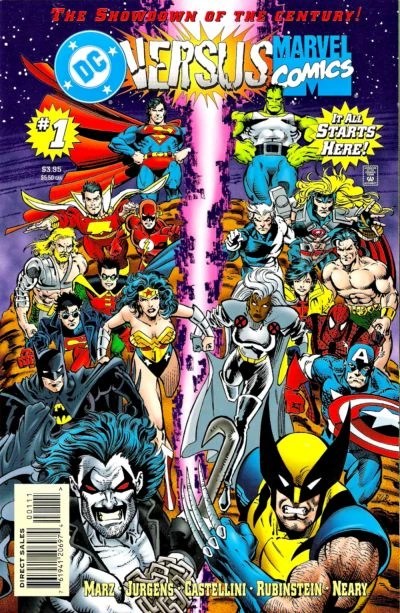
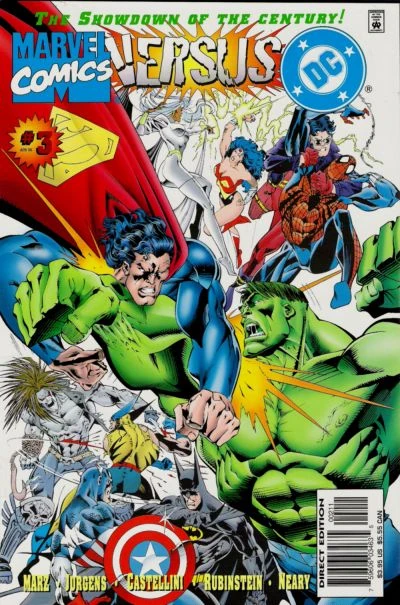
After decades of crossovers, Marvel and DC finally decided in 1996 to settle the debate once and for all. Announcing DC Versus Marvel/Marvel Versus DC, the publishers declared this would give readers what they always wanted- a definitive answer on which universe would come out on top. Over the course of 11 one-on-one battles, the event would show fans which universe would reign supreme.
The series brought together comics juggernauts to chronicle the tale. Ron Marz and Peter David co-plotted and alternated scripting; Dan Jurgens and Claudio Castellini split pencilling duties and were inked by Josef Rubinstein and Paul Neary; Bill Oakley lettered the event, with colors by Gregory Wright and Digital Chameleon, and it was all edited by Chris Duffy, Joe Andreani, Mike Carlin and Mark Gruenwald.

When two similar but very different universes start to collide, the heroes of both universes rush to discover what is causing the merger. Soon they discover two cosmic beings- the embodiment of each universe- have gone to war. And the world’s greatest heroes are going to have to fight it out, and the losers will cease to exist forever!
This story is a lot. And that means in some cases it’s very fun, and in others it’s very rushed and confusing. It’s never outright bad by any means though.
The fun lies in seeing these worlds collide. Gambit and Nightwing have a show down while Wolverine brawls with Killer Croc … then they steal the Batmobile to try to go home to the Xavier Mansion. Hulk and Superman stop Mole Man from taking over the Batcave. Jubilee and Robin fall in love at first sight. Peter Parker flirts with Lois Lane. It’s all very fun, and very entertaining.

The problem: because so much is going on, and there’s only four issues to do it in, it goes quick. And unfortunately, some of the brawls suffer for that. The first three fights — Thor and Captain Marvel, Flash and Quicksilver, Aquaman and Namor — all get a decent amount of page space, but from there it’s hit or miss.
For example, Superman and Hulk’s brawl gets the right amount of room, but Wolverine and Lobo’s is only about two pages, and is decided off panel. Meanwhile, the plot of new hero Access teaming with the Spectre and Living Tribunal to convince “the brothers” to give the universes a chance to live is barely an afterthought until Batman and Captain America step in to help. Plus, the third issue ends on a cliffhanger with the universes merging, then picks up showing that one of the previous week’s Amalgam Comics one shots — Dr. Strangefate — was actually issue 3.5 of the series.
In other words, and I don’t say this often, this event should have been longer; at least by an issue or two.

Art wise, this looks great. The only complaint I could have about the linework is that Jurgens and Castellini are almost too different style-wise. An artist with a style more complementary to Jurgens — like Spider-Man artist Mark Bagley or X-Men artist Andy Kubert– might have made the art shift not so jarring. Plus, you do get some of the late 90’s digital coloring issues that plagued the entire industry- though at a certain point, the colors do go a little more flat than over-rendered.
This event series is legitimately a lot of fun, even with its issues. The rushed plot just needed a little more time to breathe. If you can find the back issues or the recent omnibus that included the series, I highly recommend it, if only for the historical relevance of it.
