
An Interview With ‘The Cramps: A Period Piece’ Writer-Director Brooke H. Cellars
by Rachel Bellwoar
Agnes (Lauren Kitchen) is used to letting her mom (Brooklyn Woods) tell her what do. When a job opens up at a beauty salon, however, Agnes decides to take it anyway, only to realise her mom’s been steering her wrong about a lot of things, including not asking for help when she’s in a lot of pain. The Cramps: A Period Piece is Brooke H. Cellars‘ debut feature and here’s what Cellars could reveal before the film’s premiere at Fanastic Fest:

Rachel Bellwoar: While you’ve directed multiple shorts, The Cramps: A Period Piece is your first feature. What made you know this was the story you wanted to expand into a feature length movie?
Brooke H. Cellars: While I’ve always tried to say something meaningful in my short films, it wasn’t until I made Violet Butterfield: Makeup Artist for the Dead that I allowed myself to be truly vulnerable in my storytelling. That film felt different. It carried a passion that pushed me into a new space as a filmmaker, and in turn, it connected with audiences in such an unexpected and wonderful way. Experiencing that showed me how powerful it can be to lean into honesty and vulnerability, something I had feared for much of my life. With The Cramps, I wanted to take that same openness and expand it on a larger scale, to tell a story that could dig even deeper and reach further. It was really the love I discovered in that process that made me want to grow it into my first feature.
Bellwoar: I think the wordplay of the title is absolutely brilliant. With regards to the subtitle, though, how did you decide which time period to set this “period piece”? Was it always going to be the 1960s?
Cellars: Thank you! From the beginning, the aesthetic was always going to lean 1960s. Midcentury Technicolor, but also I wanted it a little ambiguous. I sprinkled in hints of the ’50s and ’70s, and even played with 60s-style dialogue with a modern twist. It’s not just a time period; it’s a little universe all its own with no rules. I don’t like rules.
The inspiration actually came from a joke I made years ago: “What if we made a period piece about actual periods?” Meant to be a joke, but the second it left my mouth, my brain lit up like lightning. I had to tell this story and I knew the story I wanted to tell. I wanted to make a film that reflected what it feels like to live with endometriosis, this invisible creature hijacking your body while the world around you can’t see it. That invisibility, that “nobody believes me” feeling, has been one of the hardest parts of my life, shaping the choices I made, the person I tried to be, even as it held me back. So while the joke got me here, the story is fierce, personal, and unapologetically mine.
Bellwoar: For most of the film Agnes splits her time between her job at the beauty salon and life at home with her mom and sister (Harlie Madison). What was it like working with Kasey Delahoussaye and Alicia Tenney on the art direction and production design to ensure these two environments couldn’t look more different?
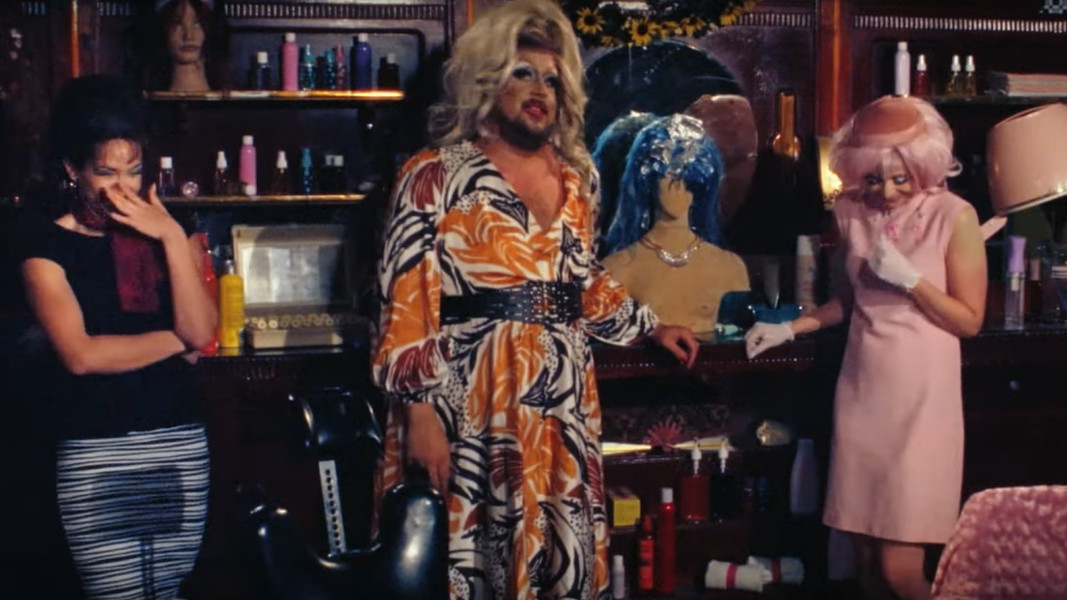
Cellars: I wanted to create two completely distinct worlds that Agnes moves between. Her family home is traditional, tightly wound, and steeped in fear. A place where her father’s rules still linger, even after his passing. Agnes respects her family, but she also longs to break free and live her own life. Then she gets her new job and is thrust into a vibrant, colorful world where people speak freely and express themselves. The way she wishes she could be. The production design was intentionally crafted to reflect these two extremes: the house dark, religious, and meticulously kept; the salon bright, bold, and expressive, like Violet Butterfield dialed all the way up.
Working with Alicia Tenney was a dream. We were still hunting locations just a couple months before shooting, and through a social media post, an acquaintance tagged Alicia. She sent photos of her home, and I was drooling over the images. It was a small Victorian filled with gorgeous antiques, exactly how I envisioned the Applewhite house. It was uncanny, and we barely had to touch set decoration that first week.
The salon was a whole other adventure. We built a set from scratch in a Franklin banquet hall and yes, it was a mad, glorious rush. On our weekend off, Brandon Taylor (production manager), Chase Williamson (set construction), Emi Sikes (Miss Pennyworth/PA), and I literally built and painted the entire set in a single day to be ready for the next week of shooting. It was chaotic, exhausting, and completely magical.
We were also incredibly lucky to have Kasey Delahoussaye on art direction and Kaley Daniel as props master. Working with them was easy, breezy, beautiful cover girl. They understood my vision down to the tiniest detail, brought their own passion to every corner of the sets, and even had a huge hand in creating the fabulous wigs for the hair show. Having teammates like this made all the difference and turned what could have been stress into pure creative joy.

Bellwoar: In addition to writing, directing, and producing, you’re also credited as the costume designer on Cramps. Are there any looks you’re especially proud of?
Cellars: Fashion is my second love, so yes,I absolutely have a favorite look! Teddy Teaberry is one of the dreamiest characters I’ve ever created, the sweet, satanic church lady! Every piece of her look was crafted with pure dark-heart intention. From the gloves, some from my actual wedding, to the fun floral church lady hats, everything was designed to tell her story. Her soft pink wig blends into her pastel outfits, which are set off with just the right touch of inverted cross jewelry, including an iron-on pink inverted cross on her baby blue shirt. It’s playful, sinister, and a little chaotic and I couldn’t be prouder of how it all came together.
Bellwoar: It may be set in the ’60s but the monster in this movie feels straight out of a ’50s sci-fi film. What made you choose that type of monster to represent period cramps?
Cellars: Since the world of The Cramps is intentionally ambiguously midcentury, this one’s actually easy to answer: The Blob! One of my all-time favorite creature features, both the Steve McQueen original and the ’80s Shawnee Smith version (which, fun fact, was shot in Abbeville, Louisiana, just 20 minutes from where I live). I wanted the raw, primal, practical effects of a period blood monster, the kind that feels messy, tactile, and just a little terrifying, exactly the vibe of the Blob. Hannah Garatie and her incredible special effects team absolutely nailed it, and watching it come to life on set was an absolute glittery blast.
Bellwoar: Famously in the movie Carrie, Carrie gets her period at school and doesn’t understand what’s happening to her. It’s been nearly 50 years since that film came out but do you feel a lot of the same problems persist, in terms of girls not being told or being made to feel comfortable to ask questions about menstruation?
Cellars: Carrie is actually one of my favorite movies of all time and it has not only inspired this film but some of my shorts as well. Sadly, many of the same problems persist. When I was growing up, I had a mother and a sister, but there was this unspoken rule: you just didn’t talk about periods. So when I got mine, I received almost no guidance, and I didn’t dare ask anyone outside the house. I was extremely shy, quiet, and fear was instilled in me very early on. For a time, this fear and the condition itself almost completely took over my life. I had given up. It wasn’t until nearly my 40s that I could finally start breaking these chains.
That’s why it’s so important for people with uteruses to speak openly about what’s happening with their bodies. Periods affect women’s lives in ways most people don’t even realize. When menstruation isn’t talked about, it isolates, confuses, and can even harm. I don’t want anyone else to ever feel the way I did over something they had no responsibility for. It’s normal, it’s natural, and it’s nothing to be ashamed of. No one should ever have to suffer in silence. It should be spoken about. It will be spoken about.
Bellwoar: Agnes has a mannequin in her room that she occasionally talks to named Miss Crabtree. Could you talk a little about the inspiration behind that idea?
Cellars: Miss Crabtree is really Agnes’ conscience or her way of talking to herself. She always knows who she is, but she’s too afraid to say it out loud to her family. Miss Crabtree quietly reminds her of who she wants to be, even when she doubts herself. That’s why Miss Crabtree wears red, which Agnes’ mother ominously calls “the color of sin” a bold, symbolic presence in Agnes’ room.
For me, the mannequin also represents the art and fashion design I desperately wanted growing up. Things my parents never supported or actively talked me out of. It became a little symbol of rebellion and creativity, a reminder that it’s okay to dream bigger and embrace your passions.
The idea also comes from a childhood memory: my brothers and I had an old reel-to-reel projector, and we’d watch Little Rascals episodes on film. The voice of reason was always the teacher Miss Crabtree. That stuck with me, and it felt perfect to give Agnes the same steady, guiding presence in her own world: part nostalgia and part imagination. Maybe a guiding presence I longed to have in my own childhood.
Bellwoar: Thanks for agreeing to this interview, Brooke!
The Cramps: A Period Piece will have its world premiere at Fantastic Fest on September 19th.


