
Talking ‘Red Dragon’ With Rob Williams, Steve Yeowell, And Patrick Goddard
by Rachel Bellwoar
The last time Red Dragon appeared in the Prog it was the ’80s. Now original artist Steve Yeowell, along with writer Rob Williams and artist Patrick Goddard, are bringing the Welsh superhero back to show the impact he had before and after the events of Zenith. With colors by Dylan Teague and letters by Simon Bowland, here’s what Yeowell, Williams, and Goddard could share about the character’s return:

Rachel Bellwoar: For new readers who want to try 2000 AD for the first time, what is Red Dragon about?
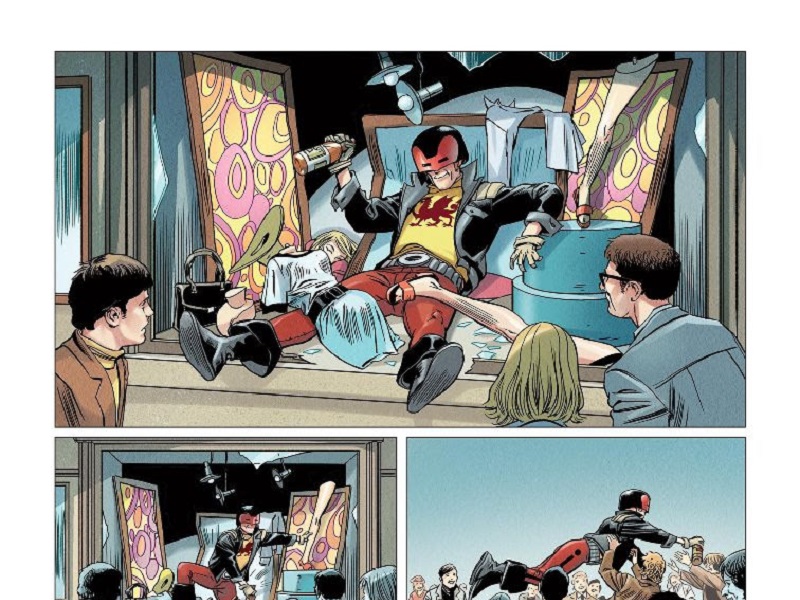
Rob Williams: In the 1980s Grant Morrison and Steve Yeowell created a superhero universe in 2000 AD starring a pop singer super called Zenith. Red Dragon was one of the characters in that series – a Welsh superhero, who had slipped into alcoholism. Our Red Dragon series is the first time a story has been told in the Zenith world since 1992, really. It looks at the legacy of Red Dragon in 2025 as well as showing some of his history in his heyday in the 1960s.
Rachel Bellwoar: Of those supporting characters from Zenith, why is Red Dragon the one you feel fits a solo strip?
Williams: I was asked if I was interested in doing something in the Zenith world and was a little hesitant. The original strip has such an effect on me as a teenager, and is held in such high regard. Grant’s one of the best writers we’ve ever had in comics, so the standard and the sense of nostalgia meant it was probably a hiding to nothing to bring Zenith back.
But then I was asked about Red Dragon, which was a dirty trick really as I’m Welsh, and Red Dragon was that rare thing — a Welsh superhero who actually felt Welsh and rooted in our culture. I had no interest in doing ‘the new adventures of Red Dragon’ or a revamp. But I started thinking about a story which looked at Wales, and the United Kingdom, and where we were in the optimism of the 1960s, and where we are today, and I started to get excited about that. I don’t think it’s the sort of story people would expect.

Bellwoar: As someone less familiar with Red Dragon, will his behavior in this strip be recognizable to fans or will they be getting to see another side to him?
Williams: We only briefly met him in 1987, and he was like a Dylan Thomas at the end of his life, really. Here we get to see him when he was at the height of his powers. When he and Cloud 9 — his ’60s superteam — are like the Beatles in Swinging London, really. And we get to see his slide, from exciting hedonistic character to the reasons for his alcoholism, and why he left the team.
And then we also get to see some other sides of him, from the memories of people who knew him when he returned to his small town in Wales.
Bellwoar: While longtime readers will be familiar with Siadel Rhys, what can you tell us about the other main character of this strip, Martin?
Williams: Martin Howe briefly appeared in Zenith Book One. He was an author and media face who had written a book about the 1960s era of the Zenith superheroes, about Red Dragon and Cloud 9. When we meet him here his career and life are on a downward trajectory but he’s been offered a chance by a production company to have his book turned into a ’60s nostalgia documentary series.
As Martin says in episode one ‘I don’t really give a shit about superheroes.’ He’s just looking for a paycheck really. But he and a Director and a Camera Person from the production company head off to Red Dragon’s hometown in West Wales and they accidentally uncover a very dangerous mystery.

Bellwoar: On the art front, how did you divide the labor? Was it an easy call to make, who would draw the sixties sections versus who would draw the present day? What did you want to bring to your section of the comic as an artist?
Steve Yeowell: I was asked to draw the nineteen sixties sequences at the very beginning of the project when Matt [Smith] and Rob invited me to take part. Other than inking digitally over analogue pencils, I haven’t approached those sequences any differently than I’ve handled projects previously.
My preference is for formal layouts and, being mostly influenced by everyone who was anyone in the sixties and seventies, the way I draw is rooted in that period.
Williams: When Steve Yeowell agreed to draw the 1960s scenes it was a huge deal for the strip. These are Steve’s characters. he co-created them. And he’s always been a fantastic artist. I re-read the four Zenith books a bunch to try and get the history right for the series and some of the things Steve pulls off there is really top-tier comic illustration. I wanted the 60s sequences to be in colour. Bright, vibrant. A more vibrant time. Dylan Teague came onboard to colour Steve. I know Dylan well, he’s from Cardiff, so he was allowed in to this blatantly Welsh comic venture.
As was Paddy Goddard, who draws the modern day sequences. Paddy’s from Penarth near Cardiff. Again, Paddy’s a really strong storyteller. But it was important to me to have someone drawing the Welsh hills and valleys who knew what they look and feel like. So that world felt authentic.
Patrick Goddard: Rob got in touch to ask if I would be interested in the project, with us being both Welsh (just like colourist Dylan Teague!) he knew I could draw the environment and landscape well as we’ve both grown up with it. It was cool to draw a strip for 2000 AD set in Wales, not something I thought I would get the chance to do. I think having Steve back made it more comfortable for me to jump on board, having one the original creators involved made it easier to say yes and make it feel all part of the same universe.
As for the art, I enjoy working in b/w and looked forward to the challenge of drawing more ‘realistically’ for a change. Keeping it interesting even though it’s not all exploding actions panels for me, so hope I keep the readers engaged. Plus it connects back to the original b/w strip.
Williams: It’s very easy to cliche-up that type of thing. I’m from the Rhondda in the South Wales’ valleys. I was writing a lot of that world from experience. And the modern timeline being black and white I think tells its own thematic story.

Bellwoar: Is it more fun to draw superheros from another era? The groovy costumes worn by the members of Cloud 9 are extremely fun to look at, though the same could be said of the sixties fashions worn by the hippies in the crowd gathered to see them.
Yeowell: Those groovy costumes that Brendan McCarthy and Grant Morrison designed were extremely fun to draw, too. I have a huge affection for nineteen sixties superheroes and I enjoy drawing costume drama generally, so I’m having a great time.
Bellwoar: Often the past is portrayed in black and white while the present is in color. What inspired the choice to swap that and paint a more dour present?
Goddard: For me, it shows how grey the present day has become in comparison to the heyday of the team, especially when it’s set in the 60s which was such a colourful decade. Dylan has done a great job over Steve’s lines that their work really pops and has so much energy compared to my pages, it really shows the contrasts to the time periods.

Yeowell: Showing the past as colour and the present as monochrome was all part of Rob’s narrative plan — the subtext as I understand it being to counterpoint the optimism of the nineteen sixties with the disappointment in the way things actually played out. What a great idea.
Williams: In the 1960s all things felt possible in Britain, for Red Dragon and for the country. Where we are in 2025 is a more worrying prospect. Brexit, the rise of nationalism, economic prospects. This is a story about that as much as it is about one Welsh superhero.
Bellwoar: Thanks for agreeing to this interview, Rob, Steve and Patrick!
Red Dragon starts September 24th in 2000 AD Prog 2451.


