
An Interview With ‘Sergio Leone: The Revolution of the Western’ Author Amazing Ameziane
by Rachel Bellwoar
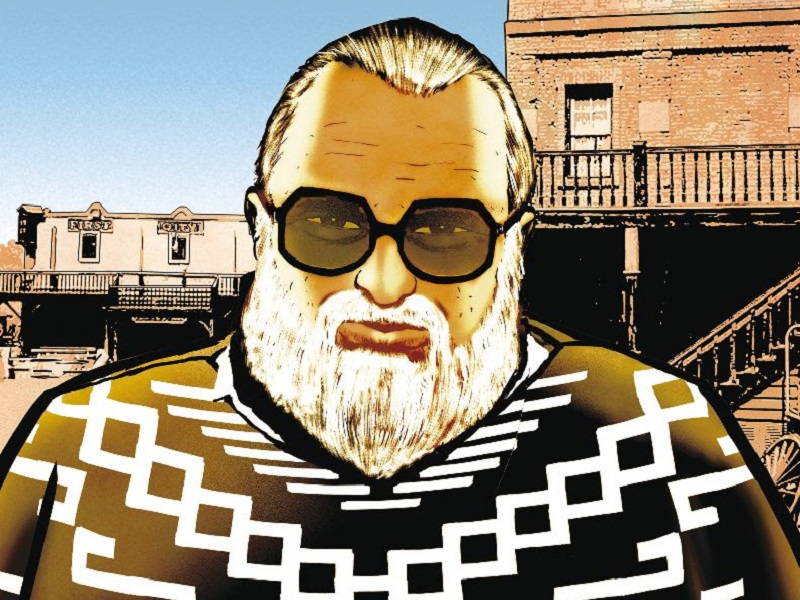
There’s a reason Sergio Leone is lauded as a master of the spaghetti western. From The Good, the Bad and the Ugly to Once Upon a Time in the West, his is a resume that few could match and, in his latest graphic novel, Amazing Ameziane is turning his pen on Leone to reveal more about the director’s life. With letters by Lauren Bowes and translated by Christopher Bradley, you can find out more about Sergio Leone: The Revolution of the Western in the following interview with Ameziane:

Rachel Bellwoar: Sergio Leone may not have set out to make trilogies, but he’s certainly become famous for his Dollars and Once Upon A Time movies. Having just completed your own Ciné Trilogy of graphic novels, what made you choose Leone as your next subject and is there a theme to this second trilogy?
Amazing Ameziane: For Sergio, neither trilogies were planned. The first film was a bet. The second in the Dollar trilogy was a revenge against the producer, and the third was an obsession about the Civil War.
I chose to make a trilogy, with three books signed each time. Daddy needs to eat! But I carefully planned the connections between them. Choosing was simple; I started with my absolute favourite directors (Martin, Quentin, Francis).
Bellwoar: Some of the directors you’ve covered before, like Tarantino and Scorsese, make appearances in this book. Was that always the plan or did that come about naturally?
Ameziane: I learn to write dialogues in the style of Tarantino and Scorsese, I know I will use them for future books, as they are the two most erudite cinephiles we have nowadays. They are from different generations, and I can tell more profound things about a director in a first-person speech. You can understand that those are the funniest parts to write. And if you have the delicious pleasure of reading or re-reading all the Ciné Trilogy Books, you’ll find parts that talk themselves between the books.
Bellwoar: For the intro you share the saga of how you finally got to watch The Good, the Bad and the Ugly in its entirety. Now that Leone’s films are more accessible would you say you have a favorite or one you like to revisit the most (since they are a time commitment)?
Ameziane: It’s honestly hard to choose, but I will for you! The Good, The Bad and The Ugly is the obvious answer as it is the one I watched the most times in my life. But I’m very fond of Fistful of Dynamite, Leone’s favourite…
Once Upon a Time in America is one of the most beautiful films in the world … And yes, I need four hours in my life, or I don’t watch it.
Bellwoar: Across this graphic novel Leone appears at different ages and in different styles. What’s it been like to study one person so thoroughly?
Ameziane: It was an absolute pleasure to do that. I read one or two books, no more. Just to do my homework, fix the timeline.
Because those books are the writers’ versions of Leone, it’s their opinion, not the facts. And when you know enough about a director’s life, you see the bending facts printed. The same anecdotes are passed on to the next generation of writers.
I wanted to hear him speak, so I mostly used the hours of interviews available on YouTube.
70% of the dialogues in my books came from that. For the 30% left, I retro-engineered who the director would be if he were a fictional character. How would he talk? How would he tell his stories? Is he calm or Italian? Does he have a sense of humour, or is he very full of himself?
Scorsese is funny and a movie master. Quentin is always funny and very particular about his choices and opinions. Leone is more vocal; he doesn’t cut corners, he smashes them.
If I did the job right, the readers won’t know which parts are mine and which are real. But I never invented facts. Never. But because I create biopics (Biography & Pictures), I have to dramatise certain parts. But I never betray the original meaning of an anecdote.
Bellwoar: One thing fans of Leone’s spaghetti westerns might not realize is his dad, Vincenzo, was a director, too, before he was blacklisted. He even directed the first Italian Western in 1913. How much of an influence would you say Vincenzo Leone (or Roberto Roberti as he was credited) had on his son’s career?
Ameziane: His father had a huge influence on him. He showed him that the movie business is fierce and ungrateful. The fascists who blacklisted his father were gone, but the industry remained hard to crack. Italy was rebuilding itself from its ashes, and it was hard to make art.
So Sergio waited a long time before sitting in the director’s chair. He did one film uncredited. And the second one was a peplum, a genre he didn’t like or even care about…
So he used the emerging fame of European westerns to start his real career. But still without much faith! Even Fistful of Dollars was directed under a pseudonym of Bob Robertson… Robert, the son of Robert. His father. Full circle.

Bellwoar: Before stepping into the director’s chair Leone made a name for himself as an assistant director, working on such lauded titles as The Bicycle Thief and even directing the chariot sequence in Ben-Hur. Do you think assistant directors will ever get the recognition they deserve or that Leone would be as celebrated today if he had remained an assistant director?
Ameziane: Leone was the best and most expensive assistant director in Italy at the time; he often earned more than the director. And most American directors who shot their movie in Cinecitta asked personally for him, even if he didn’t speak English and never learned it!No, I don’t think assistant directors will ever be recognised. The movie business doesn’t work like that. The movie is a body that must have one head and heart. But in reality, the director is the head, and the assistant his heart.
Bellwoar: Do you have any favorite behind-the-scenes stories from your research, or stories you had to cut for space?
Ameziane: Yes, as I write and draw, I visualise parts of the story that never were, like unproduced posters or sequences that were never shot.
Leone wanted the intro of Once Upon a Time in the West to have Clint Eastwood, Eli Wallach, and Lee Van Cleef as the three killers who wait for Harmonica at the train station. Eli and Lee accepted, but Clint refused. And I wanted to draw that: a 13-page intro, one page per minute for the book. Having the intro translated to comics is all silent. But it would have taken too much time to produce, and I worked on a tight schedule!
Bellwoar: Leone’s Westerns didn’t tend to feature female characters (with Claudia Cardinale’s Jill in Once Upon a Time in the West being an exception). Do you think he was too rigid in his views on this subject?
Ameziane: Leone thought that women were slowing down the action of Westerns. So he used them as little as possible. In a crime story, they are very important. Some scenes with women were shot in the Dollar Trilogy, but were cut to keep the flow steady. In The Good, the Bad and the Ugly, the action always go forward. So all the scenes that returned to the same locations twice were cut.
While the producers and the actors conspired to have Leone direct Fistful of Dynamite, he was so furious to have been tricked that he rewrote the whole script and removed all the women’s speaking roles. But the Mexican Revolution was one of the very first to have women in prominent fighting roles, and he removed them all. To have a more dry movie. Without hope and kindness. Just the rich lady in the wagon who will know Juan in the hay later. Even the love triangle of John hasn’t a line to speak.
And I’m not fond of movies without women. They are often very bad and a “bollocks fest” like a football locker room talk. But there are some exceptions.
This one is an example. The other that comes to mind is Once Upon a Time in Hollywood. Sharon Tate has 17 words in the whole movie. It is as much as the Terminator in the first [Terminator film]. Funny, because Leone and Quentin have proved they can write great female characters.
Movie-making is all about making choices.
Bellwoar: Even though he was one of the creatives the producers forced on him, Ennio Morricone’s music remains forever linked to Leone’s movies. Leone would even play his music on set for the actors. Did you listen to Morricone’s scores a lot while you were working on this book and do you think there’s something lost in separating Leone’s images, like the opening titles, from Morricone’s compositions?
Ameziane: Of course, I listen to Ennio’s music. But that wasn’t a big change, as I often do it while working. Leone considered Ennio to be his co-writer for the movies. The only real one with input.
The score of a particular scene is impossible to separate. It’s half of the story. The Duel with Bronson and Fonda. They don’t move. The music speaks for them. Or the scene where Tuco runs in the Sad Hill cemetery. Pure genius.
Bellwoar: What was your approach to color for this graphic novel? Outside of the Italian flag, most of the first chapter is black and white but then more color is introduced in chapter two.
Ameziane: The Cinema Trilogy has a few rules. The childhood tales are in black and white until the director shot his first frame. I bend the rule to have the real colours of the Italian flag. My book, my rules. And after they start the magi c… I do as I please. Each idea, each reference brings its own set of colours and tones. I use a texture called “sand” to get some good accidents in my colouring. And I play with the effects I need.
Colouring, I do it fast. It’s more a mood I seek than reality. My favourite colour is orange. I like bright contrasts. But the book could be printed in black, white, and grey if I wanted.
I got inspired by the warm grey of Richard Corben, who often worked with delicious greys and added flat colours on top. All the hues were already there, and all became magically done in one second of superposition of layers.
The colours are the fun part because all the other problems have already been resolved.
I would love to produce a full black and white crime fiction, but for the Ciné Trilogy, I need colours that the cinema also uses. But 1/3 of my books are usually in black and white.
I love doing those books. I always say, “I will proceed with one book per year until I’m fired or die.” My publishers like those books and their translations. Quentin by Tarantino was published in 14 countries. And I’m in peak health condition for an old man. So you may have to support me for quite some time. Hopefully…
Bellwoar: Happily! Thanks for agreeing to this interview, Amazing!
Sergio Leone: The Revolution of the Western goes on sale November 4th from Titan Comics.
