
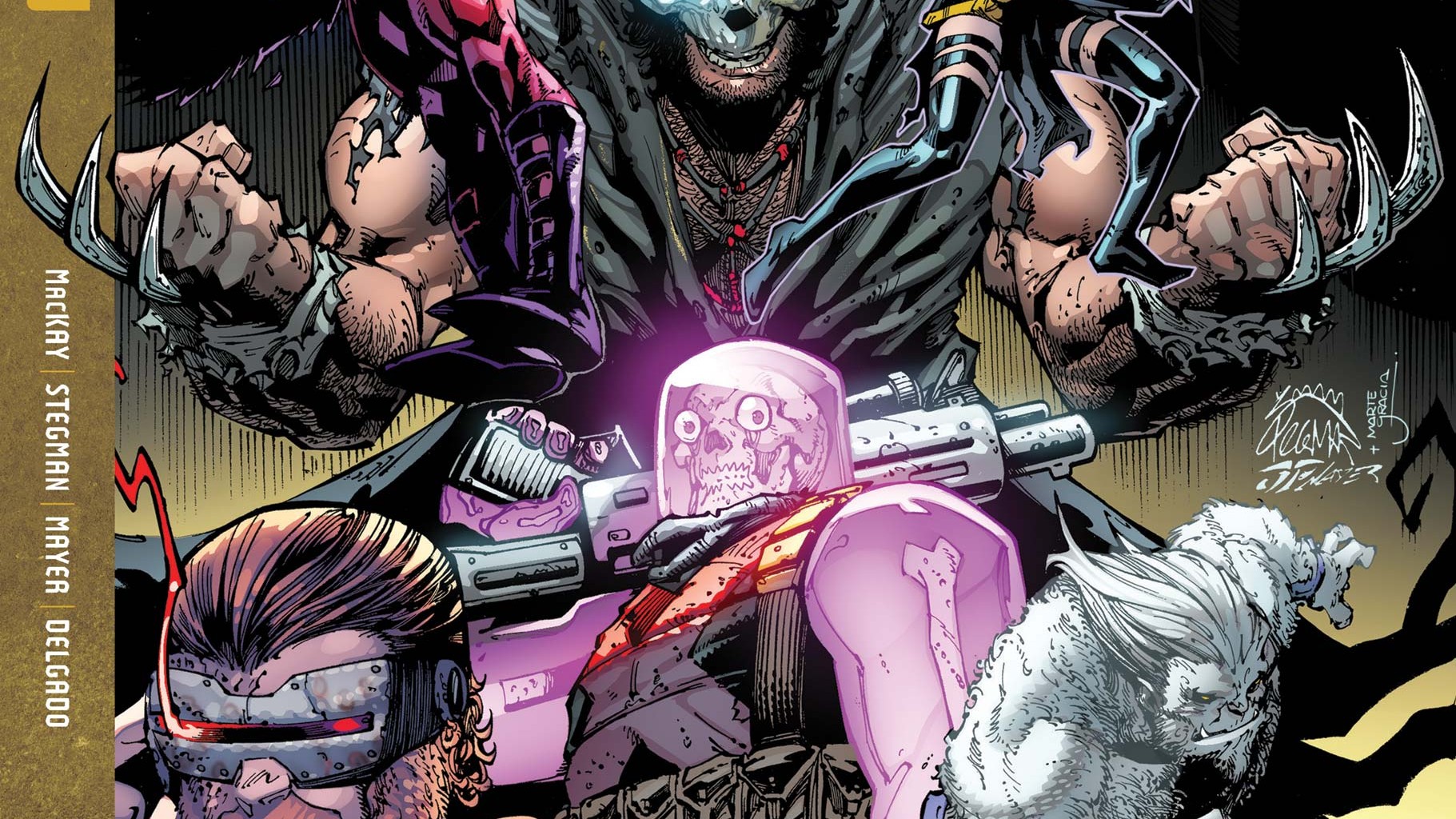
Previously On X-Men: A Surprisingly Strong Start In ‘Age of Revelation Overture #1’
by Austin Gorton
In this week’s X-books, the “Age of Revelation” is finally here, and it’s…not terrible! Cassandra Nova is also here, for reasons. And another “From the Ashes” book mercifully ends.
Age of Revelation: Overture #1 by Jed MacKay & Ryan Stegman – Book of the Week
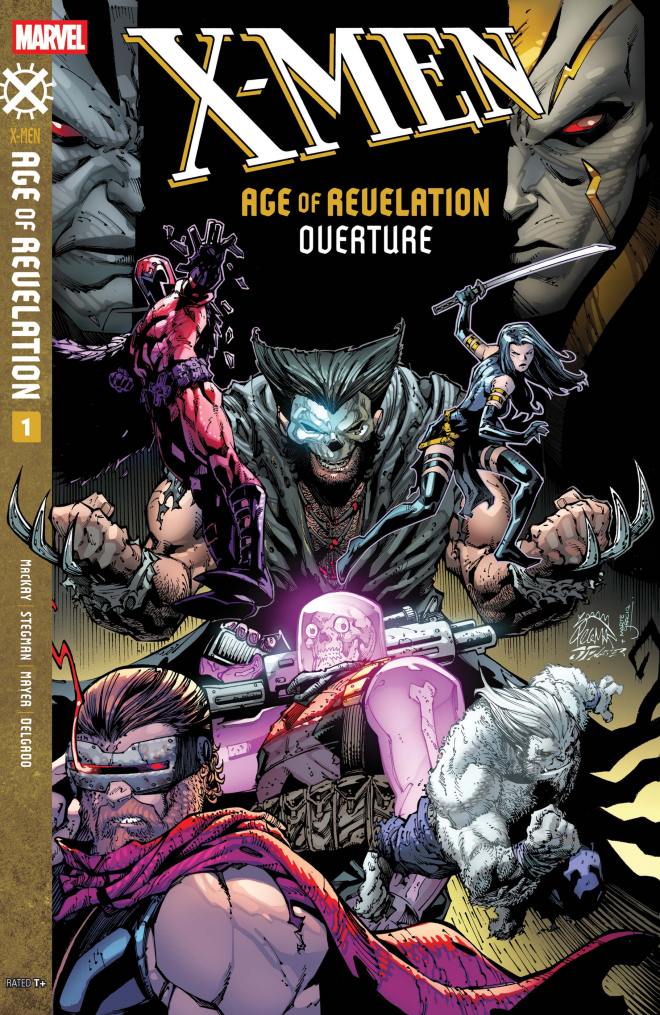
The time-traveling consciousness of Cyclops awakens in the “Age of Revelation.”
- We received a walkthrough of this timeline in July’s X-Men: Age of Revelation #0 oneshot, but this issue covers most of that ground again.
- The narrative captions set this at “X years later”; this was used during the Krakoan Era to create a sense of timelessness, though here, the X is established to explicitly be the Roman numeral X, as the future timeline is ten years from the present.
- That said, ten years really isn’t that long a period of time; there’s A LOT that has changed in that time, both in terms of the physical and political environment and specific characters. Like, if we assume all X-Men stories up to this point cover roughly ten years, many of these characters have veered off in wild new directions in ten years relative to their relative staid development up to now (Glob, and to some extent Psylocke, are good examples of this).
- The Topaz who appears in this issue is from Gail Simone‘s 2018 Domino series, where she was an anti-mutant villain despite being a mutant herself.
- The teleporting Locus was a member of Reignfire’s Mutant Liberation Front a long time ago, and most recently appeared as one of Bedlam’s Hellions.
- As previously established, Psylocke is on Revelation’s side and serves as one of this “Seraphim”, his chosen enforcers (kinda like Apocalypse’s Horsemen), as opposed to his “Choristers”, which are mutants who enhance his power.
- Teased in X-Men #22, this issue establishes we’re basically doing a reverse “Days of Future Past”; as with that story, a character’s consciousness has been sent through time, but while DoFP focused on future Kitty in the present, this event will be from the perspective of present Cyclops in the future.
- Revelation’s line about tolerating the X-Men due to “nostalgic indulgence” seems a little fourth-wall breaking.
- Both Angel and Forge being part of the X-Men is new information (they weren’t shown in the zero issue); Beast having also been consciousness-swapped is a genuine surprise; if that information had been mentioned in promos, I’d completely missed it.
- Schwarzchild is one of the 3K X-Men; he continues to be insistent he has ALWAYS been one of the X-Men, which is what the 3K X-Men have always insisted.
- Babels are established as outcasts punished by Revelation by taking away their ability to use language (which, all else aside, is a cool name and use of Revelation’s power that also speaks to Doug’s character, as he always struggles when confronted with a language he can’t learn); curiously, Magneto says both the future Cyclops and Beast were turned into Babels and that’s why their past selves can be brought forward, but we saw them speaking in the zero issue, at the same time this whole time travel plan was being concocted. Editorial mistake or a hint at something larger? We’ll (maybe) find out!
- Speaking of Magneto, his powers seems to be working normally and he’s out of his chair.
- “From the Ashes” has seemingly thrown a few bits of shade at the Krakoa Era (Tom Brevoort is on the record as not being a fan), and we seemingly get a bit of that here, as Cyclops seems to consider the proto-Krakoa world created by Revelation to be not all that bad for mutants, despite it clearly being positioned as a dystopian future that needs to be averted.
- I appreciate the fact that the apparent big secret — that 3K didn’t release the “turn you into a mutant or kill you” virus, but rather, Revelation did — was revealed relatively quickly.
- This isn’t the first time a virus has been a plot MacGuffin for the X-Men; other examples include the 90s era AIDS-analogous Legacy Virus and the late 2010s’ M-Pox, designed to foster conflict between mutants and Inhumans (in a ill-regarded effort by Marvel to make Inhumans the new mutants).
- Bei breaking with Revelation (she was curiously absent from the zero issue; now we know why) to call in Apocalypse is fun, both in terms of having one of Doug’s closest allies in the present working against him in the future and in terms of bringing Apocalypse, who has been off the grid (Deadpool/Wolverine aside) for awhile and in whose name Revelation is working both in-universe and out-of-universe (in terms of this being a spiritual successor to “Age of Apocalypse) back into the mix. Presumably, the disagreement between Bei and Revelation will come down to interpretation (ie “he’s doing Survival of the Fittest wrong!”) but maybe there’s more to it.
- This isn’t the first time Wolverine has been an Angel of Death — he served as Apocalypse’s Horseman in the late 90s’ lead up to “The Twelve.” Presumably, his own AoR book will explore why he’s working with Revelation and/or if he’s just under his control.
- It seems wild that Wolverine kills as many X-Men here as he does; seems like Magneto alone should have been able to handle, especially since this Wolverine seems to have MORE metal on his person.

- Unlike the analogous X-Men Alpha #1 that kicked off “Age of Apocalypse”, this issue doesn’t really setup a bunch of plotlines to be explored in the subsequent altered series, outside of MacKay’s Amazing X-Men, which picks up with the remaining X-Men where this leaves off.
- The map on the Bullpen Bulletins page showing the boundaries of the various Age of Revelation territories, however, does channel “Age of Apocalypse” pretty well; there was a similar map of that alternate timeline’s US circulated at the start of the event that I was mildly obsessed with back in the day.
- I will do my best not to rant about it every week, but I *really* dislike the trade dress of this event, which seems really basic/slapped together, and oddly reminiscent of the old “Marvel Age Digests” trade dress (which was, by design, simplistic).
Much of how this ultimately works will depend on how the whole events plays out, and I wish this did more to setup at least some of the other series (as it is, there’s nothing in this issue that suggests it couldn’t just be X-Men #23, the next chapter in a story unfolding exclusively in that title, aside from the obvious “let’s sell a bunch of tie-ins!” motivations). But I’m genuinely surprised by how much I enjoyed this just as a world-building exercise, especially given how generally cool I’ve been towards the entire endeavor since it was announced.
Astonishing X-Men #38 by Tim Seeley & Edoardo Audino
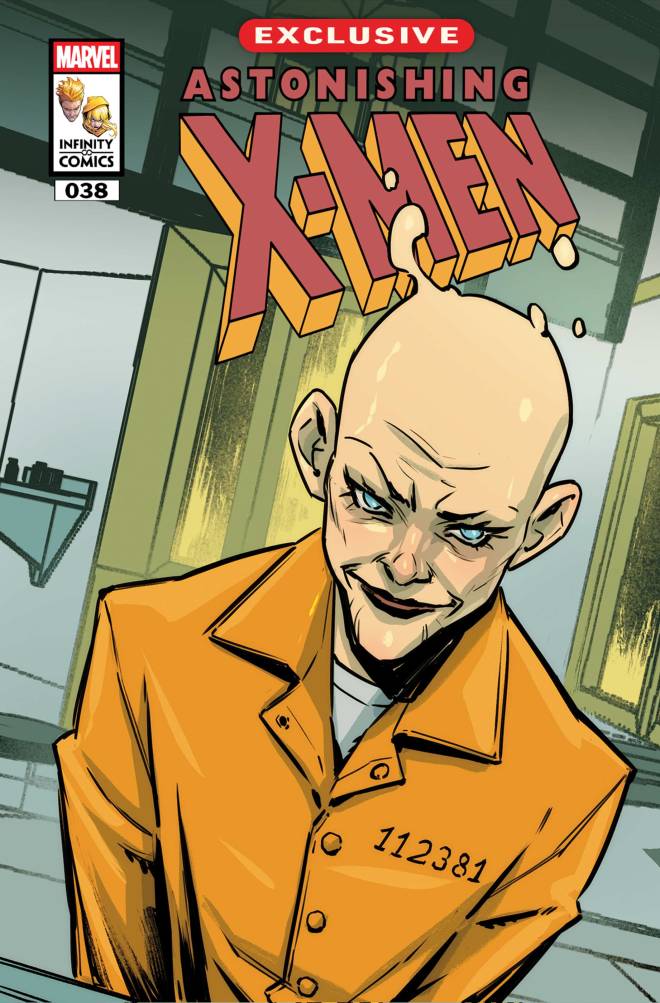
Banshee visits Changeling in prison and reveals the true villain behind his actions.
- Apparently this series is continuing uninterrupted/unchanged by the events of “Age of Revelation”. Last issue sure seemed like the end of the arc, but here we are.
- Changeling has been imprisoned in the Vault, Marvel’s usual go-to super-villain prison, except, we’ve got Graymalkin, a specific mutant prison, doing its thing over in Uncanny X-Men, which begs the question of why he’s in the Vault and not there.
- When Changeling appears as “regular” Kevin Sydney, he looks like the animated Morph from the ’93 cartoon (who was of course inspired by the original comic book character), which is nice touch.

- It turns out Cassandra Nova is behind Changeling’s actions, though it begs the question of WHY she’d want to start a nuclear war and/or how that fits with the agenda of 3K — on whose leadership body she sits. Not even several pages of straight monologuing from her make it any clearer.
- In terms of Banshee, it seems like this whole arc is meant to setup his new purpose as someone working to advocate for former evil mutants, giving them the shot at redemption they had on Krakoa in this post-Krakoa world. Which is fine (if nothing else, it’s nice to see a non-disparaging reference to Krakoa).
Cassandra Nova’s involvement here is simply baffling, even if I appreciate where this leaves Banshee’s character.
Deadpool/Wolverine #10 by Benjamin Percy & Joshua Cassara
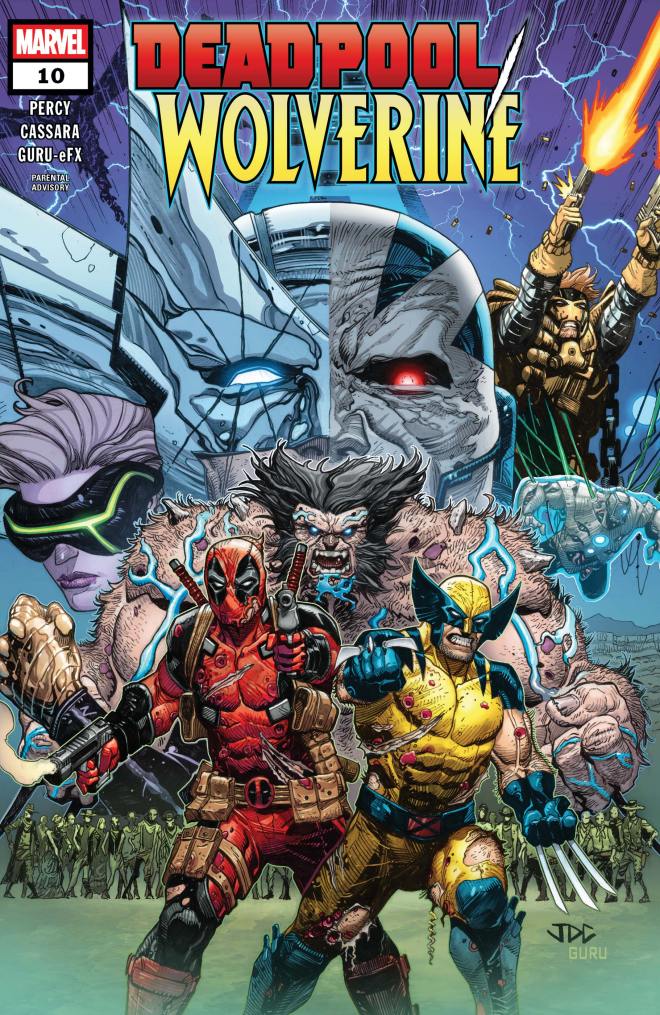
Deadpool and Wolverine defeat Stryfe-pocalypse as the series shuffles off the mortal coil.
- At least Cassara came back to finish the arc.
- Is this the end of ONE director Talsyn? Let’s hope so, as she was extremely one-note and incongruous with an organization that is meant to be a more down-to-earth anti-mutant organization (in the same way Warden Ellis over in Uncanny X-Men is meant to be a “mundane” villain but dresses like a super-villain).
- “The Ewoks haven’t danced” is my new favorite idiom for “it’s not over yet.”
- The running gag with Wolverine telling Deadpool he can just not talk while Deadpool continues to prattle on made me chuckle despite myself.

- In the letters page farewell (this series is officially cancelled, and while both its title characters have “Age of Revelation” series, there is no AoR team-up book for them, thank god), Percy talks about how he and Cassara wanted this ten issues story to serve as a sort of spiritual successor to the early 90s “X-Cutioner’s Song” crossover, which also involved Stryfe and Apocalypse and introduced (in its literal final panels) the Legacy Virus. Which is a sentiment that I — an avowed fan of that crossover — can hardly disagree with, but I would disagree that they pulled it off. For one thing, as much as that crossover is rightly dinged for centering itself around the question of Cable and Stryfe’s relationship (and their relationship to Cyclop’s time-lost son) and then just hinting at it some more while punting the actual revelation down the road, it did featured roles for all the major X-villains at the time and represented the first direct interaction amongst all the books since the big 1991 shakeup, all of which gave it a sense of scale and import Percy and Cassara couldn’t hope to — and, indeed, don’t — achieve in this book.
Not at all sad to see this go. I generally like Percy in “gonzo action mode” and this always looked nice (even when Cassara was, frequently, spelled). The pacing on it is terrible, however, making it read like a book from the heavily-trade-paced 2000s trying to emulate the blockbuster storytelling of the 90s, featuring the cinematic stars of 2024, with each of those elements ultimately working against the others.
For a full review of the issues, check out Scott Redmond’s thoughts here.

