
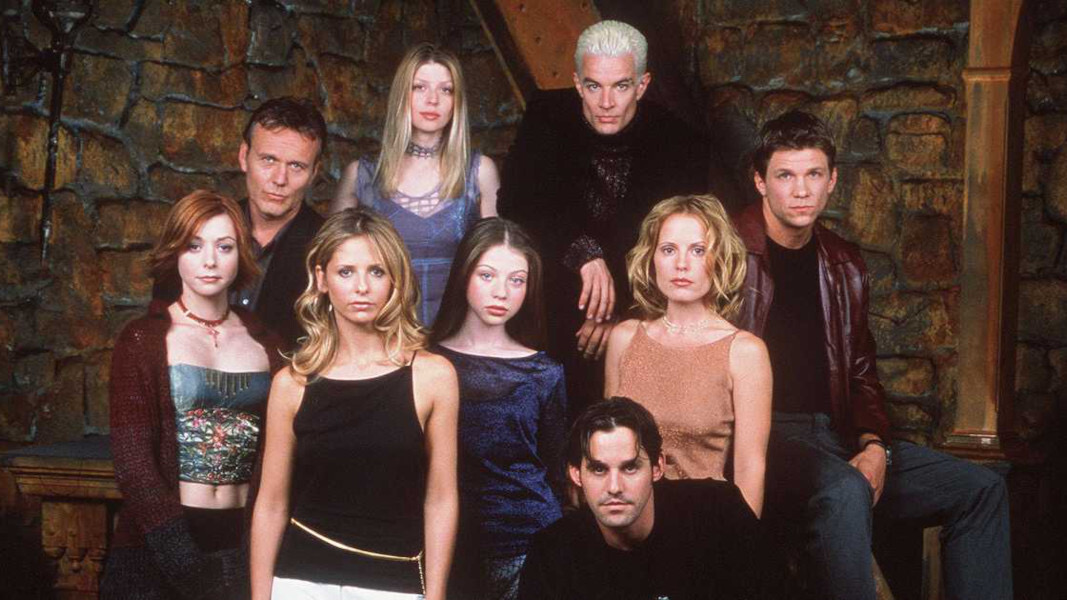
Characterization In The Buffyverse — ‘Buffy The Vampire Slayer’ Season 5, Episode 12
by Benjamin Hall
This is part of a bi-weekly series concerning the characterization of Buffyverse characters. Arguably the best place to begin reading this series is at the beginning, but that is up to each reader. As a reminder this column will cover major and some minor characters from the shows Buffy The Vampire Slayer (1997-2003) and Angel (1999-2004). Other Buffyverse media, such as the graphic novel Spike: Into The Light (2014) are not pertinent to this series. Also there will be no referencing real world events that have direct relation to either show in this bi-weekly series. Although this series does reference things that have no direct relation to the show in order to examine things such as metaphors and literary analogues.

This week: Buffy Summers (Sarah Michelle Gellar) faces a fight for authority from the Watcher’s Council. Also Glory (Clare Kramer) stops by Buffy’s house.
(Warning of spoilers from this point on!)
Joyce Summers (Kristine Sutherland) raises two points with what she says while in Spike’s (James Marsters) crypt: it is now, to an extent, more like a home, albeit a decrepit one. The second point: interest in the soap opera Passions (1999-2008), which leads to her and Spike bonding some more (Season 3, Episode 8, “Lover’s Walk”). This further establishes that there are things about Spike that Joyce likes. Nevertheless, she does not want Buffy dating vampires because she still wants “normal” things for Buffy, such as grandchildren (Season 3, Episode 20, “The Prom” and Season 5, Episode 14, “Crush”). Additionally, her clothing plays a factor in her characterization since she is wearing a scarf to remind viewers of her cancer surgery.
Dawn Summers’s (Michelle Trachtenberg) eavesdropping on the Scooby meeting foreshadows her discovery in the near future that she is the key (Season 5, Episode 13, “Blood Ties”). Other than that, she is bratty when meeting Glory, and seeing her mom and Spike relating over a soap opera.
Buffy doing some house cleaning during the opening Scooby meeting highlights her anxiety. This is a sign of her self-esteem issues since she is not only worrying about possible death, but how authority figures view her. Luckily, the attempt at a power play by Glory, and then the Knights of Byzantium’s first attack, gives her a strategy to use against the Council. Her attempt to use non-verbal communication to warn Dawn away displays Buffy being quick at adapting to dangerous situations. An interesting moment occurs with Buffy when she trusts Spike to protect Joyce and Dawn without payment. It suggests that she may already know of his feelings for her, but is in deep denial of that knowledge.
Rupert Giles (Anthony Stewart Head) has a more casual sense of fashion at the beginning of this episode. This change in style, along with his current car, suggests he is either going through a mid-life crisis or loosening up as a person (Season 5, Episode 11, “Triangle”). Either way, it makes how he acts in the upcoming seasons arguably feel like two different characters from this one. He also seems to lack a quick enough wit when Buffy makes demands since neither he nor she asks for slayers to receive funding. While other standout moments exist in this episode for Giles, they are mainly just quotable ones and not things that really affect characterization.
Spike interrupts Buffy’s stress-relieving slaying. It occurs at such a speed that it is hard to say whether he is right in anyway to do so. Nevertheless, he is in no way right to attack her on the subject of her past relationships. Still, this is a decent example of how poorly characters can communicate on this show. Spike may be perceptive, but his inability to think before speaking hinders him when it comes to healthy pursuits of romance. Fortunately, despite his mouthing off to her and past misdeeds, Buffy continues to see him as an asset when it comes to protecting her family.
Xander Harris (Nicholas Brendon) comes off as an unimportant idiot during the Council’s scrutiny. One example: how he fails to mention the army knowledge remaining from the costume spell (Season 2, Episode 6, “Halloween”).
Anya (Emma Caulfield Ford) gives a backstory for her current human self that may or may not tie into her first appearing in Sunnydale while a demon (Season 3, Episode 9, “The Wish”). What makes this unclear is how new the information is to viewers as well as the fact she noticeably has to think about it.
Willow Rosenberg (Alyson Hannigan), for some reason, ignores Buffy’s mention of the Kralik incident and the Watcher’s Council’s involvement (Season 3, Episode 12, “Helpless”). This places some emphasis on how she tries to deny certain facts to fit things in her view of how they should be.
Tara MaClay (Amber Benson), along with Willow, displays a nervous energy while facing a civil enough interrogation by the Watcher’s Council. While she remains a separate character from her girlfriend, Tara’s actions and reactions in this episode seemingly exist just to enhance Willow’s own.
Quentin Travers (Harris Yulin) is similar in manner to his prior appearance — in that he has a pompous air about him. The way Travers apparently gives so little information to Buffy’s group after giving into her demands reinforces this fact.
Lydia (Cynthia Lamontagne) initially comes off as just another member of the delegation. Yet, when she meets Spike there is a hint of lustful interest in him that suggests she may, on some level, want to rebel against the status quo.
Philip (Oliver Muirhead) and Nigel (Kris Iyer) are two toady-ish members of the Watcher’s Council’s delegation. Being annoyances to the main cast of characters seems to be their primary function, but one could argue that function is secondary to supporting Travers.
Professor Roberts (Wesley Mask) is a stereotypical college professor who seems to abhor interruption or independent thought. He mainly exists to remind viewers that Buffy is still in college.
The mailman (Peter Husmann), Council Member #4 (Jack Thomas), Council Member #5 (John O’Leary), and Council Member #6 (Jessica Biscardi) are all stock in characterization. Although the mailman is more plot device than character since his existence allows for a scene of exposition that moves the over-arcing plot.
Orlando (Justin Gorence) pretty much only exists in this episode to provide exposition and a fight scene. Thus, one might say this less establishes him as a character and more foreshadows him as a plot device (Season 5, Episode 20, “Spiral”).
Dreg (Kevin Weisman) and Jinx (Troy T. Blendell) assist Glory with keeping her sanity by kidnapping the mailman for her to “drink” from. Jinx also provides exposition about the timeline for using the key. Arguably, this exposition should come from Dreg because he seems to be an important minion when it comes to magical knowledge (Season 5, Episode 8, “Shadow”). Yet, one can assume that Dreg lost some favor with Glory since the snake demon’s failure. Whatever the case, Dreg’s status of importance falls in this episode when Jinx’s rises.
Ben Wilkinson (Charlie Weber) and Glory continue their differing reactions to her minions. An example: Ben’s message back to Glory via Jinx. The truth of what their connection to each other is remains hidden. Nevertheless, the way Jinx and Ben interact with each other, and how Glory reacts to Ben not helping, is a strong hint. Although, it is easy to see how some first time viewers might, at this point, interpret them as either brother and sister or ex-lovers. While not clearly present in the episode, the theory that they are a bad analogy for transgender individuals still can fit in to an analytical view of the narrative. It could be argued that Ben and Glory are experiencing supernatural gender dysphoria in their attempts to communicate through the minions.
For the most part, this episode does well at providing levity while speeding up the over-arcing plot’s progression. However, the amount of characters reduces the potential to really explore certain ones. Case in point: Quentin Travers and Lydia have the possibility of adding more figurative meat to their respective characterizations. Instead, they do not get enough screen time because of characters like Orlando and Professor Roberts. This same problem causes some of the main supporting characters to be here more for levity and exposition than any real purpose.

