
Epic Dissection — ‘X-Men: Wounded Wolf’ Is An Embarrassment Of Artistic Riches
by Austin Gorton
This is the first entry in a new semi-regular column in which I break down the chonky Epic and DC Finest collections from Marvel and DC, which collect a hefty chunk of a series’ issues chronologically in each volume, but whose volumes are released out of order, such that the next batch of stories collected may be from earlier or later in the series’ run. In each entry, I’ll detail the notable events chronicled therein, highlight creative efforts, and spotlight overlooked issues and characters. Enjoy!
Vital Statistics

X-Men Epic Collection Vol. 13: “Wounded Wolf” collects Uncanny X-Men #199-#210, X-Men Annual #9-10, New Mutants Special Edition #1, Marvel Fanfare #33 (1985-1986, 1987). 496 pages, $54.99.
Creator Central
This volume collects issues originally released roughly 2/3 of the way through writer Chris Claremont‘s initial 15 year run on the X-Men, and as such, he is the credited writer on every issue collected therein. He is joined by a Murderer’s Row of artistic collaborators. This marks the end of John Romita Jr.‘s first run on Uncanny X-Men (he draws part of Uncanny X-Men #211, but #210 is his last full issue), and he contributes to nine of the issues collected here.
Art Adams, who was in the midst of breaking into comics via the Longshot miniseries around this same time, begins his collaboration with Claremont as well, penciling both the series’ annuals collected here (one of which serves to introduce Longshot and his archenemy Mojo to the X-Men universe) as well as New Mutants Special Edition #1.
Barry Windsor-Smith contributes his third issue to the series as a guest artist, with the gorgeously-illustrated Wolverine solo story in Uncanny X-Men #205. Rounding out the collection are June Brigman (on Uncanny X-Men #204 and Marvel Fanfare #33) and Rick Leonardi (on Uncanny X-Men #201), neither of which are slouches in the art department. All in all, it would be tough to find a collection with this many artists with different styles that all nevertheless look fantastic.
Notable Events
Though this volume ultimately collects only eleven issues of the main series, it is packed with incident and notable happenings, including:
- The adoption of the Phoenix identity by Rachel Summers.
- The first appearance of the Brotherhood of Evil Mutants-as-federal-agents aka Freedom Force.
- The fan fan-favorite “Asgardian Wars” story.
- The trial of Magneto, which concludes with Professor Xavier leaving Earth and putting Magneto in charge of the school.
- The birth of Cyclops’ son (and future Cable), Nathan Christopher Charles Summer, and Cyclops’ subsequent retirement from the X-Men (setting up his appearance in spinoff series X-Factor).
- The book’s final two crossovers with the Secret Wars II event.
- The aforementioned Wolverine story in Uncanny X-Men #205, another fan favorite.
- The introduction of Longshot and Mojo to the X-universe.
- The lead-in to the “Mutant Massacre” crossover event and Romita Jr.’s final full issue of the series.
Cover Concerns

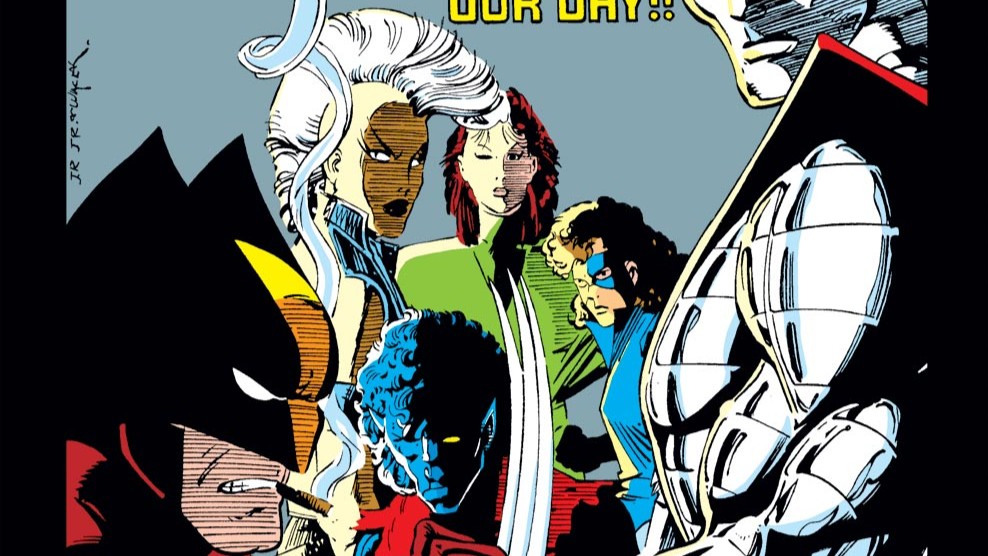
The cover for this collection comes from Uncanny X-Men #210. While the cover of Uncanny X-Men #205, the issue whose story title gives the collection it’s name, is fantastic in its own right, it’s tough to beat Uncanny X-Men #210’s oft-homaged group shot as the cover for a collection of X-Men stories.
Best Single-Issue – Uncanny X-Men #205
Here is where we give Uncanny X-Men #205 its due. A taut self-contained story (its biggest flaw is that it drops in the middle of the book’s ongoing narratives with little setup) that finds Wolverine brutalized by a trio of cyborgs (the surviving Hellfire Club mercenaries he attacked back in “The Dark Phoenix Saga”) led by Lady Deathstrike (who debuted in Daredevil, of all places, not long before this but debuts her iconic cybernetic-and-claws upgrades here) while trying to protect Katie Power, the youngest member of the superhero kid team Power Pack both from the cyborgs and his own animalistic brutality.

Gorgeously-drawn by Windsor-Smith (easily the best of his four one-issue collaborations with Claremont in this period), its panels feature intricate detail, from the cybernetic wires to the splatters of blood to the falling snow. He also taps into the visual language of Wolverine stories for the final Wolverine/Deathstrike showdown, mimicking Frank Miller and Paul Smith’s layout from the Wolverine miniseries and Uncanny X-Men #173, respectively. At a time when solo Wolverine stories were still something of novelty, Claremont and Windsor-Smith turn in one of the best.
Best Story – “Asgardian Wars”

“Asgardian Wars” in New Mutants Special Edition #1 and X-Men Annual #9 is considered by many X-Men fans one of the best stories, period, and I’m not going to argue with that. Spinning out of the X-Men/Alpha Flight miniseries (which takes place chronologically earlier than this volume but whose final issue was published more or less at the same time as these issues) it finds Storm and the New Mutants transported to Asgard by Loki, with the rest of the X-Men quickly following behind to rescue them.

Both giant-sized issues are drawn by Art Adams, and he’s clearly having a blast drawing these superheroes in fantasy setting. This isn’t the first (or last) time Claremont would fuse the sci-fi/social metaphor tropes of the X-Men to the tropes of high fantasy, but its arguably his best such effort, in part because he has such a worthy collaborator in Adams. While far removed from both the thematic core of the X-Men and the immediate narrative concerns of the other stories collected in this volume, the way “Asgardian Wars” uses the fish-out-of-water tension between its characters and their setting to further characterization will be felt for years to come.
It also just looks really, really good.
Standout Character – Rachel Summers

It’s rare in one of these collected editions where the beginnings and endings are dictated as much by mapping out how the whole series is going to fit into the right number of volumes with a consistent number of pages to find a character who undergoes something approximating a complete narrative arc, especially in a team book.
But that’s more or less what this volume gives us with Rachel Summers, claims her birthright as Phoenix at the start of the volume, battles the Beyonder and almost destroys the universe in the middle, and then is ultimately left feeling abandoned and alone, on the verge of death, by the end, thereby concluding her initial tenure on the X-Men (she was meant to star in a solo miniseries that would continue her story, but it never came to fruition; instead, she would have to wait until the launch of spinoff series Excalibur to return). Wolverine’s solo outing may have given this volume its title, but if it’s anyone’s story, it’s Rachel’s.
Standout Creator – John Romita Jr.
In a book crammed full of artistic standouts (and with Claremont eligible in plenty of other X-Men Epic collections), this nevertheless has to go to John Romita Jr., whose strongest work in this first run on Uncanny X-Men comes here, at the end. Uncanny X-Men #202-203, in which he’s inked by Al Williamson, are a preview of the duo’s phenomenal work on Ann Nocenti’s Daredevil later in the decade (and the cosmic #203 features Romita having some fun finding ways to visualize the existential conflict between Phoenix and the omnipotent Beyonder).

But his other issues, inked by Dan Green, are no slouch either, particularly the Hellfire Club/X-Men/Nimrod threeway fight in Uncanny X-Men #207-209, which is a great slice of superhero action storytelling. Plus, his occasionally-maligned costume design skills (in which he leaned heavily on contemporary fashions of the time which…haven’t aged great) get a boost here, with his revamp of the Phoenix look, his ironic-but-now-iconic “Big M” Magneto costume, and the so-bad-it’s-good “bedsheet cape and domino mask” look for Hellfire Clubber Harry Leland (let’s not talk about Fenris).
Hidden Gem – Uncanny X-Men #199

If it’s remember for anything, it’s for Rachel’s adoption of the Phoenix mantle, but Uncanny X-Men #199 is a pivotal issue in Claremont’s series-long development of the X-Men as non-traditional, anti-establishment superheroes. It’s the issue where the establishment — the US government — officially deploys licensed super-villains — the former Brotherhood of Evil Mutants, in the form of Freedom Force — against the X-Men. If the villains have become the heroes fighting to uphold the status quo, what do the heroes need to do to survive? Become villains in the eyes of the establishment, perfectly setting the stage for the Xavier-to-Magneto changeover in the next issue.
Fun Fact

Future Uncanny X-Men penciller and Image co-founder Whilce Portacio inks Uncanny X-Men #201 in this volume, in which Storm and Cyclops duel for leadership of the X-Men, his first work on the X-Men.

