
An Interview With ‘Hello Sunshine’ Author Keezy Young
by Rachel Bellwoar
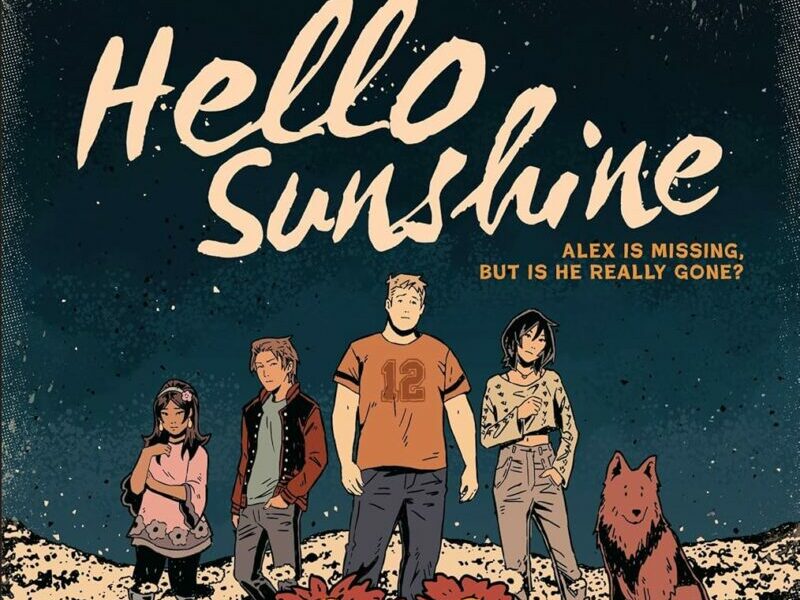
Cell phones aren’t allowed at church summer camp. That’s why when Noah returns home he’s the last to learn Alex Lombardi’s been missing for months. While he may have been late to the news, however, it doesn’t take long for Noah to connect with Alex’s friends and twin brother in Keezy Young‘s new graphic novel, Hello Sunshine. Their search to find Alex won’t be easy but this interview with Young was a dream:

Rachel Bellwoar: Hello Sunshine isn’t the first book or TV show (i.e. Riverdale) to feature teenagers trying to solve a local mystery on their own. It’s easy to pass this off as teen rebellion but do you think the real problem is adults and authority figures are failing to be trustworthy?
Keezy Young: I think teenagers are in an essential stage of growth where they have started to realize that adults aren’t all-knowing, aren’t perfect, and sometimes don’t do the right thing. They respond to that in different ways, but often they’re disappointed at this slow reveal, as they watch as people they once idolized turn into just average joes with hangups and traumas and mistakes of their own. And that turns into rebellion, because who wants people who aren’t actually better than you–sometimes even worse–controlling every aspect of your life? So they start pushing back against adults and authority figures in order to stake out as much freedom as they can, testing boundaries, limits, and their loved ones’ patience, haha.
In the case of Hello Sunshine, we see different responses; for someone like Jamie, he’s grown up with adults disappointing him on all sides for years, now, and has basically no trust or respect for them at all. He’s a delinquent, constantly chafing against authority. Noah, in contrast, has never had any reason to disbelieve or question adults’ motives, so hasn’t really done anything rebellious until now, either. Part of his growth arc is having to recognize that his parents aren’t necessarily the kind, good people that he wants them to be, and if they aren’t, then who else might let him down? Who else let Alex down?
All the kids ultimately realize that the adults in their lives, regardless of how decent they are, aren’t up to the task of finding Alex, and that leaves them to see if they can step up where their elders have failed. It’s partly teenage hubris, partly rebellion, and partly frustration–”why isn’t anyone doing anything?” Which becomes “maybe because anyone is us.”
Bellwoar: Each chapter of Hello Sunshine is told from a different character’s perspective. Was it difficult to land on the chapter order and was Noah always chapter one? What was it like finding each of their voices?
Young: Noah was always chapter one, yeah! I knew that I wanted him to be the new kid. He’s known Alex for a year, but only under very specific circumstances, and isn’t familiar with the other kids or Alex and Jamie’s situation with their mom. It was a convenient mechanism for introducing the context and characters, and having him step into it late, having missed what happened before Alex disappeared, was similarly a fun way to amp up the mystery.
I also knew that I wanted Alex’s chapter to be second to last, and be the one that tells us what actually happened (albeit through his warped perspective). Jamie felt natural as the last chapter, since he’s the one with the most growing up to do, and arguably the most important relationship in Alex’s life. That left Sky and Izzy to fill in the middle chapters–Sky being the mundane murder mystery, and Izzy being the shift to supernatural avenues of investigation.
As for finding their voices, some were easier than others. Noah’s and Sky’s came quickly, and Alex went through some growing pains before I landed on his (the key was his list-making, which is something I do myself, haha). I struggled a bit with Izzy, because I’m not shy myself, or an introvert, but in the end I realized I could lean on the things I do have in common with her–a distaste for taking the lead, and anxiety around doing the wrong thing. And Jamie’s was…while not difficult, exactly, definitely emotionally taxing; I had to dig into a very angry, self-hating place to do it. And unlike Noah, who’s figuring stuff out slowly but surely, Jamie is very self-aware; he knows he’s messing up, he knows he needs to let go of his rage and access other emotions in order to help his brother, but that doesn’t mean it’s easy to do so.

Bellwoar: The chapter from Alex’s point of view is especially powerful in how it portrays his self-isolation and uses word balloons, not just for dialogue but to get across how overwhelming the voices he’s been hearing are. Word balloons are a staple of comics but where did you land on the idea to wield them in such a way?
Young: It was a little tough, honestly! Auditory hallucinations are a staple of psychosis, and they’re not something that most people have experienced or understand. For example, people think it’s “the voices in your head,” when in reality, they’re usually coming from specific spots (from behind the wall, from the space to your left, from the ceiling, etc). They can be overwhelming and painful, or just sort of vaguely annoying. Some are scary-sounding, while others just sound like normal people talking, or even people you know. I also had to balance including that much text in the environment with the panels still being legible–Alex’s pages are harder to read than the other kids’, purposefully so, but I didn’t want it to feel like a slog, either.
For this reason I knew early on that I wanted to do my own lettering, and so I studied it as much as I could beforehand. I read Nate Piekos’s book on the subject, I followed blogs and newsletters, I took note of interesting balloons I saw in other people’s art. I started thinking of the lettering as part of the art, and not just something to put on top of it, and I think that the blending of the two is what ultimately made it work!
Bellwoar: You can learn a lot about a person from the music they like or the posters on their walls. It’s clear you put a lot of thought into those details here (shout out to the Bewitched and Suspiria posters in Alex’s room). For Alex, why did you decide to have him be the only character with a soundtrack?
Young: Mostly because music is so important to him. He uses it as a coping mechanism to drown out the voices, as a way of relaxing, and a way to cheer himself up (note that all of his songs are upbeat aside from maybe “Perfect Day” by Lou Reed, which he listens to at his worst). He’s trying to escape what’s happening to him, and music is one way that he does that.
I also wanted Alex to feel as human as possible, because so often, just the fact of severe mental illness dehumanizes someone in our eyes. It was important to me that he wasn’t just a sick kid, but rather he’s a person, and he has dreams, desires, flaws, and quirks, and one of those quirks is that he really likes 60s music!
Bellwoar: Clothes can be extremely telling, too. For instance, the way people in town say “Lombardi” like it’s a bad word you’d think Jamie wouldn’t want anything to do with his last name. Instead we always see him in a Letterman jacket with his last name blazoned on the back. Do you enjoy coming up with wardrobes for your characters?
Young: Jamie is nothing if not stubbornly unconcerned with what other people think of him haha. I do enjoy outfitting my characters! I think character design can tell you a lot about a person, and the choices they make in their clothing selection is a huge part of that. The fact that Jamie even has a letterman jacket throws you off a little bit, because it suggests he plays sports and maybe has a degree of popularity, despite his delinquency and caustic attitude at the beginning of the book. Izzy’s styling is a bit of a mystery at first, too, because she seems shy, not someone who would put herself out there that way, until we find out that she got the clothes from Mrs. Danner, and she’s partly doing it as a way to honor Alex’s suggestion that she wear whatever she wants to wear. Sky’s choice not to wear makeup is an important one, because it suggests that she’s unconcerned with ultra-femininity, and confident enough to go without. Alex’s outfits are pretty par for course, but I made a point of having him wear his parka even in hot weather before he disappears–something that people in psychosis often struggle with is temperature management, and he also might be doing it to feel safer. But it makes him stick out awkwardly, just another angle on his uncomfortable behavior while unwell.

Bellwoar: Speaking of Jamie, stories about siblings are a personal favorite. Why was that a relationship you wanted to explore?
Young: I have two siblings, myself, a twin brother and sister. I think a lot of people have this idea that twins are closer than other sibs, supernaturally so, even. I wanted to explore what it’s like to be a twin and not feel that way–to feel like you let your brother down when he needed you most, to not have noticed anything was wrong, and to not know how to help. I don’t think familial relationships come easily all the time; they often take work, hard work, and you can’t fall back on unconditional presumed love. You actually have to show it.
I also think it’s important to acknowledge that when someone gets sick the way Alex is, it effects more than just them. And when it’s a teenager who becomes unwell, their siblings are often tasked with taking up the slack, putting their own stuff aside, growing up very fast, and becoming a sort of extra parent figure. It’s very, very difficult to have a sibling with a psychotic illness, and I wanted to portray and explore some of that difficulty.
Bellwoar: In one of your bios you write about having “add[ed]… flowers to the margins of every homework assignment” and your award-winning autobiographical oneshot is called Sunflowers. What do you think it is that keeps drawing you to flowers and, for this book, why daisies?
Young: I like contrast! Flowers are pretty, colorful, they usually bloom in the sun, they smell nice. I write and draw horror a lot of the time, and I like throwing in these bright beautiful things because I think it throws readers off kilter a little.
Daisies specifically are an interesting one, because they’re one of the “nicest” flowers you can think of, and they were very popular in the 1960s, summer of love and all that. But they also don’t really smell good. Flies and earwigs really like them. In Alex’s mind, they’re associated with his mom, because they’re the flowers she loved, and so as the story progresses and he starts thinking of her as a source of evil, they get scarier, eventually incorporating human eyes. They represent his illness corrupting everything he thinks of as safe with terror and distrust; he’s even afraid of daisies, by the end.

Bellwoar: So many horror movies like to capitalize on the ambiguous ending where there’s a logical explanation for everything that’s happened but also a supernatural one. Hello Sunshine dares to ask “why can’t it be both?” Is this a trope that’s bugged you before?
Young: Definitely! I think we have a ton of both ambiguous endings, and a ton of endings where it’s concretely one or the other, all the way back to the Cabinet of Dr. Caligari in 1920 (where the protagonist wakes up in an asylum, and the story has all been a figment of his deluded mind). There are some great works in there, don’t get me wrong, but at the time I’d never seen a movie where the supernatural coexisted alongside real, diagnosable, treatable mental illness. It made me feel like people like me don’t get to exist in horror stories, or even fantasy in general; we’re always a metaphor, or psych! The ghost was real all along (or, conversely, psych! You were actually crazy all along).
Hello Sunshine started with the core premise that it would be both, because I wanted to explore what would happen if someone who had access to supernatural abilities also was dealing with psychosis, and the complications on both sides of that equation that would arise both for that person, as well as their loved ones. I wanted to write a story where someone like me could exist in a world with magic.
Bellwoar: Another popular thing to do in horror is be really vague about what mental illness a character is struggling with or pick a hodge podge of symptoms without committing to a diagnosis. How important was it to you to give Alex’s mental health struggles a name?
Young: I think it’s really important to acknowledge that there’s no such thing as “insanity.” That’s not a diagnosable condition. Usually what people mean when they say “insanity,” or “madness,” is psychosis (which is a symptom, not a diagnosis in itself, and found most often in schizophrenia, schizoaffective, and bipolar) but we rarely even bother to name that. I think most writers shy away from naming an illness because, for one thing, it requires you to have to know something about severe mental illness, and most people don’t have a clue. They have a lot of stigmatizing assumptions, but not any real idea of what severe mental illness entails. Secondly, once you start looking into what it means to have bipolar or schizophrenia or whatnot, you start to realize that whatever plot or “insane” character you’ve come up with just isn’t realistic. We’re scared, not scary; we’re capable of living good lives, not doomed; and while there’s a lot we don’t know about severe mental illness, we’re definitely not just a mishmash of whatever spooky symptoms you feel like throwing at us! There are identifiable patterns and experiences that go along with these diagnoses. So I think people recoil from naming an illness because they want to cling onto the stigma–the idea of what it means to be crazy, rather than the reality.
It was also really important to me that Alex’s illness be named because I did make him relatable, and loveable, and quirky, and kind, and I didn’t want readers to come away from the story thinking “he can’t possibly have something like schizophrenia–he’s not scary enough.” Naming it makes it impossible to escape the truth of it; that people with psychotic illness are just people like everybody else, and all the stigmatizing assumptions about them you’ve probably come into this with need to be teased out. Naming it essentially confronts readers with the reality of their own prejudice. It makes Alex into a real person, someone you might see on the street, or at school, or on a date, or in the psych ward–or in the mirror.

Bellwoar: Thanks for agreeing to this interview, Keezy!
Hello Sunshine is on sale now from Little Brown Ink.