
Revisiting ‘The Florida Project’ — Second Sight’s Blu-ray Reviewed
by Rachel Bellwoar
When one door closes, another door opens. Nice enough, as far as sentiments go, and it’d be great if that were true. It’d certainly make job hunting less scary but sentiments won’t pay the bills and it certainly seems like more doors are closing for Halley (Bria Vinaite) than opening in Sean Baker‘s film, The Florida Project.

Halley and her daughter Moonee (Brooklynn Kimberly Prince) live in a motel right outside of Disney World, but it might as well be lightyears away. Part of the hidden homeless, their living accommodations are far from stable (every 29 days they have to move out for 24 hours in order to not establish residency), and yet for Moonee the precariousness of their situation hasn’t tarnished her summer at all as the film notes the difference between her understanding of what’s going on and Halley’s efforts to preserve her childhood.
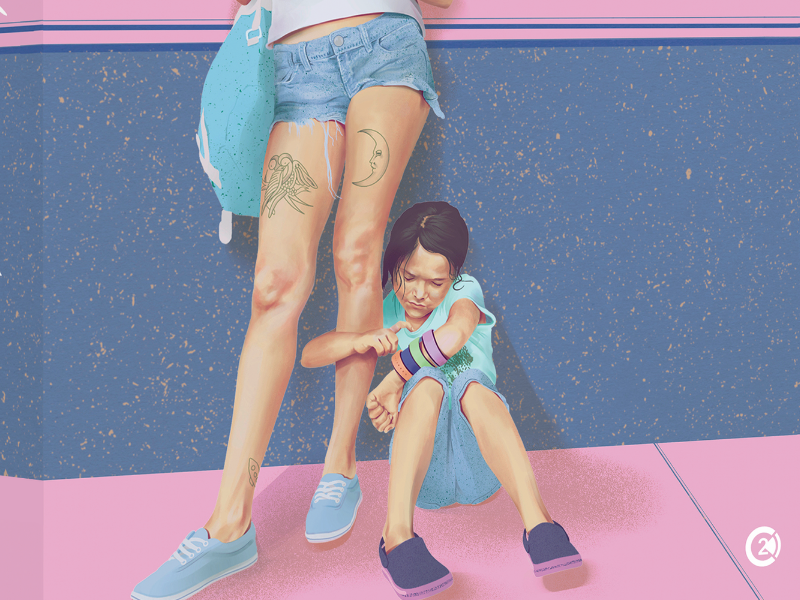
The Florida Project was first released on Blu-ray in 2018 and the same bonus features have been ported over for Second Sight’s new release, including fifty minutes of essential making-of footage. However, Second Sight have more than upped the ante by including new interviews with all the main cast, two new commentaries, and gorgeous packaging that features new artwork by Michael Dunbabin.
I do wish Second Sight didn’t force collector’s hands by making the 160-page hardback book with new essays (it’s so hefty it even has that new book smell) only available as part of the Limited Edition which includes the film on 4K and Blu-ray, as well as a separate Blu-ray disc with additional bonus features. As someone who doesn’t have a 4K player, the separate Blu-ray only release would’ve been fine, but that would’ve meant no book (plus the 8 art cards actually feature good photographs for a change) and the book deserves better than to be held hostage or made limited, as it’s filled with great writing. Nadine Whitney considers how making a truthful film doesn’t mean always being beholden to the truth, like the geographical impossibility of the ending of The Florida Project, while Hannah McGill provides a genius breakdown of the role of language (including profanity) in the film and how that culminates in one of Moonee’s last lines: “I can’t say it.” There’s also an essay on Dafoe by Tim Coleman. Martyn Conterio considers the film’s portrayal of a specifically working class summer. Dawn Stronski investigates what the architects of the “American Dream” actually intended and everyone should be able to read Elena Lazic’s essay on sexwork in Baker’s movies and how Baker argues that “…misery is caused by hatred…,” not sexwork as a profession (Lazic’s essay is also a great argument for why Starlet should be the next Sean Baker film to get the Second Sight treatment).
The other small flaw I would call out is Second putting all the new cast interviews on the same disc as the movie. When you first glance over the list of bonus features the most exciting ones, of course, are the ones like a new 2o minute interview with Willem Dafoe, who plays the motel’s manager Bobby. By putting those ones on the movie disc, however, it discourages fans from taking the time to turn on the second disc, which is also chock full of new interviews but not necessarily the recognisable names, like producer Andrew Duncan who talks about how last minute the casting of Dafoe was, as well as how they dealt with getting their permits revoked the night before shooting was supposed to start.
My favorite interview is on the second disc and that’s the one with associate producer Samantha Quan who was also the acting coach for Vinaite and the kids and is Baker’s partner in real life. She brings up the Korean film Miracle on 1st Street as an inspiration for the child acting and goes over the techniques she used to help the first time actors become comfortable in their roles. I also appreciated the new interview with Reverend Mary Downey who’s the Executive Director of the Community Hope Center and could speak on the current hidden homelessness numbers in Florida.
Other thoughts after listening to the bonus features:
- I love the mutual admiration society that is Vinaite and Dafoe praising each other in their separate interviews. Vinaite and Prince also talk about how much they’re still in touch in their separate interviews (which is something you can’t know from the interviews that were filmed when the movie first came out, which is why having both the old and new interviews is so valuable – one doesn’t supplant the other and they don’t just repeat the same anecdotes).
- Case in point: Baker appears a lot on this set, including a new 35 minute interview as well as a director’s commentary where he’s joined by co-writer Chris Bergoch and director of photography Alexis Zabé. He never runs out of new things to share, however. In the interview, for example, he talks about John Mannion, the inspiration behind Dafoe’s Bobby and rolling back on the original plan to have Halley develop a drug addiction (which you can see that decision happen in real time in the archival footage, “Under the Rainbow: Making The Florida Project”). The commentary, meanwhile, gets to be very detailed oriented and scene specific, like breaking down the open titles, talking about how they weren’t able to track down the actress Rosa Medina Perez who played the laundry attendant until after the movie came out (which resulted in her having only two scenes instead of the planned three), and being turned down by Waffle House to film there.
- Prince, Valeria Cotto (Jancy) and Christopher Rivera (Scooty) return to The Magic Castle for the first time and give a tour of the location, which comes with the sad revelation that The Magic Castle is no longer purple (though apparently it wasn’t even supposed to be purple when they started filming as producers Kevin Chinoy and Francesca Silvestri get into in their interview).
- In her solo interview, Cotto expands upon the story that she was discovered by Baker in a Target – she and her family had been in the middle of a search for a Darth Vader book bag for her cousin.
- The film was originally supposed to end with Jancy and Moonee getting on a ride at Disney World but, according to Bergoch in his interview, the kids hated the Astro Orbiter, which led to the ending of them running towards the real Magic Castle instead.
- Documentarian Rohan Spong‘s visual essay looks at how Zabé uses framing to capture a child’s perspective while film critics Kat Ellinger and Conterio cover everything from the surveillance of the lower classes to the gendered nature of films about poverty like the “angry young men” of the British New Wave in their socially conscious commentary.
The Florida Project is available as a Limited Edition 4K and Blu-ray combo release which includes the essay book. There are also separate standard Blu-ray and 4K discs that come with all the bonus features but the only way to get the book is with the Limited Edition.

