
Much Ado About ‘Abuzz’: An Interview With Amy Chase And Stelladia
by Rachel Bellwoar
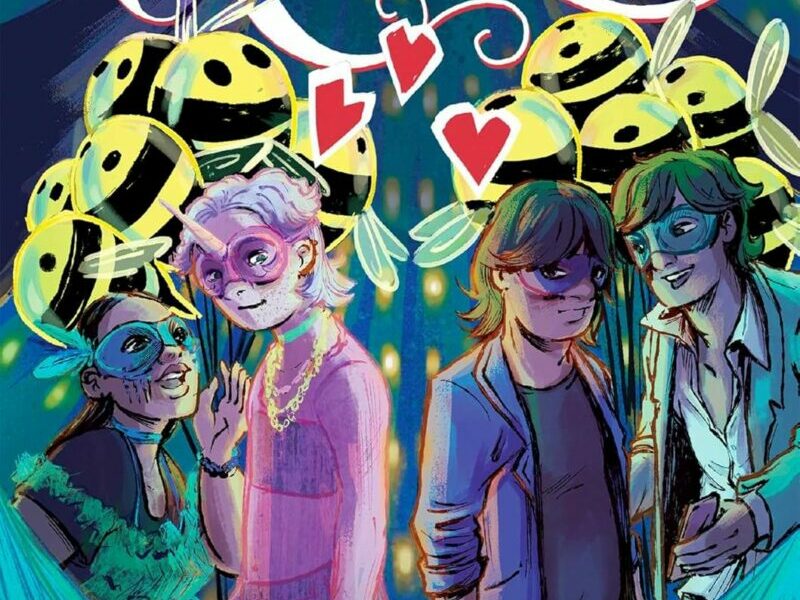
It doesn’t get much more dramatic than high school, so what better place to reset William Shakespeare‘s Much Ado About Nothing than a modern day high school? Writer Amy Chase and artist Stelladia have done exactly that with their graphic novel, Abuzz. Featuring colors by Ellie Wright, letters by Taylor Esposito, and tons of LGBTQIA+ characters, here’s what they had to say about the Bard and his continued relevance:

Rachel Bellwoar: Of Shakespeare’s plays, what made you choose Much Ado About Nothing to adapt and do you remember the first time you encountered the play?
Amy Chase: Much Ado About Nothing has been my favorite Shakespeare work ever since my freshman year of college over a decade ago. In high school, we only covered the bog-standard Macbeth, Hamlet, and Romeo and Juliet, but I had also casually watched She’s the Man and Romeo + Juliet with friends around that time as well. But in college, we deeply studied Much Ado and then watched both the Kenneth Branagh and Emma Thompson adaptation as well as Joss Whedon’s black-and-white adaptation that had just come out that year. I even went to a screening with a cast Q&A for the latter film the following summer. That really began to open my mind up to how adaptations on the same Shakespeare text could vary so drastically — I went and sought out another classic I’d missed, 10 Things I Hate About You, shortly thereafter, and saw both the musical Kiss Me, Kate and a park production of Taming of the Shrew. From then on, there was never a doubt in my mind that, given the chance, I’d love to do my own adaptation of Much Ado, which remained my favorite play out of all those I’ve ever read or seen performed.
Stelladia: I landed at the project when it was already outlined and partially written. Much Ado was one of the plays I wasn’t very familiar with. I think that was a good thing, because I was able to investigate different references without having a previous mental picture of what it was supposed to be like. It was also incredibly exciting to see how Amy approached the story chapter by chapter.

Bellwoar: Overall, do you prefer Shakepseare’s comedies or his tragedies?
Chase: I tend to prefer Shakespeare’s comedies, though I can’t deny that Macbeth and King Lear are also high up on my overall list. I think that the comedies get seen as less literary, though, because humor isn’t taken as seriously (or may just be harder to teach in a high school English class). Much Ado, A Midsummer Night’s Dream, and Twelfth Night are my overall favorites, and I feel like they get the full force of wordplay and over-the-top situations that I love to see performed or read aloud. Admittedly, the only Shakespeare works I’m really not a big fan of are the histories.
Stelladia: I love A Midsummer Night’s Dream, but I’m more familiar with Shakespeare’s tragedies. I had the chance to watch Macbeth at Shakespeare’s Globe in London, the 2013 production, which was incredible. My friend and I also had tickets for A Midsummer Night’s Dream, but we missed the play. A few years later, we got to see David Tennant’s Richard II at the Barbican Centre. I’m still not over missing the chance to see Jonathan Bailey’s version in London a few months ago, but that’s the magic with Shakespeare’s plays: they are there to be visited through new lenses and faces constantly. They are so ingrained in our culture that they’re part of the archetypes we have in our imagination, and there’s always a good time to make a new adaptation.
Bellwoar: Like 10 Things I Hate About You, Abuzz transplants the action to a modern day high school. Were there any other options you considered?
Chase: For the setting? Honestly, not really. I’d always viewed this adaptation in the context of high school students — the “he said, she said” of it felt like the perfect outline for many of the most dramatic types of incidents I remember from my school days. I also wanted to make this a relatable adaptation that a high school teacher wouldn’t be afraid to recommend to their students in lieu of the same few tragedies that always get taught.
Stelladia: I think many of Shakespeare’s plays are high school material. Sometimes I see people talk about Romeo and Juliet, and it seems like the youth’s folly element is kinda missing from the tragic romance perspective. I’m so glad Amy decided to give us a new high school adaptation!

Bellwoar: I feel like before this book I kept mixing Much Ado About Nothing and Taming of the Shrew up in my head, which is why (with the Elizabeth Taylor and Richard Burton movie in mind) I kept expecting Beatriz and Ben to be violently fighting the whole time. Getting to see them start to stabilize as a couple was a real treat. Was it important to you to show their relationship evolve beyond the bickering?
Chase: It’s funny you say that, because I had to check myself a few times during the scripting to make sure I wasn’t getting too close to Taming of the Shrew territory (with regards to Hero being unable to secure a date before Beatriz). But they do share some similarities in that regard.
That said, adding more backstory and depth to multiple characters was important to me for this adaptation, and the Ben and Bea history is actually a kernel I wanted to blossom from the Whedon adaptation, which suggested more visibly that the two had some sort of an intimate history before the events of the play. For Abuzz, I saw that as the perfect way to introduce the way that these characters are still learning about themselves, who they are, and what they want out of life. For Beatriz, that burgeoning feeling of something more frightens her, and instead of being open to it, she shuts down – on both herself and her best friend. And my hope is that this gives the fight a little more substance and gives a more relatable trajectory to the deception and reconnection that follows.
Bellwoar: Beatriz and Ben can sometimes overshadow people, which is why I like how much attention Honor gets in Abuzz. What was it like reimagining that character and coming up with their personal style?
Chase: Making Hero a more central figure to the story of Abuzz was very important to me — I mean, their name is Hero! That’s important! And as a freshman (and the child of the principal), they are in the lowest social position in the school. This made them feel like a natural fit for the audience’s main POV character as well, and I wanted to make them feel less like an afterthought in romance like Hero sometimes does in the original text. As far as the style and overall look goes, that genius was all Stelladia. They designed Hero’s bedroom, personal wardrobe, and even came up with some of their music tastes behind the scenes. My only request was that they were one of the tallest characters!
Stelladia: Hero’s my favorite character, I love them so much. They are sweet, kind, and a bit shy, so I had this mental picture of them being very creative with their fashion and overall aesthetic, but also feeling a bit uncomfortable in their own body. I’m a tiny person, but as an introvert, I can imagine it can be hard wanting to hide away or being unnoticed in high school and being so tall. Still, I feel Hero uses fashion and their room decoration as an important and unapologetic part of their expression. Their insecurities can show on their body language, but I wanted it to be more connected to their socialization rather than their own identity.
In terms of real-life inspiration, there are some references to Harry Styles in the outfits, and their face has some resemblance to Emma Myers (which I didn’t notice at the beginning!).
I also imagine Hero as a huge Conan Gray fan; there’s an easter egg on one panel. It’s funny because Conan Gray has released a very Shakespeare-coded album recently, so the circle closes.

Bellwoar: All of the characters sport some great fashions (I’m specifically thinking of Ben’s plaid suit at homecoming). Do you enjoy developing those looks?
Stelladia: Oh, I see I just spoiled some of the answer on the previous question! I believe fashion plays a crucial role in the way we view ourselves, communicate with the world, and relate to our time. It’s always been this way, but it was important to me to try to represent Gen Z in the characters instead of going to my own (late millennial) idea of high school fashion. Only they can judge if I’ve done a good job on that side, but I can vow I’ve done my best.
I love using textures in my work; it’s a great way to give a voice to the objects and environment in a story. I like to be able to guess how something would feel sensory-like and be a statement on its own that can give us information on the characters, the kind of thing they’d be comfortable with, how they want to feel, and be perceived through their clothes. As you might guess, it isn’t always the best idea in comics because it can increase the time per page. In this case, I decided to go for it in certain elements. I was worried Ellie Wright, our fantastic colorist, would hate me, so I always kept the textures on a different layer so she could remove or color them as she liked. I also encouraged her to experiment and add whatever she’d like. It’s been amazing to see how she added a new expression level to the story through her vibrant palette.
Bellwoar: Of the supporting characters, is there one you enjoy writing or drawing for the most? Having the guidance counselor take the place of Dogberry was an inspired choice, for example, and Vergil’s quite interesting.
Chase: Beatrice is my favorite Shakespearean character overall, so I had a lot of fun crafting our Beatriz and working classic quotations into her dialogue as well as developing her own unique insults and emotional arc. As opposed to her cousin, Beatriz is very socially confident, but is covering some personal insecurities of her own. But overall, Dogberry was the most unique character to adapt for this story! I wanted to have this hilarious Shakespearean “fool” have more interference with the main cast, and the juxtaposition of having an overly verbose, often nonsensical, peacekeeper being the one to advise the children on their path to college was too funny to pass up. Her dialogue was a challenge, making sure there were plenty of silly and often made-up words while still keeping the intent of the conversation understandable.
Stelladia: Oops, I spoiled it again. My other two favorite characters to draw are probably Beatriz and Dogberry. Beatriz always had a very distinctive face in my head, and she was easy to draw. I took some inspiration from Olivia Rodrigo in terms of overall vibe. I wanted Beatriz to have a confident energy. Dogberry, on the other hand, is very much like a quirky, incarnated owl. I had a lot of fun adding new-age hippie stuff around to suit Amy’s vision of her.

Bellwoar: One of the seemingly tougher characters is Claudio. Was he a challenge to adapt?
Chase: He definitely was. By giving Hero a larger arc, it casts even more of Claudio’s actions and their repercussions into the forefront of the book. But this is more Hero and Beatriz’s story than it is Claudio and Ben’s, in my opinion. Just like in the original text, Claudio does some pretty unkind things to most of his friends, but he isn’t entirely unsympathetic. It was a hard line to balance, but I wanted to ensure Abuzz didn’t wrap neatly with a bow (or a wedding) in terms of where Hero and Claudio leave things emotionally. And admittedly, I went to an all-girls high school, so I mercifully didn’t have daily interaction with all the teen boys. But that means I didn’t have too much personal reference to pull from, and I didn’t want to make him too cliche for a teenage boy.
Bellwoar: Abuzz includes some great visual gags, especially when characters are trying to eavesdrop. Were those fun to execute?
Chase: Working with Stelladia to “choreograph” the iconic eavesdropping scenes was one of my favorite parts of the OGN. And Stelladia absolutely nailed the very dynamic physical comedy! We played a lot with the formatting and even the order the pages would go in — we have the advantage, in this two-dimensional medium versus a staged performance, of having two entirely different settings we can show simultaneously. I originally wrote these pages one scene at a time (Bea’s first, then Ben’s), but being able to have the proper page count to show them happening together on the left and right sides in the finished book was the icing on the cake.
Stelladia: That was such a hilarious scene to draw! It was indeed a challenge; I worked on both scenes at the same time to make sure they mirrored each other, but I had to make sure they were working independently. Honestly, Amy’s scripts have been a joy to work with. I can’t remember if I’ve ever laughed aloud while drawing other stories, and Erik Burnham’s scripts for Potions Inc. were very charismatic. I also loved the ideas she had for the splash pages, how we explored different formats constantly, and seeing Ellie’s take through her colors.
Bellwoar: Thanks for agreeing to this interview, Amy and Stelladia!
Abuzz goes on sale November 18th from Maverick.

