Review — ‘Transformers’ #26 Keeps Its Foot On The Gas
by Austin Gorton
Overview
Structured like the typical “second issue of a new run” it is, Transformers #26 is more than just an exercise in setup and plate-spinning, as it uses the resolution of a long-running subplot as a vehicle for thematic exploration.
Overall
7/10At first glance, Transformers #26 is a pretty standard “second part of a new run” chapter, touching on several of the series’ ongoing plot threads and moving them ahead incrementally while laying the groundwork for new development. But there’s a common theme uniting at least two of the main threads — the bonds of loyalty and when/how they break — that elevates the issue above typical “keep the plates spinning” fare.

This chiefly comes in the form of the Thundercracker/Skywarp drama that comprises the A-plot of Transformers #26. Following the return of the Ark in the previous issue, writer Robert Kirkman further ties-off a lingering plot thread from the Daniel Warren Johnson by having Skywarp finally freed from his imprisonment in the Ark. Yet this comes in the form of a protracted discussion of loyalty and respect for one’s foes, with Thundercracker eventually won over to the Autobots side after their prove their willingness to do right by Skywarp even though he is their enemy.
Yet the discussion isn’t a straightforward one — while Optimus is steadfast in his insistence that the Autobots must help Skywarp, not everyone on his side agrees. And while Thundercracker ultimately is won over, the twist — that the freed Skywarp is as much an anti-Autobot zealot as ever, in part because the act of freeing him also robbed him of the memories of his imprisonment, and so the brothers remain divided even though the circumstances of their division has changed — makes it clear there are no easy answers when it comes to a conflict as deep-rooted as the one between the Autobots and Decepticons, one of the overarching themes of the entire series (and one further underscored by the sequence in which a captive Soundwave laughs in the face of Optimus’ civility towards his prisoner).

While not as obvious, the ongoing subplot involving the Autobots acceptance into broader human society/the military industrial complex also focuses on shifting loyalties. In General Flagg and Director Mayhem, we have a good cop/bad cop setup, in which Flagg is reuniting the Autobots with lost friends and supplying them with energy, while Mayhem is secretly scanning them and killing underlings to protect what he’s learned (as a general rule, maybe don’t put people with the surname “Mayhem” in positions of leadership). Flagg’s true motives remain mysterious — though he’s suspiciously chummy and I’m still waiting for Ultra Magnus to reference his time as a captive of the US military in light of this new alliance — but either way, it’s already clear that the Autobots’ newfound allies have loyalties of their own that preclude their commitments to the robot aliens.
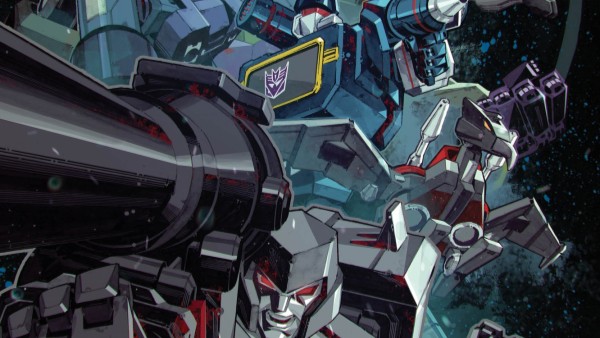
Meanwhile, the adjustment to the book’s new look is still a work in progress. While Dan Mora‘s figure work is arguably cleaner and tighter than Jorge Corona‘s, so far his action sequences feels a bit more cluttered and difficult to follow. In a sequence where Thundercracker has Wheeljack and Jazz at his mercy only for Ultra Magnus to swoop in an overpower the Decepticon, for example, it’s not terribly clear where, exactly, Ultra Magnus is coming from — you really need to look closely to see the movement effect indicating he jump-flew in from outside the Ark. That said, the relatively brighter palate of the burgeoning Kirkman/Mora era of the series is a good fit for the overall tone of rebuilding/moving forward currently characterizing the series.

All in all, Transformers #26 is a necessary de-escalation of the Sturm-und-Drang which characterized the last several issues of the book as it built to the climax of the Johnson run and the arrival of Kirkman and Mora team. Yet it’s not just killing time by making incremental plot changes. In building the issue around the resolution of Skywarp’s long-gestating status quo, it sheds a light on the challenges of loyalty throughout the various plotlines, making for a richer and more rewarding reading experience.