
Ancient Mythology Meeting Modern Storytelling: Discussing ‘Hunters Of Sheydim’ With Writer Jeff Marvin
by Tom Smithyman
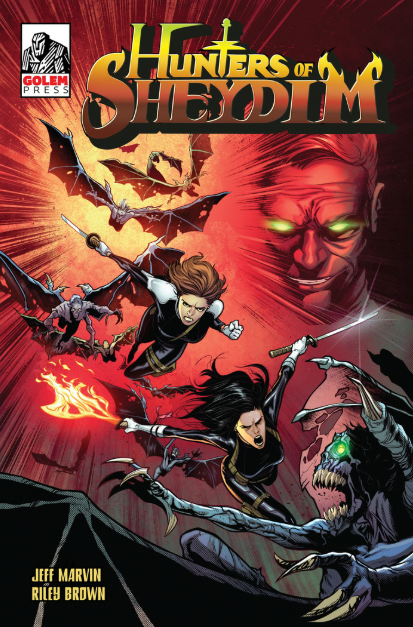
It’s never good news when the lord of demons, Asmodeus, returns to take physical form. In Hunters of Sheydim, a 12-part series currently looking for funding via Kickstarter, Jewish mysticism, history, and folklore is woven together to create a supernatural horror saga. Written by Jeff Marvin and illustrated by Riley Brown, the series follows twin sisters who must battle the demon lord and his minions. Comicon.com spoke with Marvin, who discussed the nuances of good versus evil in the story and his intention to tell a story for everyone.

Tom Smithyman: Hunters of Sheydim is steeped in Jewish lore, dating as far back as Noah’s grandfather, Enoch. What made you want to tell the story of demon hunters through a Jewish lens?
Jeff Marvin: I grew up loving mythic storytelling — Arthurian legends, Tolkien, Star Wars — all these big fantasies that pull from deep wells of history and faith. But most of the mythologies we see in mainstream pop culture come through a very Christian lens. It’s so embedded in the Western storytelling tradition that we often don’t even notice it.
When I began studying the Talmud, reading the Sages, and exploring stories about Dybbuks, Golems, Lilim, and other figures from Jewish lore, I kept wondering: what would an epic, mythic world look like if it were built from our stories instead? What if the “Arthurian cycle” had a Jewish counterpart — one rooted in our texts, our demons, our angels, our questions?
That thought became the spark for Hunters of Sheydim.
But the goal was never to make it only for Jewish readers. I wanted to create something that felt accessible and grounded — a supernatural thriller where the lore is authentic, but the themes are universal. It’s also important to me that we don’t hide the cultural context in the way creators like Jack Kirby and Will Eisner often had to in the early comics era. We can finally tell these stories openly, without masking their roots.
Hunters of Sheydim lives right in that space: ancient mythology meeting modern storytelling, seen through a lens we rarely get to explore in genre fiction.
Balancing world-building with entertainment is always tricky — especially in a story rooted in a specific cultural and mythological tradition. For Hunters of Sheydim, I wanted readers to hit the ground running. The very first pages drop you straight into the action, and the historical and mystical context builds around the twins as their world starts unravelling.
I never expect readers to absorb every detail or fully understand every Jewish term right away. The goal isn’t to teach a glossary — it’s to create a sense of authenticity and texture, the way fantasy stories often do with ancient languages, rituals, or spells. Even if a reader doesn’t catch every reference, the narrative momentum still carries them.
Over time, the pieces begin to click. Details introduced in issue #1 take on new meaning as the emotional stakes deepen in issues #2 and #3. Ideally, the lore enhances the story without ever slowing it down — you learn by following the characters, not by stepping outside the story.

Smithyman: How much of that real-world background did you already know before writing the series? And how much did you create yourself to tell a good story?
Marvin: I actually came into this story with some prior experience. Years ago, I co-wrote a more traditional, Catholic-based demon-hunter concept. But pretty quickly, we realized we were walking a very familiar path. At the same time, I kept slipping in bits of Jewish folklore almost accidentally, and that started pulling the story in a much more interesting direction.
Once I leaned into that, I began reading about Asmodeus and Azazel from the Jewish perspective — and that’s where things really opened up. In Christian mythology, they’re usually cast as pure evil, but in Jewish texts, they’re far more nuanced. Azazel is literally tied to the ritual of the scapegoat — guilt is his domain. And Asmodeus in the Talmud isn’t just a villain; he helps build Solomon’s Temple, he jokes, he schemes, he’s complicated. That humanity, even in demons, fascinated me.
So the foundation — the lore, the traditions, the historical texture — comes from real sources: the Talmud, Midrash, Zohar, the Book of Enoch, and a lot of academic writing. But once I decided the hunters themselves should be Jewish, the world expanded. I created the entire backstory of Rabbi Eli, his wife Sara, their tragic relationship with Asmodeus, and the twins’ hidden Converso heritage. Their journey of uncovering who they are — spiritually, historically, and literally — is where the storytelling really takes over from the research.
In short, the mythology is rooted in real texts, but the family history, the emotional arcs, and the modern conflict are entirely built for the story.

Smithyman: Ultimately, this is a story of good versus evil, and the lines are very clearly drawn. Do you think it’s that stark in life or are the notions of good and evil a little hazier?
Marvin: I actually don’t see Hunters of Sheydim as a clean “good vs. evil” story at all. It may look that way in the opening pages — Asmodeus hunting down the last of the demon hunters sets up a familiar dynamic — but as the series unfolds, those moral lines blur very quickly.
Moloch is the one true outlier, the embodiment of abhorrent evil. But almost everyone else exists somewhere in the gray. Asmodeus, for example, isn’t purely evil in Jewish lore, and he isn’t in our story either. His actions can be destructive, but his motives stem from something far more complex than simple malice.
The same is true for Eli and the twins. Eli withholds the truth “to protect them,” which is not entirely noble, and Caterina crosses a line early on when anger influences her judgment. Their choices aren’t heroic or villainous — they’re human.
That’s what interests me most: characters shaped by trauma, heritage, guilt, and loyalty. In Hunters of Sheydim, nobody wears a pure white hat or a pure black one. The story lives in the tension between those shades of gray, which feels much closer to real life, where the line between good and evil depends far more on perspective than absolutes.
Smithyman: Riley Brown draws the book. How did the two of you collaborate during the development process?
Marvin: We’re working from two different continents — Riley’s in Murfreesboro, Tennessee, and I’m here in Israel — so the time-zone overlap can be a real challenge. But from our very first call, it was clear we were on the same wavelength. We talked about the tone of the book, the Jewish iconography, and especially the depiction of Shamayim as described in the Book of Ezekiel. That imagery is wild, abstract, and not exactly easy to visualize, and I probably overwhelmed him a bit with how specific I needed it to be. There’s very little visual reference for any of it.
But Riley dove in headfirst. What he delivered was beyond anything I imagined — layered, symbolic, and still grounded in the emotional reality of the story. I showed it to my wife, who’s a rabbi and biblical scholar, and she was deeply impressed with how he handled something so theologically dense.
And once Vinicius Townsend added his colors — especially the cosmic, Kirby-inspired textures — everything clicked. The collaboration has been remote, but incredibly fluid. Riley asks smart questions, pushes the visuals in new directions, and elevates every page. It’s been a fantastic partnership.

Smithyman: Women don’t always feature prominently in religious stories – particularly Christian ones. Why did you choose twin sisters as your protagonists?
Marvin: Honestly, I created Caterina and Lucia years ago, and what always drew me back to them wasn’t their gender — it was their dynamic. Their personalities felt lived-in, their relationship felt real, and after a long break from writing comics, I realized I genuinely missed them.
They’re loosely inspired by my wife and her sister, so the grounded, sisterly push-and-pull came very naturally. Bringing them into a story about demon hunting and Jewish mysticism felt like the perfect way to explore that bond under extreme pressure — two young women trying to survive both the supernatural and the everyday struggles of their twenties.
And I’ll admit: I’m inspired by my wife. She’s an ordained Rabbi, observant, and deeply committed to the belief that women can be fully halachically present without altering the core principles of Judaism. That conviction — that women belong in these spaces — absolutely shaped how I wrote the twins. I didn’t set out to “fix” religious storytelling; I just wanted to center characters whose voices deserve to be there.
Smithyman: When the Triumvirate of Darkness brings back the demon king Asmodeus from the hellish Gehinnom, the first thing he wants to do is to eat a French pastry known as a croquembouche. If you were rescued from Hell, what is the first thing you would snack on?
Marvin: (laughing) He is a decadent fellow, isn’t he?
If I just crawled out of a hell dimension, I’d go straight for comfort food. For a snack, it’s absolutely White Cheddar Cheez-Its — my son and I can demolish a box without thinking twice.
If we’re talking a real meal, though? Beef stroganoff. I don’t know why, but it’s one of those dishes that just instantly puts a smile on my face. After surviving Gehinnom, I’d say I earned it.
Smithyman: I’d say so as well! Good luck with the crowdfunding campaign.
