
Reviewing George Takei’s Second Graphic Novel ‘It Rhymes With Takei’
by Rachel Bellwoar
Summary
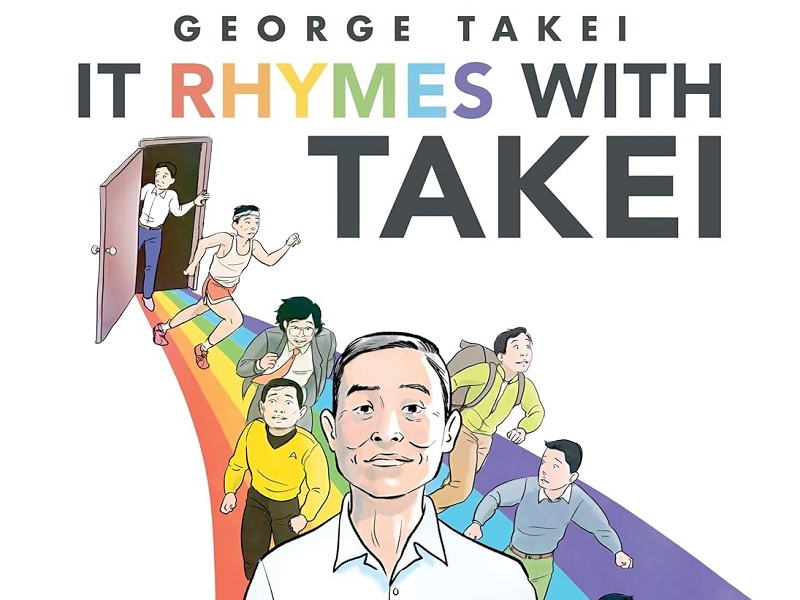
When George Takei released his first memoir in 1994 he wasn’t yet able to tell the world his whole truth. Now in his latest graphic novel with artist Harmony Becker and colorist José Villarrubia he’s able to share his coming out story.
Overall
8/10It wasn’t that long ago that an actor coming out as gay would’ve warranted a magazine cover. Granted, as more publications go online-only, the print magazines that remain become precious but while I was too young to be aware when it happened to Ellen Degeneres, I remember the brouhaha that surrounded Neal Patrick Harris and more recently Elliot Page when he came out as transgender.

As someone who wouldn’t discover Star Trek until the first Chris Pine movie, I don’t have a strong memory of George Takei‘s coming out in 2005 but in his latest graphic novel with Stephen Scott and Justin Eisinger and featuring art by Harmony Becker and colorist José Villarrubia, Takei reminds readers of the circumstances that made him feel he had to stay in the closet and how relatively recently some of the strides that have been made in LGBTQIA+ protections were hard won.
Whereas Takei’s previous graphic novel, They Called Us Enemy, focused on his experiences as a child being sent to a Japanese American internment camp with his family during WWII, It Rhymes With Takei covers a much longer stretch of time and considers what it was like for Takei to have to keep his personal life a secret out of fear of what would happen if people learned he was gay. One thing that maybe should be obvious but that this graphic novel really shows is that that decision was never an easy one. This book also breaks down why a glib response like “why can’t gay people just keep their partners a secret?” is so small-minded and unreasonable. Staying silent or feeling like you have to stay silent because of the damage it could do, not just to your career but to other Asian Americans looking to become actors, or to laws Takei was trying to pass as an activist, or to a burgeoning show like Star Trek (which the series was before it became a mammoth franchise) – these are all horrible but real truths Takei had to contend with for years.

Using interviews Takei gave on programs like The View and The Howard Stern Show as entry points, Takei addresses readers directly and is given full narratorial control of his story. The only problem with this approach is it’s not really made clear when the interviews end and when Takei’s narration takes over. It almost gives the impression that the entire book is one of these press interviews, except without the interviewers interrupting Takei to ask questions. It’s a misunderstanding that maybe could have been avoided with some different lettering choices by Nathan Widick.
One of the relationships that stands out in this book is the one between Takei and his father. It’s a real example of how when you treat your child like an adult and don’t dismiss their dreams you can forge a healthy relationship built on communication and trust. There’s no question that Takei’s father had concerns about his son’s choice in careers (and given the lack of examples of other Japanese American actors to point it’s not really a wonder), but that didn’t stop him from listening and encouraging his pursuits, as Becker beautifully portrays in their one-on-one scenes where his facial expressions and body language are open, calm, and receptive. Takei’s father passed away in 1979 and while this is suggested when his mother appears alone later on, he essentially disappears. A more direct acknowledgement of his passing might’ve been more satisfying for the book but that’s also Takei’s decision to make.
 With coming out there’s no guarantee of acceptance and one of the more crushing moments is when Takei shares his brother’s response to the news. Being famous doesn’t shield you from the pain of rejection and Takei and Becker don’t gloss over these interactions at all. Similarly, Takei’s anger at how people (including friends) were treated when the AIDS pandemic started is palpable. This book is also an important reminder of how much flip flopping went on when marriage equality was being fought over in California and then nationally. If the lesson is these protections can’t be taken for granted, it’s also that it never pays to lose hope and stop fighting.
It Rhymes With Takei unpacks a lot of trauma, but there’s a lot of beauty here as well. Readers get to see how Takei met his husband, Brad. Takei also shows the power of community and that while humanity can create a lot of cause for mistrust, that doesn’t mean everyone’s out to get you, like when Takei joins a gay running group. Any of the members could’ve gone to the tabloids and exposed him, but they didn’t, and while that story could’ve gone another way, it also shows why community is so important.
It Rhymes with Takei is on sale now from Top Shelf.

