
A Silent Film For The ’90s: Criterion’s ‘Compensation’ Reviewed
by Rachel Bellwoar
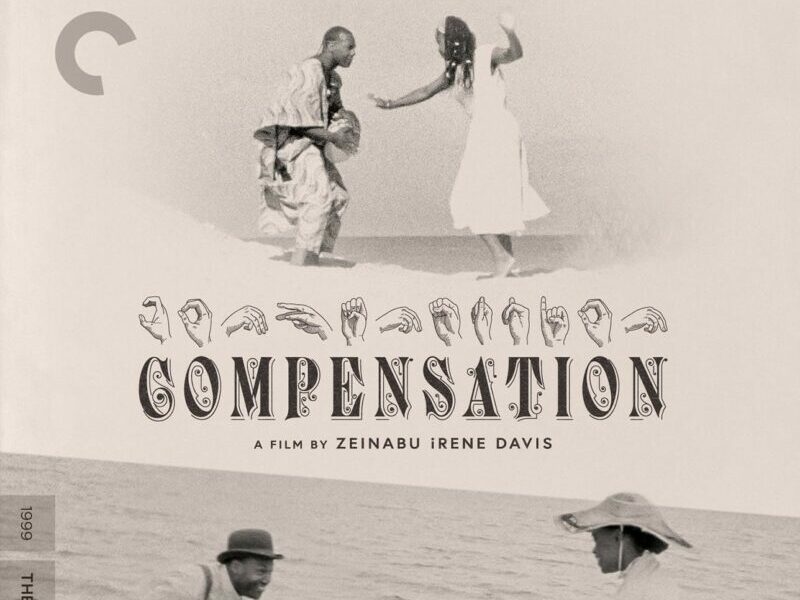
African American history. The Deaf community. More specifically, the Black Deaf community. These are all topics and groups that go underrepresented in movies, and Zeinabu irene Davis’ Compensation features them all, using silent film techniques to tell parallel stories of a hearing man (John Earl Jelks) and a Deaf woman (Deaf actress Michelle A. Banks) in the 1900s and 1990s who meet and fall in love while learning to communicate with each other. Form and subject matter are perfectly matched, so that instead of the Deaf person who has to adapt to a hearing world, it’s the hearing audience members (as represented by Jelks’ Arthur/Nico) who are asked to immerse themselves in Malindy/Malaika’s world. That isn’t to say there isn’t any dialogue in Compensation, and there’s definitely plenty of music courtesy of Reginald R. Robinson and Atiba Y. Jali, but it’s put on Arthur/Nico to decide to learn ASL and take the time to get to know Malindy/Malaika in both timelines.

Sound becomes much more prominent, like the scritching of pen on paper to the clacking of chalk on a chalkboard. In a commentary recorded in 2023 by Davis, screenwriter Marc Arthur Chéry (who’s married to Davis in real life) and director of photography Pierre H.L. Désir (who sadly passed away later in 2023), Davis shares an anecdote about recording the ADR for that chalk scene and wanting to convey the right levels of anger through just the sound of the chalk.
In the same way that it requires patience to communicate with someone who doesn’t speak the same language, Compensation is a film that requires patience from viewers and takes its time to a degree that can be frustrating and quiet (like a ballet), but also realistic. Rather than differentiate the two timelines by filming one in black and white and one in color, the entire film is black and white (in the commentary, Désir talks about filming the beach scenes specifically and how he was glad for the hazy weather they often had to better capture the actors’ complexions against the sun and sand).
Davis also uses a lot of archival photos to plant the film in specific time periods and show images of Black America that otherwise might’ve sat unseen in a folder. During the commentary and a separate 15-minute featurette, Davis is able to go into more detail about those photos she uncovered, and it adds a whole other dimension to the movie. There’s power in purely seeing the photos, but there’s also power in understanding their context and learning about real historical events, like how Deaf schools went from being integrated to segregated – they didn’t start out segregated.
By having the two timelines, Compensation shows that Deaf people have always existed and come up with clever ways to thrive, like how 1900s Malindy figures out a way to know when someone knocks on her shop door. It’s truly a singular film experience that deserves to be seen as much as more lauded Oscar winners, like Coda and The Artist. Another favorite anecdote from the commentary is when Davis talks about making the film-within-a-film that Malindy and Arthur go to see together. It was inspired by a real short called “The Railroad Porter” that’s been deemed lost and which Davis was able to find a synopsis for in an old edition of the Chicago Defender newspaper.
In a strange/unfortunate coincidence, Compensation also deals with pandemics – tuberculosis in the 1900s and AIDs in the 1990s – with this restoration coming out during the ongoing Covid-19 pandemic. In a panel from the Chicago International Film Festival, though, Davis takes care to call it a rejuvenation, not a restoration, and one improvement that seems to have been made is in the subtitles (which also include descriptive text).
In fact, for this Blu-ray I was excited to see that all of the bonus features, as well as the commentary, have the option to turn on subtitles. I wish that were the norm for all Criterion discs, but for this release, especially, it shows that a lot of thought was put into ensuring this Blu-ray would be accessible.
Additional bonus features include a panel from the New York Film Festival which was moderated by Racquel Gates (who also wrote the booklet essay for this Blu-ray), an interview with Davis from 2020 where she’s able to go over her larger career, and two of Davis’ short films: her first for UCLA, “Crocodile Conspiracy” (1986), on which Charles Burnett (The Annihilation of Fish) acted as DP and Julie Dash (Daughters of the Dust) has a makeup credit, and “Pandemic Bread” (2023) about a Filipina interpreter (Princess Punzalan) who remotely translates a conversation between a doctor (Obinne Onyeador) and her Covid-19 patient (Becca Godinez). “Pandemic Bread” also has a commentary with Davis and some of the cast and crew.
Compensation is available on Blu-ray now from Criterion.
