
Talking ‘Children of the Night’ With Victoria Setian And Savanna Ganucheau
by Rachel Bellwoar
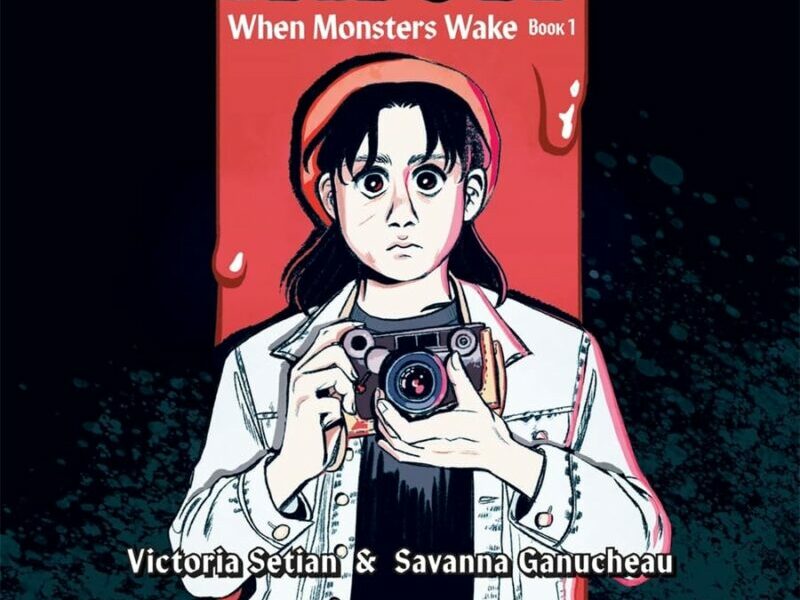
When it comes to fighting vampires, a wooden stake tends to be the weapon of choice. In writer Victoria Setian and artist Savanna Ganucheau‘s upcoming graphic novel, Children of the Night: When Monsters Wake, however, it’s a camera that Mina Murray uses as her first line of defense. With colors by Avery Bacon, here’s what Setian and Ganucheau could spill about their new tale:

Rachel Bellwoar: Pop culture is full of high school vampire stories and takes on Bram Stoker’s Dracula, but where did the idea of combining the two — reimagining Bram Stoker’s Dracula for high school — come from?
Victoria Setian: I thought a lot about what teenage heroines inspire me (which are primarily Daria and Buffy), and then took it a step further: what was it about their stories that resonated? In both cases, most of their storytelling happens at school, which is a huge part of teenage life, and both have memorable ensemble characters. And in the text itself, I thought about what can we say that’s new or current? The original text is so good, and it felt important we didn’t just retell it, we had to give a re-imagining its own purpose. So we added some twists, peppered with new takes and some fun ones, like instead of 3 marriage proposals for Lucy, she gets 3 invitations to the upcoming dance.
Savanna Ganucheau: It’s such a great choice that Tory made. The ensemble in the original is great and pushing them into teenage drama makes it even better.
Bellwoar: Usually Dracula stories tend to push Van Helsing or Jonathan Harker. Why did you decide to make Mina Murray the main character and how did you land on her go-to accessories — a camera and a red beret?
Setian: After reading Dracula I became a little obsessed with watching the different film adaptations. But time after time, I was surprised that Mina’s central role in the story was downplayed, and she was instead portrayed as purely a love interest or completely omitted. When I thought of the idea of “what if Mina was front and center?” the rest pretty quickly came together. I remember taking my notebook to Central Park and the ideas just flowed from there!
As for her signature red accessory, when I think of Mina and the world of New Whitby, I imagine them like Germany’s Black Forest — full of storied danger — and our Mina is like Little Red Riding Hood, making her way through. So when it came time for visuals, that was something Savi and I talked about from the jump.
As for her camera, I drew inspiration from lauded photographer Weegee. He was known for his candid street photography of Manhattan and Hollywood, where his work wasn’t of the beautiful celebrities, but instead the fainting fans. Having Mina mimic his style felt like a real opportunity to showcase a whole genre of photography that’s intentionally unposed and unaltered, counter to what modern teens largely experience today. And narratively, it really lines up with how Mina sees things from a different perspective, finding beauty and meaning in what others might not.
Ganucheau: And in addition to her style of photography, the camera she uses is mechanical (no automatic or electronic features whatsoever). I think this not only shows how talented Mina is, but also how dedicated she is to photography. This girl is using fragile and frustrating old-school technology because it means a lot to her and she “likes it better.”
Jumping back to her red beret, when Tory first gave me refs for the characters, she had a note on Mina’s page for a “red accessory. Maybe a hoodie.” I gave her the red beret, and I think it actually says a lot about her. It’s distinguished, peculiar, and alternative like her. I also think it’s something a teen could easily get attached to as a defining feature. I feel like at that age you’re grasping at straws a bit and thinking, “maybe that’s my thing.”

Bellwoar: When Monsters Wake also falls into another favorite subgenre of mine — teen detectives. What inspired the decision to make Mina an amateur sleuth and did that play into the choice to have When Monsters Wake open with a dialogue-free sequence that really shows how much you can convey about a person visually?
Setian: The original Dracula read like a detective mystery to me, so the “teen detective” piece felt like a natural fit, but I wanted it to be one step removed. So instead of Mina’s focus being about solving the case, it’s more about her own curiosity around death and the veil between worlds. As for the opening, the dialogue-free sequence was a chance to let the medium do the work. The idea there was to show our Red Riding Hood wandering through her respective wood and highlighting things she’s drawn to via the visuals. I remember when Savi sent those pages over, they were exactly (if not better!) than what I’d envisioned.
Ganucheau: I’m always so happy to hear that! The opening scene was a ton of fun to do. I remember looking at the map I drew and tweaking the scene to line up accurately with Mina’s path. Tory and I always seem to be on the same page with visuals. I think we both think about comics like film. So, it’s easy for me to get it right the first time when she describes something. Nine times out of ten I’m like, “Oh. Yup. I know exactly how you want this.”
Bellwoar: Certain names, like Lucy West and Renfield, appear in horror all the time. Lucy’s suitors from Dracula (embodied in When Monsters Wake by the members of the Romeros, a high school rock band) often get forgotten. Why did you want to bring those characters back into the fold?
Setian: I loved all these characters and felt like they each had their part to play. I also adored how, no matter what happened, they were always friends first; there was never any jealousy or animosity (like again, when the three suitors each proposed to Lucy). When Savi made their designs, it really crystallized them as their own important characters.
Ganucheau: The inclusion of the whole cast is one of my favorite parts about our book. I feel like I saw a meme about whenever a Dracula adaptation comes out that said, “Where’s the cowboy?” And while our Quinn isn’t a cowboy, at least he’s there. The cowboy is there in spirit.
Bellwoar: In choosing where to set this series, did you always want New Whitby to come across as a fairly normal-looking small town over a place with a lot of Gothic trappings?
Setian: I wanted New Whitby to feel within reach of any reader, like, “hey, I know that place!” So that meant not leaning as hard into the Gothic aesthetic. But Savi did find ways to hint at more Gothic elements with the school exterior and the Carfax Estate. And we did look at references of the actual Whitby, England that inspired Stoker. We wanted things to feel grounded but have that edge of the fantastic.
Ganucheau: Exactly, New Whitby is supposed to feel familiar but mysterious. A New England town that suggests a deeper history, but doesn’t necessarily seem over the top.

Bellwoar: When this series is set matters, too (I especially like how you incorporate technology into vampire mythology). Was there ever any thought to making a period piece or was the excitement in getting to tell a modern version?
Setian: My instinct was to make it modern because there was so much that still resonates today from the original story, and it felt like there was also a lot we could play if we were to update certain elements. In Dracula, there were touches of technology like the use of the gramophone, and things like Mina and Jonathan’s use of shorthand just immediately reminded me of passing encoded notes in school. And finding ways to update some of those original elements not only ended up being fun twists, but instrumental to the plot.
Ganucheau: It also gives our Dracula some fun things to try and learn about. Mainly, selfies.
Bellwoar: As for the supernatural, what was it like coming up with the look for your vampires? Were you inspired by any past Draculas?
Setian: While I’m a sucker for the German Expressionist vamps, we focused on the fact that Dracula studied Whitby society before he tried to take it over. So to translate that idea to our Raf, we talked about him feeling almost too perfect and put together because he’d been studying New Whitby via social media.
Ganucheau: Too perfect is the keyword for sure. With his long white hair I’m not escaping the Alucard allegations, but mostly I wanted him to be ethereal and a bit androgynous. Someone you would look at and think, “wow who is that?”
Bellwoar: Creating a game to promote this series was such a stroke of genius. What was that like to create?
Setian: By day, I’m a game developer, and game design for me always starts with story that then gets translated into mechanics. Since Mina is a photojournalist, having players observe their subjects to unlock the option to take a photo was the natural fit when considering how to turn Children of the Night into a game. And Twine is a wonderful engine for text-based games. Thankfully Savi and I talk games all the time, so when I showed her the concept, she immediately got what I was trying to achieve and really elevated it with her art!
Ganucheau: The game is all Tory’s genius! I was so on board to help make it pretty. And I do love to talk about video games, it’s true. The visuals in the book were also sometimes inspired by games as well. The scene where she’s walking through the funeral home and some of the POV shots.
Bellwoar: Thanks for agreeing to this interview, Victoria and Savanna!
Children of the Night: When Monsters Wake goes on sale January 13th from Abrams Fanfare.

