
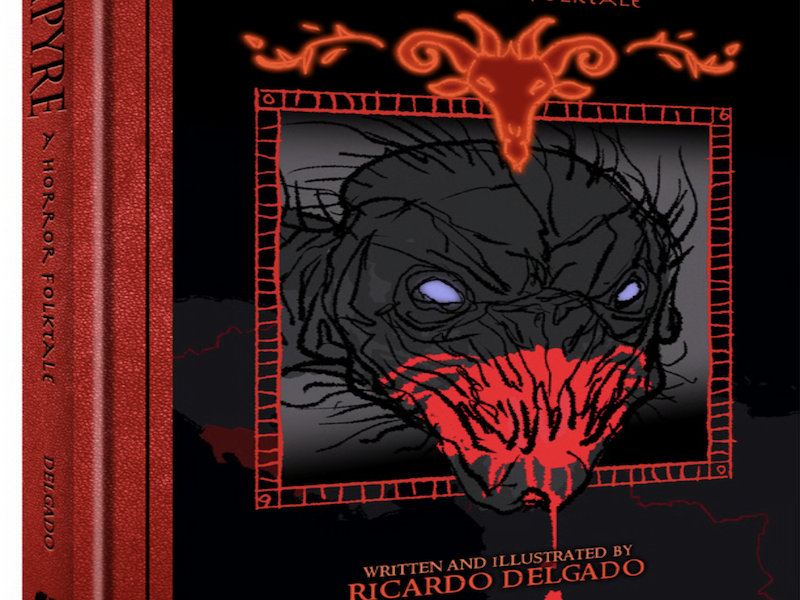
Talking With Ricardo Delgado About ‘Vampyre: A Costa Rican Fairytale’
by Benjamin Hall
Some readers may already know of writer Ricardo Delgado for his previous novel Dracula of Transylvania (2023). Others may know of him from his work on movies such as Men In Black (1997) and Apollo 13 (1995) as a character designer and storyboard artist. Here, he is discussing the upcoming novel Vampyre: A Costa Rican Folktale (2026). It is a spin-off of Dracula of Transylvania and also takes inspiration from Delgado’s personal background.
Benjamin Hall: What makes the upcoming Vampyre: A Costa Rican Folktale a follow-up to Dracula of Transylvania?
Ricardo Delgado: Dracula of Transylvania was a really ambitious project for me. I wanted to see if I could create a larger supernatural world around the king of the vampires, and it worked out pretty well from my perspective, and so Vampyre is a follow up of that expansion. All those legions of vampires throughout the world in my story, where do they go, and what do they do when they are not at Dracula’s beck and call? For me, that was an interesting question to think about, and I decided to tell a very unique story about a Nosferatu, but this one is more of a murder mystery or a manhunt. So all this is an extension of the novel, without directly stating that. It’s a stand-alone story that explores more of the world
Hall: What is the throughline of Vampyre: A Costa Rican Folktale?
Delgado: The transition to modernity. There’s a few stories going on here: a civil war in a small Central American country, the simultaneous cultural pomp and circumstance of Easter Week, and an ancient evil that arrives in the small town that my parents grew up in. All of those themes tie together to explain the transition into the world of the late 1940s, post-World War II, and into what would be the Space Age in the next decade, the Cold War, and how Costa Rica sees all of those changes occur. In many ways, Costa Rica is still a place filled with magic, ritual, tradition and verve, and I wanted to capture all that in my story. Add a vampire, stir and bake, and you have a terrific setting crammed with historical fact, cultural interest and a thing that goes bump in the night.

Hall: How is this a standalone work while also being a multimedia project?
Delgado: Well, it’s a singular narrative within the greater tapestry of the Dracula story. An isolated incident in a distant country. I had done a lot of research into vampire myths throughout the world for Dracula and had decided to set this one in my ancestral home of Costa Rica. Whenever I am down there I see so much of what I will describe as magic down there on a daily basis, the cultural mixture of the supernatural along with the everyday happenstance, that I felt like it would make a great setting for a ghost story, and here we are.
If you wanna get into the (author) Joseph Campbell monomyth thing, I was really interested in all of the similarities of the vampire stories I’d read, and how similar they are to each other, so I wanted to take that similarity, crack it open a bit and dive in. That’s why the story is separated into days of the week in an actual timeline of the 1948 Costa Rican Civil War.
Along with the Art of Dracula of Transylvania (2023) and the Dracula of Transylvania Tarot Card Set (2024), the franchise is moving in a healthy direction, multimedia-wise. Can’t wait to see where all this takes us! Certainly super happy with Clover Press’s support through all this.
Hall: Is there a reason for including your family history as part of this book?
Delgado: Yeah, I felt that my family’s connection to the town used in the story would also add a unique depth and perspective to the project. The fact that my parents were kids when all the political stuff happened in 1948 made the story even more authentic. Yes, tossing a vampire into a story is always gonna work, I’ve talked about how that’s a great universal plot device, but what about the other characters? And that’s where the texture of the story starts to gain traction and weight, at least for me and in this instance.
If you read Salem’s Lot (1975) by the great (author) Stephen King, it’s not the vampire that you’re hanging your emotional hat on, it’s the people in the town, and that’s what I was trying to capture here: a slice of life in a small town in Costa Rica called Alajuela, and how they are affected by finding a dead body on the football pitch one morning, the town park the next. That’s the stuff that gets readers interested.
Hall: Do you find working on personal projects like this more rewarding than on movies, such as Men In Black?
Delgado: I do now, but back then I was just trying to make my way into the film industry and had no idea that I would end up writing my own stories, but in retrospect, I worked with some of the best storytellers, and how could I not be affected by all that wisdom? When you’re in a room with (screenwriters) James “Jim” Cameron, Ron Howard, or John Landis, you just shut up and absorb their story acumen, and that’s what I did, and it totally paid off. I’m still big on reading, always will be. Think that’s an important facet of writing that’s not talked about enough: how other voices can continue to inspire, regenerate, and reinvigorate our own work. I don’t and can’t write anywhere near the stratosphere of a (author) Ray Bradbury, rest his soul, yet his words still take me to those cupboards of my childhood imagination that meant so much to me growing up.

Hall: Do you consider this multimedia project your attempt at a masterpiece for your career?
Delgado: Noooooo, that’s for far more influential voices than my own. I’m just trying to tell stories that I love as best I can, and I hope that readers enjoy them as much as I do.
Back during my Disney animation days, the entire Feature Animation division were put onto buses and driven down to Hollywood’s El Capitan to watch the new Pixar film Cars (2006). (Director) John Lasseter came out to introduce the film, and he said two things that have always stuck with me. The first one was to always overdeliver on a product like a DVD set, to include extras so that the buyer would come away with more than she, he or they paid for said product. I took that to heart, and I do that with my books as well. The second point he made was that Cars would be remembered as his magnum opus, and I remember sitting there in the theater and instantly disagreeing with that, and I still do. The public decides all that stuff, and it was a lesson to me to just keep my head down, do my own stuff as best I could, overdelivering in the process, and the rest would take care of itself.
Hall: Last, what can fans of yours expect from the Kickstarter campaign?
Delgado: Lots ‘o goodies! Clover has planned out some cool stuff, including a skeletal pen(!) of all things, and I could not be more excited about the release of the book. It’s crammed with all kinds of really fun stuff in my attempt to overdeliver to those who enjoy the same stuff I do.
There’s a magic in sitting in one of the local churches while pigeons swoop in during a rainy morning in Costa Rica, and there’s added magic in building Aurora monster model kits in the 1970’s. I’m trying to combine the two, and I hope you all will come along for the ride.
Hall: Thank you, Mr. Delgado, for your time and answers!
Vampyre: A Costa Rican Fairytale is currently crowdfunding with the help of publisher Clover Press. One can find the campaign on Kickstarter.
