
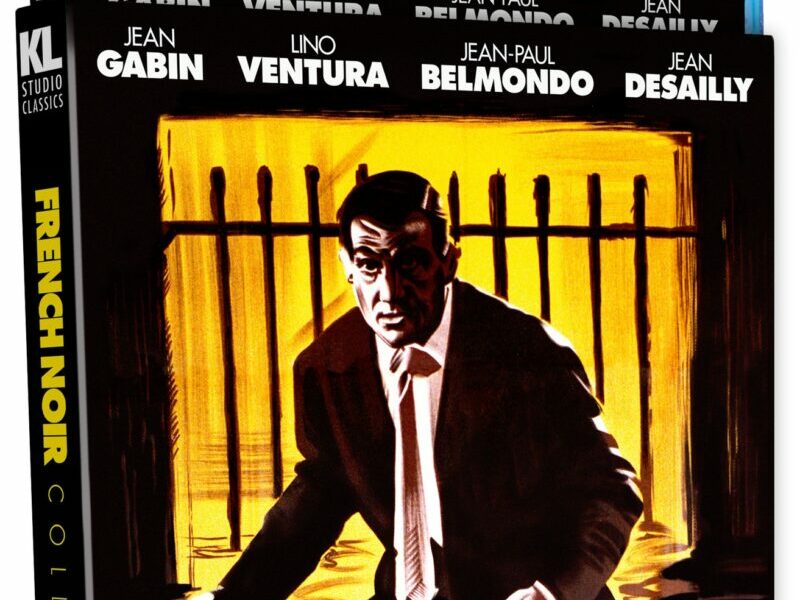
Belmondo And Desailly: A Review Of Kino’s ‘French Noir Collection II’ Part 2
by Rachel Bellwoar
For Disc 2 of Kino’s French Noir Collection II, Jean-Paul Belmondo attempts to help an old war pal while Jean Desailly tries to prove he didn’t kill anyone. More thoughts on Disk 2 below…

Jacques Dupont‘s Trapped by Fear (1960)
If you’re going to steal a car, make sure the brakes work. Laurent (Claude Brasseur) learns this the hard way when the car he steals with bad brakes causes him to kill a cop. On the run from the police, Paul (Belmondo) finds out about the accident because he’s a photographer and supposed to snap photos of Laurent for a magazine. For Paul, however, it’s a blast from the past. Laurent saved his life in the war, and instead of trying to use their friendship for a story, Paul immediately goes out, finds Laurent, and invites him to hide in his apartment.
The power of this movie comes from the relationship between Laurent and Paul and Paul’s willingness to help Laurent, which never wavers or gives Laurent space to decline. Paul’s offers are sincere — he’s not just trying to assuage his conscience, and whether they’ve been in touch since the war or this is the first time they’ve reconnected in months, it’s easy to believe in their no strings bond.
In his commentary, filmmaker Mike Siegel argues the film could’ve been improved by focusing more on the history between Paul and Laurent, and that is the most interesting aspect of this movie (certainly preferable to Paul’s exploits and mistreatment of women), but it also feels more realistic this way. These are two men who have a deep connection yet barely say two words to each other. Their relationship isn’t cinematic, but how many times are we told actions speak louder than words? Paul embodies that idea while leaving it unspoken.
While Siegel has every right not to hold this film in the highest regard (you can speak on a movie without being its biggest fan), it does get old. At one point, Siegel so much as says there’s nothing about this movie to talk about for an hour and a half, and that’s simply not true even if this film isn’t Breathless (which Siegel mentions more than once, but it’s not supposed to be). Siegel is right that it can be hard to find information on French actors in English and Siegel (who’s German and was able to read and translate French for this commentary) is able to go much more in depth than IMDB as a result when discussing the film’s key players.
Édouard Molinaro‘s The Passion of Slow Fire (1961)
If Trapped by Fear is a film about blind loyalty regardless of guilt, The Passion of Slow Fire is the complete opposite: a film about how quickly a community can turn on you.
It’s the voiceover that provides viewers with the first hint that something bad is about to happen. In it Stéphane (Jean Desailly) tries to make sense of how quickly his life has changed — how these innocuous events he thought nothing of the night before could suddenly carry so much weight and consequence. Basically, Stéphane’s only crime is turning in early instead of going out to play bridge with his wife (a chilling Monique Mélinand). This puts him at home when Belle (Alexandra Stewart), the young girl who’s been staying with them, returns (Stewart played Belmondo’s main squeeze in Trapped By Fear). When Belle is found dead the next morning, all eyes are on Stéphane (including his wife’s), and while he’s able to make a strong case for his innocence, the damage is already done.
Adapted by Jean Anouilh from a book by Georges Simenon (who’s responsible for the Maigret detective novels), The Passion of Slow Fire has a similar energy to Kafka’s The Trial. In that story, of course, the main character had even less to go on (the cops wouldn’t even tell him what he’d been accused of) but in terms of being completely blindsided by this turn of events and how quickly people, including his wife, are willing to believe he’s a murderer, The Passion of Slow Fire fits the mold exactly. A devastating character study with a strong supporting cast (Marc Cassot is especially good as the overly friendly cop who gives Stéphane a false sense of security), it’s a film that isn’t easily shaken and my second favorite from this box set after Rhine Virgin.
Mystery writer Max Allan Collins and Cereal at Midnight podcaster Heath Holland are back on commentary duty, and, having established a sort of formula with their commentary on Rhine Virgin, I enjoyed this one even more. They consider the title (in France it’s more literal), debate whether or not it’s really a noir (Holland has some doubts but I’d argue it’s noir with a capital N), and talk about the possible queer subtext (Molinaro would go on to direct La Cage aux Folles).
French Noir Collection II is available on Blu-ray from Kino Lorber. You can read my thoughts on Disc 1 in my previous review.


