
An Interview With ‘Romo The Wolfboy’ Creator Ilya
by Rachel Bellwoar
You’d think circus folk would be better at not passing judgement on others. While Romo is allowed to travel with the circus in Ilya‘s graphic novel, Romo the WolfBoy, he’s not exactly accepted or understood, especially as he also can’t talk. That doesn’t mean he can’t communicate, however, and when strange accidents start occurring during the show, it’s Romo who investigates. For more on Romo’s efforts, here’s Ilya:

Rachel Bellwoar: Romo the WolfBoy originally started life on Kickstarter. What sold you on SelfMadeHero being the right home for this graphic novel?
Ilya: They were my publisher before now. I’d assisted with a few titles behind the scenes, and helped suggest art choices for many of their Manga Shakespeare line as well as doing King Lear myself. The last time I had an Original Graphic Novel out with them, though was 2014 (!), with Room For Love.
I’d actually approached them very early on with it as a fresh proposal. But at that time their concentration was explicitly on adult fiction, anandomo has always been very much intended as an All Ages title, suitable for child/YA readers as well — a different market for them. I’d already succeeded with my crowdfunding venture for the first hardback volume when SMH announced their September titles, including two that could be described as YA. So their goalposts have shifted, and now we, er, share the same goal!
What I get from our deal is into the shops, something I couldn’t have done under my own steam. But also what I hope to get is a second paperback edition for the wider market, and then further publication, with them, of the next volume in what’s intended to be a whole series of adventures.
Bellwoar: As you talk about in the Easter Egg section, Tarzan came out in 1912 (so after the events of this story) yet Romo feels like a cross between Tarzan and the Victorian Gothic, with a little bit of Elephant Man tossed in. One way the circus has been presented in the past is as a home to misfits. What interested you in telling a story about an outcast among outcasts?
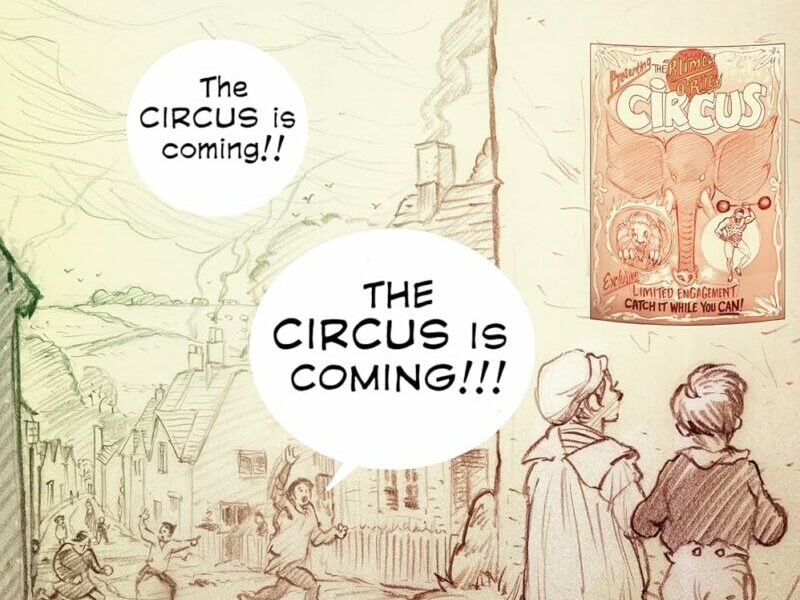
Ilya: The period setting for Romo is (loosely) the last decade of Queen Victoria’s reign, so notionally the 1890s, a hugely rich playground worldwide. I didn’t want steampunk or Ripper-style clichés of smoky London town, though and so set this first one in the countryside, which we almost never see in fiction depicting that time.
It’s a perceptive question — I have always been drawn to outsiders, marginalised characters — from my (award-winning!) graphic novel series The End of the Century Club, right up to Room For Love, but also in prose fiction with The Clay Dreaming (Myriad Editions, 2010), as well as many of my unpublished concepts that languish as historical proposals. I guess on some psychological level, that means I identify. I do tend to take my revenge on history on behalf of those who get forgotten (as with cinema pioneer Robert Paul in my Time Traveller booklet, and many of those featured in my semi-regular strips in the Cartoon History feature for the New Internationalist magazine).
Elephant Man, yes — more than Tarzan I think. My influences are many. Maybe Mowgli from The Jungle Book too. There have been many factual cases of abandoned human children brought up — or alleged to have been raised in some way — either apart from human contact, or literally by animals.
At root, I think I do deliberately tell my stories on behalf of those denied a voice, or who for whatever reason cannot speak for themselves. I couldn’t easily tell you why — that’s just what’s happened.

Bellwoar: Punctuation can be something that gets taken for granted, yet all of the punctuation in this book feels so intentional. Is that something you enjoy playing with?
Ilya: Absolutely. I’m a writer who not only believes clear communication — and therefore intent — is paramount, but also has to constantly resist wordplay and puns (most often failing completely). I’m also a proofreader born. I spot mistakes from miles away … from the moon! So naturally, I am intensely picky when it comes to things like punctuation. Comics is my language, and it is a language of rhythm and meter, much like poetry (they go together beautifully).
This means I can get into fights quite easily when others try to change my wording and, therefore, mess with my precise intent. Be warned! Haha
Bellwoar: Of the different circus acts, was there a character you enjoyed working on the most or who was the most fun to research?
Ilya: This was a difficult one. Reflecting on that, it felt like each time any character was my focus, be it in a panel or a scene, they were, for a time at least, my favourite. Any capable graphic novelist will tell you they get to act out all of the parts (which is why Manga Shakespeare is a dream project to do!*). If I had to pick one, then I think my enduring sympathy rests with the so-called Fat Lady, Two-Ton Tillie. Maybe that’s no accident, since that’s the member of the circus troupe that appears most sympathetic towards Romo himself — and when she ultimately comes to doubt him, the effect is immediate and tragic in the extreme.
*In manga, the psychological POV one takes (and for the mangaka or creator, aims to convey) is very effective — manga succeeds so well (and has become the supreme global iteration of comics) because of audience identification: you live with and through the characters and their deepest feelings and truth.
Research? Not so much. I have plenty of life experience by now and tend to trust to instinct/feel my way. What I was basing my casting on was more of a shared sense of who or what makes a vintage circus — what we all tend to call to mind if we try to imagine such a thing. That’s a part of cartooning really.

Bellwoar: I love the entrance that the antagonist, Dr. Cackle, is given. Was she a character you developed early or late in the process?
Ilya: In media res, I think. And thank you. My stuff tends to arise out of dream logic, and then fill in bit by bit in a very haphazard way, that I then have to work to corral together and make narrative — but not necessarily linear — sense of. I think this is where the skills of storytelling properly come in: the sequencing. My narrative skills are pretty well developed by now, but a part of that is staying light on one’s feet, always being present as the author, by which I mean open eyes, open ears, but also open to change. So any process is pretty amorphous and never stops developing — things can get further refined or even transformed as and when you come to finally commit them to a page. The page decides.
Dr Cackle is a good example of a story element that remained very mutable and, to an extent, made up as I went. She’s the antagonist, the villain of the piece, as it were, but not entirely without sympathy. Her backstory plopped out very naturally and came together almost without much conscious thought on my part. Until I committed her to those later pages, her motivations were still forming.
Bellwoar: What was it like designing the cover for Romo? Specifically, I’m very interested in the choice to tease and foreshadow some of what’s to come on the cover.
Ilya: Hell, sheer delicious hell. So much rides (or dies) on the right cover design. I went through a great many variations. Not just in what was depicted thereon, but the whole conceptual approach — “illustrative”, “designy”, “faux vintage” – seriously, those are the actual folder titles of the many and various options I considered long and hard, and even road-tested! The overall winner (for the current hardback first edition) was “designy”, although it also contains elements of the other categories too. I worked hard to have it (hopefully!) suggest All Ages — a character-based image that anyone could be drawn to, whether an adult, a child, or anywhere in between. Sales will tell me whether or not I chose right, I guess, or otherwise succeeded.
I get the luxury of taking another run at it from a completely different tack for the upcoming second (international and paperback) edition, come September. If at first you don’t succeed… (or, hope hope hope, even if you do, who could resist a second bit of the cherry?)
‘Tease and foreshadow’, really? You tell me what you see. All I can aver is that you may have really good eyesight, to allege such foresight!
Bellwoar: Thanks for agreeing to this interview, Ilya (and looking forward to Romo’s future adventures as a “criminologist extraordinaire” and “specialist in the paranormal” [to quote the cover])!
Romo the Wolfboy goes on sale February 19th from SelfMadeHero.

