
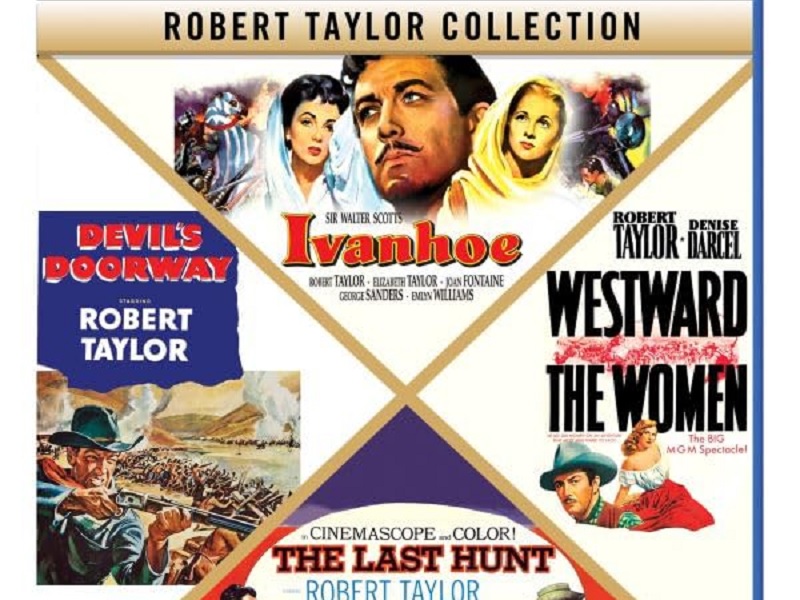
Reviewing Warner Archive’s ‘Robert Taylor Collection’
by Rachel Bellwoar
Warner Archive provided me with a free copy of the Blu-rays I reviewed in this article. The opinions I share are my own.
Three westerns and a medieval times movie. If that doesn’t sound like a good time I don’t what is. For my review of William Wellman‘s Westward the Women (1951), click here. Otherwise, for my thoughts on the other three films in the Robert Taylor Collection, keep reading:

Anthony Mann‘s Devil’s Doorway (1950)
To get the elephant out of the room first, there’s no way Robert Taylor should’ve been cast as an Indigenous person and (as The Last Hunt will prove) it didn’t initiate a larger shift in how Westerns would portray Indigenous Americans going forward, but its existence does prove that there were folks in 1950 who were aware of the injustices and racism at play and the film’s outlier status is fascinating. Would that Warner Archive had included more bonus features, because I’d be curious to know if this film got ignored upon its release or created any discourse, or if people were just resistant to change (as it is, the only two bonus features are an unremarkable Droopy and Tom and Jerry cartoon).
The film begins with Lance (Taylor) returning home from the war, having risen to the rank of sergeant major. Mistakenly believing his war record is a sign of progress and that he’s going to be treated differently now by his white neighbors, Lance learns the truth when his land rights are brought into contention by the Homestead Act. A real act that would have lasting consequences, Devil’s Doorway doesn’t just cover it on a surface level but breaks down how duplicitous it was (and while it doesn’t go as deep with reservations, it does start asking the right questions as to why Lance and the Shoshane people would be unwilling to accept that “solution”). The only lawyer who will take Lance’s case is a woman (Paula Raymond), another way Devil’s Doorway is ahead of the times. Even with that storyline, the film pushes back at Hollywood’s usual instinct to turn their relationship into a romance. You always hear about John Ford‘s evolving portrayal of Indigenous Americans, but it’s this Anthony Mann Western that should be getting discussed.
Richard Thorpe‘s Ivanhoe (1952)
A Robin Hood movie by any other name but just as sweet … Ivanhoe was clearly an attempt on MGM’s part to replicate the success of Michael Curtiz‘s The Adventures of Robin Hood (1938). Going so far as to cast Olivia de Havilland‘s sister, Joan Fontaine, as Ivanhoe’s love interest was diabolical (especially knowing they didn’t get along in real life). Rip off or not, Ivanhoe rules, and it’s a film that could be watched over and over again and still be engaging.
Maybe there were behind-the-scenes reasons for not making the main character Robin Hood. As a viewer, it comes across as a lot of effort for no reason. All of the other Robin Hood staples are there: Sherwood Forrest, King Richard (Norman Wooland). Prince John (Guy Wolfe giving Prince John from the Disney cartoon energy). Even Robin Hood (Harold Warrender) himself, though he’s called Locksley for anonymity purposes, but yeah. For some reason, Ivanhoe (Taylor) is the hero of this story, and that’s OK.
Rather than a bow and arrow, Ivanhoe comes in singing and strumming a lute (because that’s why you cast Robert Taylor — for the singing ability). Maybe Taylor felt that way, too, because it doesn’t seem like a coincidence that Ivanhoe destroys the lute early on in a fight, but the singing is revealed to be a code Ivanhoe is using to uncover where King Richard is being held prisoner. Finding Richard is half the problem. Ivanhoe also has to raise enough money to pay off Richard’s ransom and ensure Prince John doesn’t seize the throne for himself.
A love triangle between Fontaine’s Rowena and Elizabeth Taylor‘s Rebecca is unnecessary, yet the two actresses eat it up (and, to Fontaine’s credit, while she’s playing the “nice princess” who usually gets passed off as boring, she very much holds her own and gives Elizabeth Taylor some tough competition).
The jousting and battle scenes are extremely well-staged. Sure, the arrows look cheap, but what they lack in menace, the film makes up for in quantity. The costumes by Roger Furse are gorgeous across the board (and another example of where the film doesn’t sway the love triangle towards Rowena or Rebecca). The screenplay by Noel Langley, Marguerite Roberts, and Aeneas MacKenzie is especially smart and clever. If you have a soft spot for medieval times movies, this is one of the finest. Plus, Warner Archive’s Blu-ray comes with the adorable Tom and Jerry cartoon, “The Two Mouseketeers”, featuring Jerry’s French nephew, Nibbles.
Richard Brooks‘ The Last Hunt (1956)
“Oh give me a home, where the buffalo roam…” So begins the song “Home on the Range.” Knowing that lyric, the statistics that open The Last Hunt are pretty crazy, revealing just how quickly and how close America came to making the buffalo extinct. The Last Hunt could’ve been a fascinating look at how greed almost took out one of the West’s iconic images. Instead, outside of Lloyd Nolan (the only actor in this film who has any success passing for roughing it and whose natural charisma can only do so much), this film is pretty dreadful. Russ Tamblyn is horribly miscast as a half-Irish, half-Dakotan cowboy whose identity doesn’t a character make. Going from Taylor’s role in Devil’s Doorway to this film is liable to give a person whiplash. Here he plays a hunter who hates Indigenous people (and while there’s no use pretending racism’s new, the same person shouldn’t have been able to play both roles). His frenemy status with Stewart Granger‘s Sandy makes no sense from the beginning when Sandy insists he wants to retire from buffalo hunting but then he quickly caves in to partnering with Gilson (Taylor). One bad film out of four isn’t bad, so this is still an overwhelmingly good set.
The Robert Taylor Collection is available on Blu-ray now from Warner Archive and to purchase from Movie Zyng.
