
Fire & Blood Files: Why That Flashback Matters
by Austin Gorton
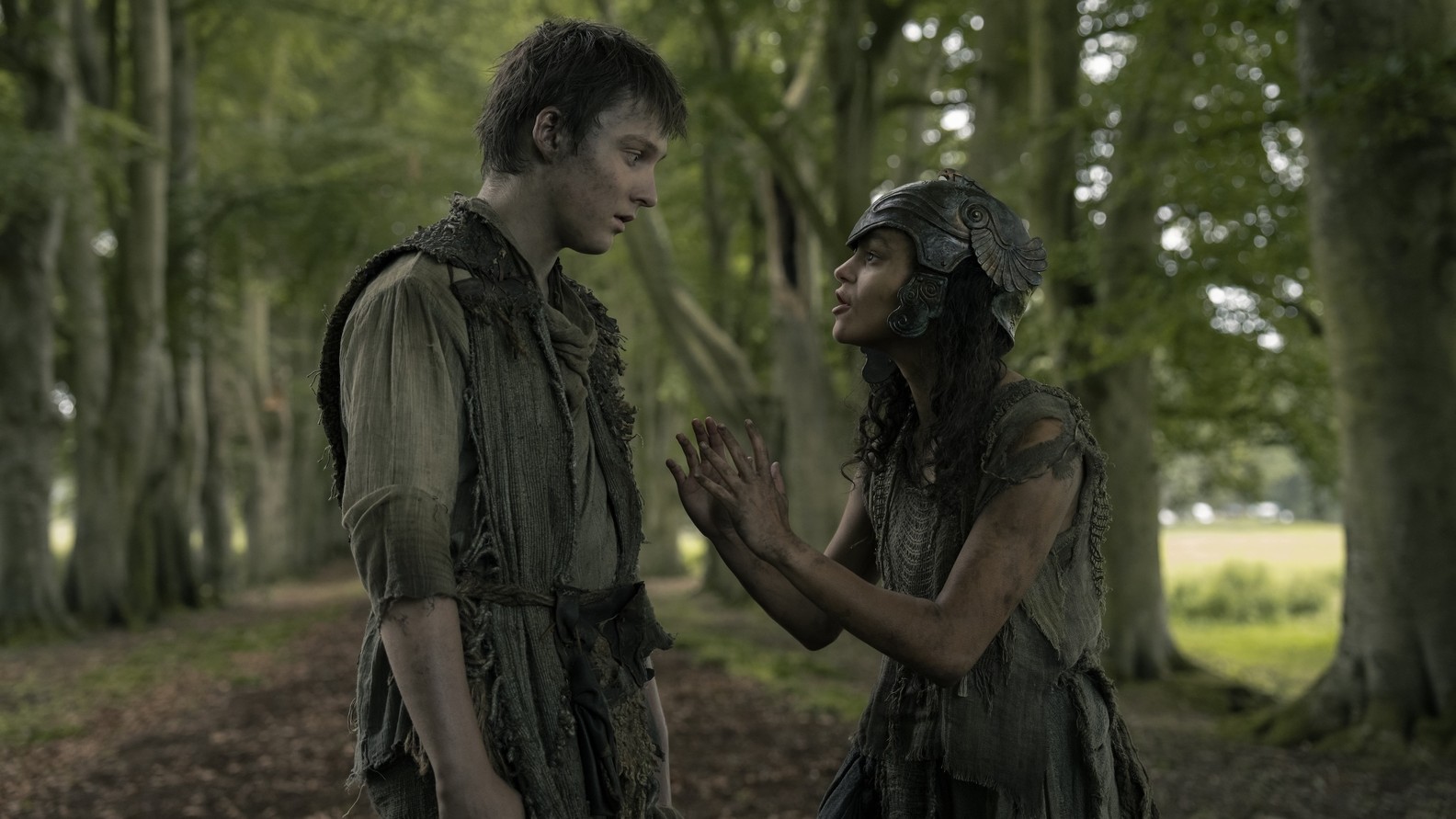
The flashback in the middle third of “In The Name of the Mother”, the penultimate episode of A Knight of the Seven Kingdoms‘ first season, is by far the biggest invention of the show relative to the source material. While the name “Rafe” appears in a later Dunk & Egg novella in reference to one of Dunk’s (Peter Claffey) Flea Bottom childhood friend (and isn’t explicitly gendered), the majority of the narrative arc of the flashback, from Rafe (Chloe Lea) and young Dunk (Bamber Todd) looting bodies to trying to book passage to Essos to running afoul of the City Watch only for Rafe to die and Dunk to be saved by Ser Arlan (Danny Webb), are new to the series.
Not only does the flashback sap momentum from the present day Trial of Seven combat, but in killing Rafe, it fridges one of the series’ few female characters, and not even in the service of providing new information, but merely to underscore known information: Dunk genuinely believes in helping people crushed under the wheel of unfair, oppressive system. Yet for all that, the flashback is neither a complete failure, nor a complete waste of time, as it does do a few key things which help improve the episode overall.

The key thing the flashback does – and the reason I’m sure it exists at all — is to extend the run time of the Trial of Seven. Both Baelor’s (Bertie Carvel) surprise throwing-in with Dunk and his death at the end of the trial are such obvious, “Holy shit!” episode-ending cliffhanger moments, that’s no way a showrunner could avoid deploying them as such – nor would we, the audience, want them to (honestly, the Egg reveal to Baelor siding with Dunk to Baelor dying is one of the all time great runs of cliffhanger endings across consecutive episodes).
At the same time, the actual trial isn’t really that long (and 30 minutes of just watching Dunk get pummeled in the mud would be exhausting), especially since the trial is being shown from Dunk’s point of view, meaning we don’t get any cutaways to what is happening with other people involved in the trial (aside from what we can glimpse over Dunk’s shoulders). So the choice to draw out the trial to be able to end the episode on the Baelor reveal is either break the show’s mostly-consistent POV, or do a flashback. Flashback is as good an answer as any.

Of course, doing a flashback doesn’t mean they had to do this flashback; the death of Rafe is really not a good look, and even a tweak like having Rafe run off to Essos without Dunk, or having Dunk be forced to choose between staying with Rafe and going off with Arlan, could have accomplished the same things with less on-screen violence against women. But one decent thing the flashback, as written, does well is tie the central characters of the story — Dunk and this branch of the Targaryen family — to the events of the first Blackfyre Rebellion; something important now, but even moreso in the future of the series.
By starting the flashback in the aftermath of the Battle of the Redgrass Field, with Dunk picking over the corpses of people slain in the fight which earned Baelor and Maekar (Sam Spruell) their reputations as the Hammer and the Anvil, and in which Arlan’s nephew and squire was killed, thereby putting Arlan on the (drunken) path of helping Dunk later in the flashback and leaving a squiring position open for Dunk to fill, it draws a straight line from that battle to the tournament at Ashford Meadow, which we now know is another fateful day in the history of Westeros. Without the Battle of the Redgrass Fields, Dunk and Baelor don’t end up in this Trial of Seven together; without that trial, what comes next doesn’t happen. The flashback is saying something about the chance turning points in history, something the season’s final episode will return to with gusto.

Finally, the flashback is, in its way, simply a dramatization of something which happens inside Dunk’s head in the novella. Because prose can put readers inside the heads of characters in ways film can’t, readers know that between the first charge that ends with Dunk knocked from his horse and impaled by a lance and his final, satisfying pummeling of Aerion (Finn Bennett), Dunk laments his foolishness at thinking he could be a knight before remembering that while Ser Duncan the Tall may not have experience in this kind of combat, Dunk of Flea Bottom knows how to fight in his own way, and it is on these baser street-fighting skills Dunk calls to ultimately prevail. You could view this flashback as an extended riff on that realization, dramatized for a viewing audience.
Dunk, quickly dissuaded of any notions of knightly prowess, thinks back to that time his girlfriend was killed by someone lording his power over “lesser” people and Dunk responded with an animalistic fury against that killer, and realizes he’s in the same situation again, and turns on the “Flea Bottom” energy to gain the upper hand against the latest person-in-power who used his power to hurt both someone Dunk cared about and Dunk himself.

Ultimately, it’s tough to argue that the flashback in “In the Name of the Mother” couldn’t be improved. There’s plenty wrong with it, from the way it handles Rafe’s fate to the way it doesn’t really add much to what we already know about Dunk, to just how blatantly “we need to churn up a dozen or so minutes of time before something actually important happens” constructed it is. But it’s not entirely devoid of value. Restating a character’s whole deal isn’t intrinsically bad. It further ties together the eddies of fate swirling and intermingling amongst Dunk, Baelor, and the course of history. And it dramatizes something difficult to capture on screen, the way Dunk embraces his whole self — and, pointedly, his socially “least” self — to ultimately prevail against his princely foe.
Maybe just let’s skip the dead girlfriend next time, okay?
