
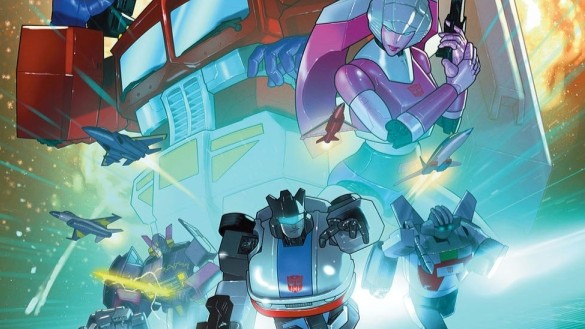
Review: It’s Rock ‘Em Sock ‘Em Robot Time For Better And Worse in ‘Transformers’ #29
by Austin Gorton
Overview
Transformers #29 is an action-packed slugfest, but the visual storytelling struggles to make clear what’s happening beyond “robots smashing together.”
Overall
6/10Purely in terms of the number of Transformers involved, Transformers #29 is the biggest action-oriented issue of the series yet. While the series has certainly turned in a number of spectacular action sequences in the past, the swelling of both the Autobot and Decepticon ranks over the previous four issues means this issue features hefty robot-on-robot action. Unfortunately, it a couple of key ways, “biggest” doesn’t automatically mean “best.”

Plot-wise, it is pretty straight-forward: Megatron is leading an assault on the Autobots and just viciously destroyed Trailblazer, prompting a ferocious Autobot counterattack. There’s a status quo change for one character and a chance for the Decepticons to react to Thundercracker’s face-turn, along with an issue-ending cliffhanger that sets up the arc’s finale next issue. But it’s mostly just all-out action. And while there’s nothing inherently wrong with that — this book has done it before — artist Dan Mora struggles in terms of storytelling within the broad conflict, making the whole thing difficult to follow and exhausting to parse.
This is largely due to the depth of focus he uses. Aside from a few (gorgeous looking) double-page spreads, he tends to render the action at medium depth as a default, filling the panel with the partial renderings of the players, thereby making it difficult to spatially place specific action in the broader context of the battle. When the action cuts from a full-page splash of Bulkhead smashing Bruticus to a half-page splash of Optimus Prime and Megatron grappling, it’s not at all clear where the former and the latter are in relation to one another; the “camera” is zoomed in so far on both as to exclude any background details. The next panel drops the Bruticus/Bulkhead fight into the background of a closeup shot of Brawn, but the next three panels show entirely different characters, with no visual relationship to any of what was shown on the preceding page and a half.
Later, when one of the Constructicons calls for the formation of Devastator, Bonecrusher raises an objection because only half the Contructicons are present. His dialogue is lettered like he’s about to be interrupted, but when the page is turned, the half-formed Devastator is attacking the Magnuses Arcee and Ultra. Top Half Devastator is a great bit of visual humor in an otherwise intense issue, but it feels like panels are missing, as the transition from Bonecrusher’s objection to the emergence of the partial Combiner is so abrupt.

The art is much more successful on a smaller scale. Mora’s Transformer faces tend to be highly expressive, from the snarl on Megatron’s face, to Rumble’s panic when Megatron starts having another fit, to the contortions of Brawn’s mouth as he rallies the troops against Bruticus. Mora also uses the lens in Megatron’s fusion cannon (a rare example of an artist acknowledging its use as a scope in his alternate mode) to great effect, such as reflecting Thundercracker’s face while his back is to the reader. But as good as this little bits are, they’re ultimately just eyes within a storm of noisy, chaotic art.
Mora’s storytelling isn’t helped by Robert Kirkman‘s plotting. Whereas earlier throwdowns in this series represented a crescendo of plotting, the battle in Transformers #29 just sort of … happens. Megatron had a mental breakdown last issue, then decides its time to take the fight to the Autobots; the Autobots, in turn, defend themselves. There’s obviously more story to be told regarding the source and impact of Megatron’s breakdowns, but at the moment, using them as the impetus for this fight isn’t terribly far removed from “because Kirkman felt like it was time for a big battle issue.” Which, fair enough. But if there was a bit more narrative spine to the conflict, a clearer sense of what prompted the confrontation, it might help support the visual storytelling.

Ultimately, there’s plenty to enjoy here. Kirkman and Mora deserve credit for finding new ways to shake up the action relative to the Johnson/Corona run (like the half-Devastator, or having Bulkhead battle Bruticus instead of another Combiner), and Mora lands the smaller details. But the visual storytelling — undercut by the somewhat random motivation behind the fight — is muddied enough to make reading the issue a slog, thus dragging down some of its more successful elements.
Transformers #29 is available now.

