Talking ‘Twin Peaks’ With ‘A Place Both Wonderful and Strange’ Author Scott Meslow
by Rachel Bellwoar
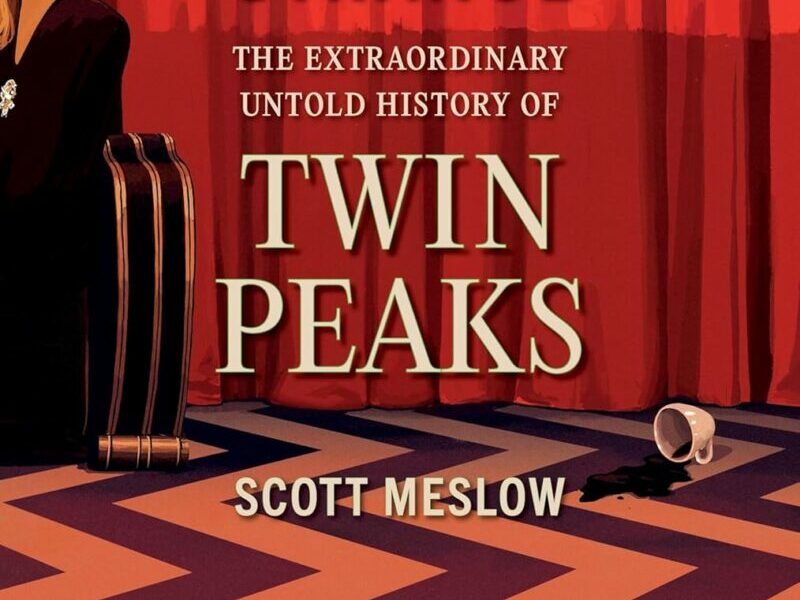
Twin Peaks will never go out of style, but that doesn’t mean there aren’t new things that can still be revealed about the beloved cult series. Scott Meslow‘s new book, A Place Both Wonderful and Strange: The Extraordinary Untold History of Twin Peaks sets out to do just that and, for more on the project, let’s rock with Meslow below:

Rachel Bellwoar: Since his passing, it seems like even more books have been announced on David Lynch and his art. How long have you been working on this history and what made you want to focus on the behind-the-scenes side of Twin Peaks?
Scott Meslow: I worked on the proposal for about six months and sold A Place Both Wonderful and Strange in March of 2024 — about nine months before David Lynch passed. His death didn’t change the timeline of the book’s publication, but I found that the interviews I conducted after he died had a different feel, as people who had worked with him were grappling with their own appreciation and their own grief. (I understood that because I was grieving too.)
From another perspective, I’ve been working on this book since I was in middle school, which is when I discovered a VHS of the Twin Peaks pilot at my local video store, which kicked off my lifelong fascination with the show. A behind-the-scenes history always made the most sense to me. I work in entertainment journalism, so reporting is always my first instinct, and I knew (even before I had all reported the details) that this had the broad outlines of an especially amazing story. My broad goal was capturing how David Lynch and Mark Frost essentially smuggled art onto TV twice: First with the original series, which was so unlike anything on network television at the time, and then with The Return, which kind of weaponized the TV reboot at a time when it seemed like every old TV classic was getting a legacy revival.
Bellwoar: As Twin Peaks writer Harley Peyton brings up in his introduction, “untold” is a bold word to use in a title. Without asking you to give anything away, were there any questions you specifically felt other books had left unanswered or topics you were excited to look into?
Meslow: Anyone who writes about Twin Peaks is standing on the shoulders of giants. I’m indebted to writers like John Thorne and Craig Miller, whose magazine Wrapped in Plastic was a vital source for Twin Peaks fans in the late ‘90s and early ‘00s, as well as authors like Brad Dukes, Courtenay Stallings, and Scott Ryan, who have written their own fantastic books exploring Twin Peaks from numerous unique angles.
What I wanted to do — and which didn’t already exist — was a book that explored the entire Twin Peaks canon under a single cover: The original show, Fire Walk with Me, and Twin Peaks: The Return, as well as tie-in novels like The Secret Diary of Laura Palmer, The Autobiography of F.B.I. Special Agent Dale Cooper and the two books Mark Frost wrote to bookend Twin Peaks: The Return. For “untold,” I was especially excited to get into The Return, which is less than a decade old and has, by definition, been reported on much less than the original series. But I was happy I was able to dig up some previously unreported details on Twin Peaks and Fire Walk with Me as well.
Bellwoar: What was the research process like on this book? Were you able to speak to a number of the cast and crew?
Meslow: I was! My first choice was always to interview someone directly. Fortunately, dozens of the show’s creative team, both in front of and behind the camera, were willing to get on the phone (or, in a few cases, sit down for a cup of coffee) with me. In general, people were really generous with their time and stories, and I’m extremely grateful for what they shared with me.
Of course, I couldn’t get everyone. For people who had passed away before I started writing the book — Frank Silva, Catherine Coulson, David Bowie, etc. — I relied on stories from those who worked with them and archival material and was able to dig up some really cool stuff that had kind of fallen by the wayside. Unfortunately, David Lynch died about nine months into my reporting. I don’t know if I ultimately would have had the chance to speak with him — I finished the book months later — but obviously I would have loved to do it. Fortunately, many of Lynch’s closest friends and collaborators told me amazing stories about working and spending time with him, so he’s very present in the book.
Bellwoar: Rather than go through the series episode by episode, why did you want to spotlight certain characters and include essays on their arcs across Twin Peaks, Fire Walk With Me and The Return?
Meslow: The character essays were something I came up with in the middle of the writing process. I realized that — as fascinating as the behind-the-scenes production stories were — the book also needed some top-level analysis of the plot of Twin Peaks or it would feel incomplete. Following the arcs of a series of individual characters, especially those whose stories spanned from the original show to The Return, felt like a more interesting way to explore the story from a variety of perspectives instead of simply summarizing the plot. It was very difficult to determine which characters to include, and there are still some essays I regret didn’t make the book; if I’d had the time and space for it, I would have loved to do a deeper dive into either Bobby Briggs or Major Briggs.
Bellwoar: With regards to Fire Walk With Me and The Return, you write about expectations fans might have had versus what the film and series would ultimately become. I especially appreciated your comparison of The Return to The Missing Pieces. Could you expand on that a little?
Meslow: The Missing Pieces (the collective name for the roughly 90 minutes of deleted scenes from Fire Walk with Me) was a holy grail for Twin Peaks fans for many, many years, and anyone who hasn’t seen it should. I think of it as a Twin Peaks tone poem — a series of quick vignettes exploring what many of your favorite Twin Peaks characters were doing just before Laura Palmer died — and I think it works really well that way, as a companion piece and counterweight to the darkness of Fire Walk with Me. I also think The Return benefits from having The Missing Pieces as context both literally (for a little more time with soon-to-be-important characters like Phillip Jeffries) and thematically (as a way to prepare viewers for how much rangier and less linear The Return turns out to be).
Bellwoar: It is amazing how enlightening these behind-the-scenes stories can be (I’m specifically thinking of the light you were able to shine on Audrey’s storylines). Is there a revelation you’re especially proud of?
Meslow: I was very pleased to get some new information — from Sherilyn Fenn, Mark Frost, Harley Peyton, and others — on the two major Audrey storylines impacted by events behind the scenes: The scuttling of her will they/won’t they with Agent Cooper in season 2, which Kyle MacLachlan objected to for both creative and personal reasons, and Audrey’s overall arc in The Return, which was altered when Fenn rejected what Lynch and Frost had originally written. But even for Twin Peaks diehards who think they know everything, I’m hoping there’s at least a fun surprise or two in every chapter. (One quick tease: According to casting director Johanna Ray, who’s an amazing storyteller and person, she had Brad Pitt or Michael Madsen in mind to play Leo Johnson before David Lynch took a shine to her son Eric Da Re, who ultimately played the role.)
Bellwoar: To this day there’s an expectation that if a series introduces a mystery it will get solved. Twin Peaks is so much more than a whodunit but do you feel that bad marketing is most responsible for creating the expectation that Laura Palmer’s murder would be solved sooner rather than later or was it always going to be a sticking point?
Meslow: I certainly don’t think the marketing helped on the creative side, but I wouldn’t call it a bad decision, either. “Who killed Laura Palmer?” is a great hook, and those ads drew a lot of people to Twin Peaks in the first place. As I cover in the book, I do think ABC’s marketing team overpromised at times; Bob Iger’s claim that viewers would “see the killer, and know it’s the killer” in the Season 2 premiere, which ends with a quick flashback of BOB killing Laura, is just disingenuous compared to the true answer. My personal feeling — and one that several of the writers I spoke to agreed with, at least in principle — is that the solution came at a reasonable time, but that Leland was subsequently written out of the show too quickly. It’s easy to play Monday morning quarterback, but I think the back half of Season 2 might have been stronger if Leland had been alive longer: possessed by BOB and killing more people while becoming more aware of (and horrified by) the truth, while Cooper and company try, with increasing desperation, to stop the killing spree.
Bellwoar: The importance of Jennifer Lynch’s The Secret Diary of Laura Palmer and Scott Frost’s The Autobiography of F.B.I. Special Agent Dale Cooper don’t always get brought up. Do you think it’s important to include them as part of the canon?
Meslow: I do — that was a major goal of mine. I would say The Secret Diary of Laura Palmer is legitimately important: Though there are details that don’t line up with the show, its portrait of Laura’s interior life was hugely informative for Sheryl Lee’s performance, so it mattered quite a bit, especially for Fire Walk with Me. It’s also just a beautifully written book worthy of serious consideration. The Autobiography of F.B.I. Special Agent Dale Cooper is less important (and more dubious, canonically), but it’s also just a lot of fun and full of weird, lesser-known details I thought fans who hadn’t read it would enjoy. I especially like the scene that implies BOB has had an eye on Cooper since adolescence, which adds an interesting wrinkle to the Season 2 finale, and the revelation that Cooper has a draft-dodging brother across the Canadian border, which Scott Frost told me he added because Mark thought he might want to introduce that character into the TV show at some point.
Bellwoar: “Lynchian” is a word that gets thrown around a lot (if a little too freely and not always well-defined). Could Mark Frost use his own adjective?
Meslow: That’s a good question! In general, I think Mark Frost deserves more credit for Twin Peaks than he gets — people tend to assume that Lynch was the guy who did all the “weird” stuff, and Frost was the guy who knew how to do more conventional TV show. There was truth to that, at times, but the lines were also a lot blurrier than you might be think[ing], and some of the so-called “Lynchian” flourishes can absolutely be credited to Frost. I guess I would say the most “Frostian” elements of Twin Peaks blend the surrealism with a very rigorous intellectual underpinning. Lynch was very intuitive, but more instinctual, introducing stuff like the Red Room or Judy without worrying too much about what it meant (or if he’d ever explain it). Frost was very good at recognizing the brilliance of those ideas, then finding a way to give them a more logical framework later in the narrative — which is how, for one of many examples, a monkey saying “Judy” in Fire Walk with Me became Jowday in The Return.
Bellwoar: Jennifer Lynch recently announced that the scripts for Unrecorded Night, a TV series Lynch had been in the process of developing, will be published. Throughout the book you touch on a number of projects Frost and Lynch tried to get off the ground. Without knowing how far each of them got, is there one you especially wish could’ve seen the light of day?
Meslow: My first answer, by far, would be a third season of Twin Peaks back in the early ‘90s — I wouldn’t trade The Return for it, but I would have loved to see what they would have come up with if ABC had seen that amazing Season 2 cliffhanger and given them another season to wrap it up. Of their pre-Twin Peaks projects, I’d probably say The Lemurians. It was the least developed, but it had a lot of potential: a small group of FBI agents investigating weird supernatural mysteries — a little bit of a proto-X-Files.

Bellwoar: Thanks for agreeing to this interview, Scott!
A Place Both Wonderful and Strange: The Extraordinary Untold History of Twin Peaks is on sale now from Running Press.
