

Trek Thursdays — Majel Barrett: The Number One Lady Of ‘Star Trek’
by Anton Kromoff
Welcome to the table,
“Space…”
When I hear or read that word isolated on its own, even if a pregnant pause follows it, my brain immediately kicks into “The Final Frontier. These are the voyages of the Starship Enterprise…”
This is because I grew up deeply submerged in Star Trek. From the reruns of The Original Series to the iconic Star Trek: The Next Generation to my favorite, Star Trek: Deep Space Nine, and the adventures that would follow from there, I found a kind of idealized, almost religious experience without the guilt or risk of eternal damnation.
There is a certain wonder to Star Trek that sticks with you. It’s this quiet kind of peace that comes with every story, even during tales of war and conflict. It’s something I’ve carried with me for years. This universe where, somehow, some way, things worked out even when things were falling apart. Where hope and science and knowledge were elevated, and universal care for each other reigned after atrocities, giving way to a brave new world of possibility. It’s this place where it feels like theater kids were handed the keys to massive starships to venture into the unknown, not out of some sense of survival or desperation, but out of a want to feed curiosity. Hunger was not the driving force. Lack of resources did not come into play. There was no real class struggle. Between replicators and universal income, humanity had leveled out, and the real goal was just to see what was beyond the horizon and how they could offer aid if and when it may be needed … provided it did not conflict with the Prime Directive.
Sure, I will admit the civilizations they encountered could be complicated, conflicted, and even messy at times. Sometimes they were dangerous and downright diabolical, but at its core, the Federation, at least the Earth aspect of it, felt different than it did in any other window to a possible future I had experienced. It did not just seem possible … it seemed worth trying to steer our world towards. A body of work where we should have put in the effort to make Life imitate the Art we were seeing flash across our screens.
In that vast sea of stars, for me at least, there was one constant north that felt like it was leading the way — Gently, with style and absolute authenticity that empowered as much as it reinforced what this future was and what our future could be.
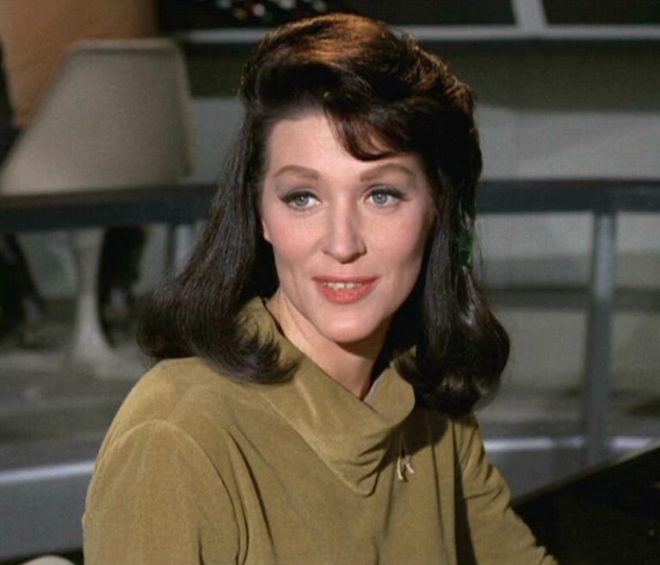
I say “presence” deliberately, because calling Majel Barrett just an actress doesn’t quite feel like it encapsulates everything I am trying to express. It’s like calling the sun just another light in the sky. You’re not wrong, but you’re missing the scale of it all by vast lifegiving amounts. Barrett wasn’t just part of Gene Roddenberry‘s universe. She was not just a player in his bold future. She was wired into the very circuitry that ran Star Trek so completely that removing her would unravel something so essential that Scotty would not be able to fix it even if he tried.
Before Star Trek became the cultural monolith we know today, before the convention halls full of cosplayers and the RSS feed battlegrounds flooded with thousands of posts about what was “canon,” posted at random hours by the “elder nerds” who tutored me on pop culture and pizza in the back of comic shops, there was “The Cage,” and Barrett was there.
In the original pilot for Star Trek, Barrett played Number One, the Enterprise’s first officer under the command of Captain Christopher Pike (Jeffrey Hunter). Back in 1965, Barrett was commanding attention on screen. She was not playing some supporting role in the way television often boxed women into. She was composed, intellectual, and she did not defer … she led.
The first time I saw the pilot, I was at a convention as a teenager, and I was genuinely caught off guard. I had grown up watching reruns of The Original Series and new episodes of Star Trek: The Next Generation, so it was not because it felt out of place, but because it felt so right and yet … so rare. The pop culture space and Trek itself often felt, especially in those years, like a gatekeeper-esque environment where more vocal fans than not wanted to hem women into some kind of “dancing green lady” role and would not accept something other than that representation, even when we had icons like Nichelle Nichols, Marina Sirtis, Gates McFadden, Diana Muldaur, Whoopi Goldberg, and even Denise Crosby.
I was disappointed that, through some choice or another outside my scope or control, we had not been given the Pike series where Barrett would have featured as the first officer. I enjoy TOS, but I still to this day wonder what would have been if they had allowed her to be in that role.
However, if Trek has taught me anything, it’s that sometimes progress does not move in a straight line, and the unexpected eventuality of an event can bloom into even cooler things in the second act.

While Barrett was not the first officer when The Original Series aired, she did return to the Enterprise as Nurse Christine Chapel. While the role was more in line with what was expected on television at the time, she still brought a quiet resilience to the character, and there was a humanity there that felt emotional, but never weak or wavering. There was an authentic truth to it all that resonated. Of course, Nurse Chapel was only one aspect of how Barrett was influencing Trek.
Even if you didn’t realize it on screen, you heard Berrett in almost every episode. Her calm, measured voice was given to the Enterprise‘s computer. Every question a captain had, every processed command from security, every alert and informational offering was Majel Barrett making the future feel just a little more approachable.
There is something so poetic about that. In a show so focused on relationships between humanity and technology, she became this bridge between the two, serving not only as a bridge for characters in scenes but for audiences to gather invaluable information about the universe and strange new worlds we were exploring alongside the crew.
Generations of fans grew up mimicking that interaction. “Computer…” followed by whatever question imagination could conjure. Her voice became a ghost in the machine of our mind, answering back while we imagined a future that was not only equal for all but full of endless possibilities.
What’s more, at least for me, her most iconic role in Star Trek has not even been mentioned yet.
If Number One was control, and Chapel was compassion, Lwaxana Troi was pure, unfiltered power. Not the power that comes from a photon torpedo or at the edge of a bat’leth, but the power that comes from knowing who you are and being that person unapologetically.

When the daughter of the Fifth House, holder of the Sacred Chalice of Rixx, heir to the Holy Rings of Betazed, and Betazoid Federation ambassador, Lwaxana Troi, entered a room, she dismantled the emotional defenses of everyone around her. This was not just in the theater of a teleplay, but something that projected from the screen to the audience watching and rippled into the world beyond. She disarmed everyone with a warm humor, a delightful chaos, a powerful sense of self, but what’s more, a purpose so believable it changed me.
For me, she wasn’t just a character… she was a revelation.
I had already heard Barrett’s voice, even if I didn’t fully realize it at the time. But Lwaxana … Lwaxana was different. She was fully in control of who she was. She was a presence not just as the voice of the ship, but as this powerful entity commanding the scene in person. She felt so comfortable in her own skin, it almost felt radical, like some kind of counter culture wrapped in the trappings of someone who was supposed to be a matron or a bane to her child. At the time, it felt aspirational for me, like I was seeing punk rock counter culture tendencies played out in a form that, when you have a family akin to the one I had, was something that normally judged you or caused you to feel insignificant and small.
Barrett also brought a layer of authentic humor and theatrics that was infused with an honest vulnerability and a loneliness that was so honest, so lived in, but also so touched with confidence that the performance became instantly timeless. What could be considered a weakness only served to make her performance more real, more human, and more powerful in every way.
Barrett’s connection to Star Trek goes beyond iconic performances, though. Her partnership with Gene Roddenberry helped shape the legacy of something that became bigger than each of them individually.
After Roddenberry’s passing, Barrett didn’t step away, she stepped up. She became a steward of Star Trek‘s ideals. Through convention appearances, interviews, and her continued involvement with the franchises she helped carry forward that sense of optimism… that hope… that defined the series from its humble beginnings. Barrett seemed unfaltering in her understanding that Trek was not just about starships and strange new worlds… it was about possibility and a hope we could all come together to be ourselves and boldly go.

Barrett was deeply connected to the fan community, treating it not as this obligation but as an extension of the world she helped build. She showed up. She engaged. She celebrated what Star Trek meant to people, and in doing so, she reinforced their finding themselves in the fandom and the idea that Trek was not just a show but a shared experience and a celebration of what our future could be.
Captains changed, crews rotated, and series evolved, but Barrett remained. Sometimes visible, sometimes not. Sometimes front and center, sometimes quite literally the voice in the background… but she was always there.
Consistent, essential, and authentically herself.
In a universe crafted around exploration, Majel Barrett was the constant reminder that no matter how far Star Trek traveled, it always took that authenticity with it. That, in my very humble, subjective opinion, is her greatest legacy. She not only helped build Star Trek, she was the actual thread that, to this day, served as the throughline that knits it all together.
Until next time, I will leave you with this quote that to this day brings me joy “How much happiness is there in always being there for someone else and never being there for yourself?”