
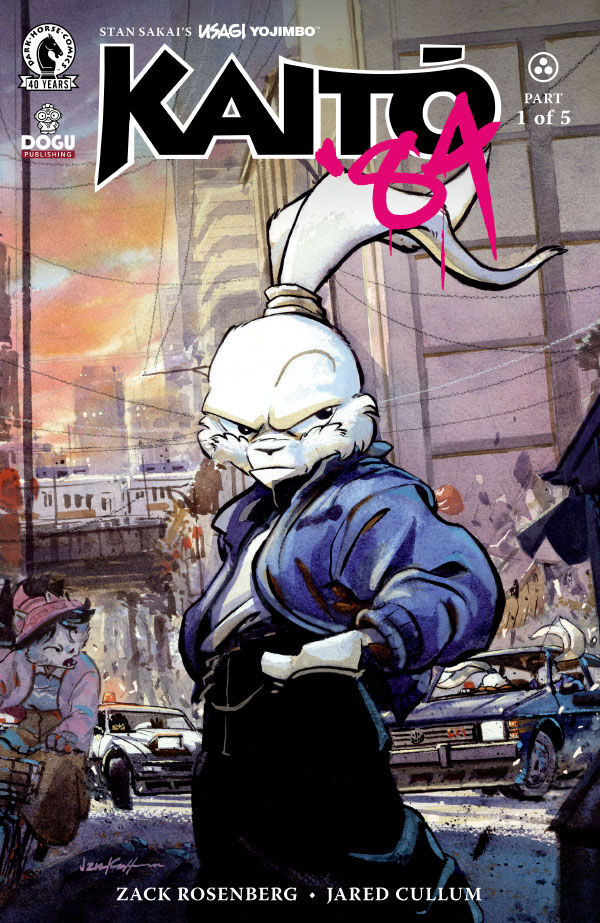
Review: ‘Kaitō’84 #1’ Feels Like The Perfect Mixtape
by Anton Kromoff
Summary
Kaintō’84 feels like the start to the perfect mixtape.
It’s moody, it’s energetic, it has something to say, and it says it in a way that allows you to drift along with it through rain-slick streets as you watch a story unfold in the shadows of towering buildings that seem to sway like ancient pines in the warm glow of the city’s nightlife.
Overall
10/10Welcome to the table,
“I don’t know art, but I know what I like,” or some variation of that turn of phrase, is very relevant to Dark Horse Comics’ Kaitō’84, but not in the way you may think.
Let’s get into it.

Kaitō’84 is a new comic by Zack Rosenberg and Jared Cullum set in 1984 Osaka and following the bloodline of Miyamoto Usagi, of Usagi Yojimbo fame.
Usagi Yojimbo, created by Stan Sakai, follows the stories of Miyamoto Usagi, a rabbit ronin in anthropomorphic feudal Japan. It blends fantasy elements and historical Japanese culture in a way that often feels authentic to the culture and time it is intending to portray. At least, as far as a layperson like myself, whose understanding is limited to samurai movies, kung-fu films, and documentaries understands.
Usagi Yojimbo does not just capture a tone while telling a story; it captures a time. I don’t know all the ins and outs of the 17th-century Edo period. I do know enough of the hallmarks from enjoying stories that take place there to know what I like, and what Sakai does, I do indeed like very much.

Kaintō’84 does something similar, but for me it’s in a totally different way.
It feels like the start to the perfect mixtape. It’s moody, it’s energetic, it has something to say, and it says it in a way that allows you to drift along with it through rain-slick streets as you watch a story unfold in the shadows of towering buildings that seem to sway like ancient pines in the warm glow of the city’s nightlife.

Everything about this book feels fluid, liquid, warm, and unanchored. I don’t know music, but I know what I like, and this feels like music in a lot of ways to me. It’s tangible for sure. You turn the pages, and it has all the physical trappings of a comic book, but the art on the page has a tempo to it, a beat that seems to really resonate as you drift from panel to panel, and page to page.
Kaitō Usagi, our protagonist and far-flung offspring of Miyamoto Usagi, kicks and punches his way through ninja footsoldiers alongside his cousin and wheel-man, Yukichi. The dynamic between the two is charming and feels lived in, even though this is the first issue we have had the two together on the page.
From their introduction, you get the feeling there is a kinship between the two, and that speaks to Rosenberg and Cullum’s ability to tell a story economically, blowing through backstory and exposition with a swiftness that many others may have taken an issue or two to hammer out.
Really strong storytelling, in both the visual and narrative areas, is in full effect here as the hook sets in. It puts Kaitō in the clutches of a criminal counselor who wants him to steal a historical relic, the Blood Kintsugi Spear, before a clan of Ninjas from the Neko Gang can steal it themselves.

Everything about this book feels lyrical in the way a Yoko Kanno & Seatbelts or Nujabes album feels. Jazzy, energetic, deeply atmospheric but always flowing from moment to moment, never fully stopping, slowing down for sure, but never hitting a full rest.
This fluid vibe gives the whole issue a very living feel, like you are part of an experience and not just a casual observer.

The art is really amazing and has already spawned a conversation where Kantō could make an excellent tattoo based purely on his style and fit.

Kantō’84 is from a time period I don’t understand, in a setting that feels strange and dreamlike because of my unfamiliarity with it. Even though I don’t know all the instruments at play that are coming together to make this story, I do know I like the result of all of them combining in a way that makes me want to keep this book on repeat.
Until next time, I don’t know where the story is going, but I do know that so far, it is exactly where I want to be.


